1958 FIFA World Cup
| Världsmästerskapet i Fotboll Sverige 1958 (Swedish) | |
|---|---|
 | |
| Tournament details | |
| Host country | Sweden |
| Dates | 8–29 June |
| Teams | 16 (from 3 confederations) |
| Venues | 12 (in 12 host cities) |
| Final positions | |
| Champions |  Brazil (1st title) |
| Runners-up |  Sweden |
| Third place |  France |
| Fourth place |  West Germany |
| Tournament statistics | |
| Matches played | 35 |
| Goals scored | 126 (3.6 per match) |
| Attendance | 819,810 (23,423 per match) |
| Top scorer |  Just Fontaine (13 goals) |
| Best player | Didi |
| Best young player | Pélé |
| Best goalkeeper |  Harry Gregg |
← 1954 1962 → | |
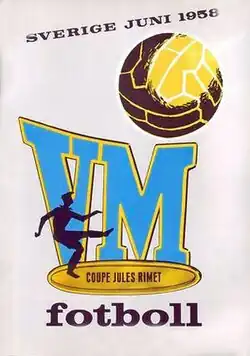
The 1958 FIFA World Cup was the sixth FIFA World Cup, the quadrennial football tournament for senior national teams. It was played in Sweden from 8 to 29 June 1958. It is the only Nordic country to have hosted a FIFA World Cup.
Brazil beat Sweden 5–2 in the final in Solna, Stockholm, to claim their first title, having beaten France in the semifinal and Wales in the quarterfinal. The tournament also marked the arrival of Pelé on the world stage, at age 17. He scored in all three of Brazil's knockout games. French striker Just Fontaine scored 13 goals, the record for most goals ever scored in a single tournament.
This was the first appearance of Wales at the FIFA World Cup. They did not qualify for another until 2022. This tournament also marked the debuts of Northern Ireland, as well as the Soviet Union. Defending champions West Germany were eliminated by runners-up Sweden and lost to France in the match for third place.
Host selection
Argentina, Chile, Mexico, and Sweden expressed interest in hosting the tournament.[1]: 24–25 Swedish delegates lobbied other countries at the FIFA Congress held in Rio de Janeiro around the opening of the 1950 World Cup finals.[1]: 24–25 Sweden was awarded the 1958 tournament unopposed on 23 June 1950.[2]
Qualification
The hosts (Sweden) and the defending champions (West Germany) qualified automatically. Of the remaining 14 places, nine were allocated to Europe, three to South America, one to North/Central America, and one to Asia/Africa.
Aside from the main European zone matches, Wales, which finished second in its group behind Czechoslovakia, was drawn into a play-off with Israel after Israel won its group by default because its three opponents, Turkey, Indonesia and Sudan, refused to play. FIFA had imposed a rule that no team would qualify without playing at least one match, something that had happened in several previous World Cups. Wales won the play-off and qualified for the first time (something they did not do again until 2022). With Northern Ireland making its debut, and England and Scotland also qualifying, this World Cup was the only one to date to feature all four of the United Kingdom’s Home Nations.
This World Cup also featured the entry and qualification of the Soviet Union for the first time, while Argentina appeared for the first time since 1934. It was also the first one for which Italy failed to qualify (Italy did not take part in the 1930 tournament but there was no qualification for that competition). Other teams that failed to qualify included two-time champions and 1954 semifinalists Uruguay, as well as Spain and Belgium.
On 8 February 1958, in Solna, Lennart Hyland and Sven Jerring presented the results of the draw in which the qualified teams were divided into four groups.[3] Seeding was geographical rather than by team strength, with each group containing one western European team, one eastern European team, one of the four British teams that had qualified, and one from the Americas.
List of qualified teams
The following 16 teams qualified for the final tournament.
|
AFC (0)
CAF (0)
|
NAFC (1) CCCF (0)
CONMEBOL (3) |
UEFA (12)
|
|
Format

The format of the competition changed from 1954: 16 teams still competed in four groups of four, but this time each team played each of the other teams in its group at least once, without extra time in the event of a draw. Two points were awarded for a win and one point for a draw. If the first two teams finished on equal points, then goal average (or goal ratio) decided their placements. As in 1954, if the second- and third-placed teams finished on the same points, then there would be a play-off with the winner going through. If a play-off resulted in a draw, goal average from the group games would be used to determine who went through to the next round. If the goal averages were equal, then lots would have been drawn. By the time the competition began, these arrangements were still in discussion. Some teams complained that a play-off match, meaning three games in five days, was too much, and before the second round of group matches, FIFA informed the teams that goal average would be used before resorting to a play-off.[1]: 117 This was overturned when the Swedish Football Association complained, stating that it was wrong to change the rules mid-tournament, but also because it wanted the extra revenue from playoff matches.[1]: 117
This was the first time that goal average was available to separate teams in a World Cup. It was used to separate the teams finishing first and second in one of the groups. However, all three playoffs finished with decisive results and so it was not needed to separate the teams involved in a tied playoff.
Almost all the matches kicked off simultaneously in each of the three rounds of the group phase, as did the quarterfinals and semifinals. The exceptions were Sweden's three group matches, all of which were televised by Sveriges Radio; these started at other times so Swedes could attend other matches without missing their own team's. Apart from these, one match per round was televised, and relayed across Europe by the European Broadcasting Union (EBU). Many Swedes bought their first television for the World Cup.
The official ball was the "Top-Star VM-bollen 1958" model made by Sydsvenska Läder & Remfabriks AB (aka "Remmen" or "Sydläder") in Ängelholm. Four FIFA officials conducted a blind test to choose it from 102 candidates.[1]: 130–136 [4]
Summary

In Group 4, Pelé and Garrincha did not play until the last of Brazil's group games, against the Soviet Union.[5] Pelé failed to score, but provided the assist to Vavá's second goal.[6][7] Brazil won the game 2–0 (also thanks to an impressive exhibition of dribbling prowess by Garrincha) and the group by two points. Previously, they had drawn 0–0 with England in what was the first ever goalless game in World Cup history. Eventually, the Soviet Union and England went to a playoff game, in which Anatoli Ilyin scored in the 67th minute to knock England out, while Austria had already been eliminated. The English side had been weakened by the Munich air disaster earlier in the year, which killed three internationals on the books of Manchester United, including England's young star Duncan Edwards.
Playoffs were also needed in Group 1 (Northern Ireland beat Czechoslovakia to join the defending champions West Germany in the quarterfinals) and Group 3 (Wales topped Hungary to advance with hosts Sweden). Hungary had become a spent force after their appearance in the final of the previous tournament. They had lost their best players two years before, when they fled in the wake of the failed uprising against the communist regime. In a rather restrictive sense, from the 1954 team, only goalkeeper Gyula Grosics, defender Jozsef Bozsik and forward Nándor Hidegkuti remained.
In Group 2, Scotland faced Yugoslavia, Paraguay, and France. France topped the group, with Just Fontaine netting six goals. Yugoslavia finished second, while Scotland came in last.
In the quarterfinals, France's Just Fontaine continued his group stage form, managing another two goals as France triumphed over Northern Ireland. West Germany's Helmut Rahn put them into the semifinals with a single goal against Yugoslavia, while Sweden went through at the expense of the Soviet Union. In the other quarterfinal, Pelé scored the only goal for Brazil against Wales.
In the semifinals, Sweden continued their strong run as they defeated West Germany 3–1 in a vicious game in which the German player Erich Juskowiak was sent off (the first ever German player to be sent off in an international game) and German veteran forward Fritz Walter was injured, further weakening the German team (substitutes were first allowed in the 1970 FIFA World Cup).
In the other semifinal, Brazil and France were tied 1–1 for much of the first half. However, 36 minutes into the game, French captain and most experienced defender Robert Jonquet suffered a broken leg in a clash with Vavá, and France was down to ten men for the rest of the game. Brazil dominated the rest of the match, as a Pelé hat-trick gave them a 5–2 victory. Fontaine of France added one goal to his impressive tally.
In the match for third place, Fontaine scored four more goals as France defeated West Germany 6–3. This brought his total to 13 goals in one competition, a record that still stands.
Final
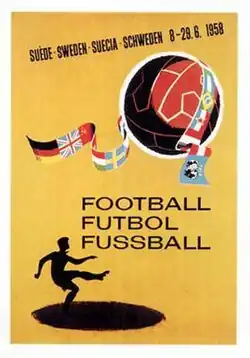
The final was played in Solna, in the Råsunda Stadium; 50,000 people watched as the Brazilians went a goal down after four minutes. However, Vavá equalised shortly afterwards and then put them a goal ahead before half time. In the second half, Pelé outshone everyone, notching two goals. For the first one, he lobbed the ball over Bengt Gustavsson then followed it with a precise volley shot. Zagallo added a goal in between, and Sweden managed a consolation goal.
In the final, many World Cup records were set that still stand as of 2018. At age 17, Pelé simultaneously became the youngest player to participate in, score, and win a World Cup final. Conversely, Nils Liedholm became the oldest player to score in a World Cup Final at 35 years 263 days. This final had the highest number of goals scored by a winning team (5), the highest number of total goals scored (7), and together with the 1970 and 1998 finals shares the highest goal margin of difference (3); Brazil played in all those three finals.
The game is also notable for many firsts in FIFA World Cup. With the exception of the 1950 FIFA World Cup final group stage, this marked the first time that a World Cup host reached the final without winning it. Additionally, the match marked the first time two nations from different continents (Europe and South America) met in a World Cup final. It also marks the first and only World Cup hosted in Europe not won by a European team, a feat mirrored in 2014, when a World Cup hosted in the Americas was not won by a team from the Americas for the first time, when Germany beat Argentina 1–0 in the final. It is also presently the only FIFA World Cup when all teams earned at least one point in the group stage.
Venues
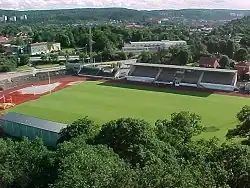
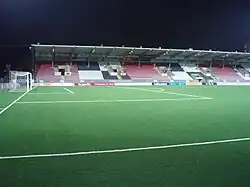
A total of twelve cities throughout the central and southern parts of Sweden hosted the tournament. FIFA regulations required at least six stadiums to have a capacity of at least 20,000.[1]: 23 If Denmark had qualified, the organisers had planned to use the Idrætsparken in Copenhagen for Denmark's group matches.[1]: 23 The Idrætsparken was renovated in 1956 with this in mind, but Denmark lost out to England in qualification.[1]: 23 When doubts arose about whether funding would be forthcoming for rebuilding the Ullevi and Malmö Stadion, the organisers considered stadiums in Copenhagen and Oslo as contingency measures.[1]: 32
The Råsunda Stadium was expanded from 38,000 for the World Cup by building end stands.[1]: 27 Organising committee chairman Holger Bergérus mortgaged his house to pay for this.[1]: 27 The new Malmö Stadion was built for the World Cup, replacing the 1896 Malmö Stadion at a new site.[1]: 30 The Idrottsparken had 4,709 seats added for the World Cup. The Social Democratic municipal government refused to pay for this until the organisers threatened to select Folkungavallen in Linköping instead.[1]: 28 At the Rimnersvallen, a stand from the smaller Oddevallen stadium was moved to Rimnersvallen for the World Cup. The crowd at Brazil v. Austria was estimated at 21,000, with more looking in from the adjoining hillside.[1]: 27 The most used stadium was the Råsunda Stadium in Stockholm, which hosted 8 matches, including the final, followed by the Ullevi Stadium in Gothenburg (the biggest stadium used during the tournament), which hosted 7 matches. The Malmö Stadium hosted 4 matches, Norrköping hosted 3 matches; Borås, Halmstad, Helsingborg, Västerås, and Sandviken hosted 2 matches each, and Örebro, Eskilstuna, and Uddevalla each hosted 1 match.
| Gothenburg | Solna (Stockholm area) |
Malmö | Helsingborg |
|---|---|---|---|
| Ullevi Stadium | Råsunda Stadium | Malmö Stadion | Olympia |
| Capacity: 53,500 | Capacity: 52,400 | Capacity: 30,000 | Capacity: 27,000 |
 |
 |
 |
 |
| Eskilstuna | Norrköping | ||
| Tunavallen | Idrottsparken | ||
| Capacity: 22,000 | Capacity: 20,000 | ||
 |
 | ||
| Sandviken | Uddevalla | ||
| Jernvallen | Rimnersvallen | ||
| Capacity: 20,000 | Capacity: 17,778 | ||
 |
 | ||
| Borås | Halmstad | Örebro | Västerås |
| Ryavallen | Örjans Vall | Eyravallen | Arosvallen |
| Capacity: 15,000 | Capacity: 15,000 | Capacity: 13,000 | Capacity: 10,000 |
 |
 |
 |
 |


Match officials
22 match officials were assigned to the tournament to serve as referees and assistant referees.
Europe
 Fritz Seipelt
 Lucien van Nuffel
 Martin Macko
 Carl Jørgensen
 Arthur Ellis
- Reginald Leafe
 Arne Eriksson
- Maurice Guigue
 István Zsolt
 Vincenzo Orlandini
 Jan Bronkhorst
 Joaquim Campos
 Jack Mowat
 Juan Gardeazábal Garay
 Sten Ahlner
 Raymond Wyssling
 Nikolai Latyshev
 Mervyn Griffiths
- Albert Dusch
 Leo Lemešić
South America
 Juan Brozzi
 José María Codesal
Seeding
There was no seeding for this World Cup; the teams were instead allocated geographically into four pots chosen by the FIFA World Cup Organisers.[8] Teams were drawn from each pot into Groups 1–4 in numerical order.
Preventing the defending champions from meeting the hosts in the group stage, either by seeding or predetermined group positions, was a practiced tradition throughout the history of the FIFA World Cup, with 1934 and 1954 being the only two exceptions.[8] This tradition continued in 1958, with West Germany as defending champion and host nation Sweden both being allocated into the same Western European Pot, which kept them from meeting in the group stage.
| Western European Pot | Eastern European Pot | British Pot | Americas Pot |
|---|---|---|---|
|
|
The geographical basis of the seeding attracted criticism, especially from Austria, who were drawn against the teams considered strongest in each of the other three pots.[1]: 8
Squads
For a list of all squads that appeared in the final tournament, see 1958 FIFA World Cup squads.
Group stage
Group 1
| Pos | Team | Pld | W | D | L | GF | GA | GR | Pts | Qualification |
|---|---|---|---|---|---|---|---|---|---|---|
| 1 | West Germany |
3 | 1 | 2 | 0 | 7 | 5 | 1.400 | 4 | Advance to knockout stage |
| 2 | Northern Ireland |
3 | 1 | 1 | 1 | 4 | 5 | 0.800 | 3[a] | |
| 3 | Czechoslovakia |
3 | 1 | 1 | 1 | 8 | 4 | 2.000 | 3[a] | |
| 4 | Argentina |
3 | 1 | 0 | 2 | 5 | 10 | 0.500 | 2 |
Notes:
The West Germans, surprise world champions four years before, were still very strong, and fielded a young forward with lots of potential in Uwe Seeler. The Germans had to contend with a tournament favorites in Argentina's team, competing for the first time since 1934. Argentina had been given a chance of reaching the semifinals or even winning the World Cup this time. Czechoslovakia was a fairly strong team with a rich football tradition, and was considered to be no walkover for the West Germans or the Argentinians.
Northern Ireland had qualified for the tournament after defeating two-time world champions Italy during World Cup qualifying despite being considered underdogs. They ultimately advanced to the quarterfinals of the World Cup Finals by defeating Czechoslovakia in a play-off match, cited as one of the major upsets in early World Cup history.[9][10]
Argentina experienced a horrible blow finishing last in the group with a −5 goal differential. Arriving home, the Argentinian team met the wrath of several thousand angry football fans at Ezeiza Airport in Buenos Aires.[11]
| Argentina | 1–3 | West Germany |
|---|---|---|
|
[Report 1] |
|

| Northern Ireland | 1–0 | Czechoslovakia |
|---|---|---|
|
[Report 2] |
| West Germany | 2–2 | Czechoslovakia |
|---|---|---|
|
[Report 3] |
|
| Argentina | 3–1 | Northern Ireland |
|---|---|---|
|
[Report 4] |
|
| West Germany | 2–2 | Northern Ireland |
|---|---|---|
|
[Report 5] |
|
| Czechoslovakia | 6–1 | Argentina |
|---|---|---|
|
[Report 6] |
|
Play-off
| Northern Ireland | 2–1 (a.e.t.) | Czechoslovakia |
|---|---|---|
|
[Report 7] |
|
Group 2
| Pos | Team | Pld | W | D | L | GF | GA | GR | Pts | Qualification |
|---|---|---|---|---|---|---|---|---|---|---|
| 1 | France |
3 | 2 | 0 | 1 | 11 | 7 | 1.571 | 4[a] | Advance to knockout stage |
| 2 | Yugoslavia |
3 | 1 | 2 | 0 | 7 | 6 | 1.167 | 4[a] | |
| 3 |  Paraguay |
3 | 1 | 1 | 1 | 9 | 12 | 0.750 | 3 | |
| 4 |  Scotland |
3 | 0 | 1 | 2 | 4 | 6 | 0.667 | 1 |
Notes:
The second group had the largest number of goals scored in a single group in the 1958 World Cup, with 31 goals in total (~5.16 goals per game). Just Fontaine of France scored 6 of his 13 goals in the tournament, making him the tournament's top scorer going into the quarterfinals.
The teams in this group had not achieved significant success in past World Cups. France, even as hosts in 1938, did not secure notable achievements; Yugoslavia failed to match their 1930 semifinal run; and both Paraguay and Scotland entered the tournament as underdogs.
France won the group ahead of Yugoslavia and went on to finish third.
| France | 7–3 | Paraguay |
|---|---|---|
|
[Report 8] |
|
| Yugoslavia | 1–1 | Scotland |
|---|---|---|
|
[Report 9] |
|
| Yugoslavia | 3–2 | France |
|---|---|---|
|
[Report 10] |
|
| Paraguay | 3–2 | Scotland |
|---|---|---|
|
[Report 11] |
|
| France | 2–1 | Scotland |
|---|---|---|
|
[Report 12] |
|
| Paraguay | 3–3 | Yugoslavia |
|---|---|---|
|
[Report 13] |
|
Group 3
| Pos | Team | Pld | W | D | L | GF | GA | GR | Pts | Qualification |
|---|---|---|---|---|---|---|---|---|---|---|
| 1 | Sweden |
3 | 2 | 1 | 0 | 5 | 1 | 5.000 | 5 | Advance to knockout stage |
| 2 | Wales |
3 | 0 | 3 | 0 | 2 | 2 | 1.000 | 3[a] | |
| 3 | Hungary |
3 | 1 | 1 | 1 | 6 | 3 | 2.000 | 3[a] | |
| 4 |  Mexico |
3 | 0 | 1 | 2 | 1 | 8 | 0.125 | 1 |
Notes:
The Swedish hosts could count themselves lucky in ending up in a rather weak group, which they proceeded to win fairly easily with their powerful, workmanlike football. The group included Hungary which had been considered by far the best team in the world some years ago, although the Hungarians could not beat West Germany in the final of the World Cup in 1954. But the Hungarian team had been dealt a blow by the Hungarian Revolution of 1956 after which star players like Sándor Kocsis and Ferenc Puskás left their homeland. Striker Nándor Hidegkuti was still playing, but he was 36 years old and nowhere near his peak form.
In spite of Hungary's recent travails, they were still considered a strong side and were expected to advance from their group. The success of Wales was a surprise but they drew all their group games and beat the Hungarians in a play-off match to follow Sweden into the knockout stage. Wales played Brazil in the quarterfinals and became the recipient of young Pelé's first World Cup goal.[12]
The 1–1 draw between Wales and Mexico was the first point scored by Mexico in a World Cup, having lost all eight matches in their previous three appearances in the World Cup, as well as their first match in this group against Sweden. To date, no other team has ever lost nine consecutive games in the World Cup.
The match between Hungary and Wales in Sandviken became the northernmost World Cup match in history.
| Sweden | 3–0 | Mexico |
|---|---|---|
|
[Report 14] |
| Hungary | 1–1 | Wales |
|---|---|---|
|
[Report 15] |
|
| Mexico | 1–1 | Wales |
|---|---|---|
|
[Report 16] |
|
| Sweden | 2–1 | Hungary |
|---|---|---|
|
[Report 17] |
|
| Sweden | 0–0 | Wales |
|---|---|---|
| [Report 18] |
| Hungary | 4–0 | Mexico |
|---|---|---|
|
[Report 19] |
Play-off
| Wales | 2–1 | Hungary |
|---|---|---|
|
[Report 20] |
|
Group 4
| Pos | Team | Pld | W | D | L | GF | GA | GR | Pts | Qualification |
|---|---|---|---|---|---|---|---|---|---|---|
| 1 | Brazil |
3 | 2 | 1 | 0 | 5 | 0 | — | 5 | Advance to knockout stage |
| 2 | Soviet Union |
3 | 1 | 1 | 1 | 4 | 4 | 1.000 | 3[a] | |
| 3 | England |
3 | 0 | 3 | 0 | 4 | 4 | 1.000 | 3[a] | |
| 4 | Austria |
3 | 0 | 1 | 2 | 2 | 7 | 0.286 | 1 |
Notes:
Despite setbacks in earlier tournaments, Brazil was still regarded as a formidable force, a reputation that they justified. The Soviet Union, having clinched the Olympic gold in 1956, and Austria, securing the bronze medal at the 1954 World Cup in Switzerland, were also strong contenders. England, despite being weakened by the tragic Munich air disaster that claimed several players, remained a team of considerable strength.
In the end, this group had the highest average attendance (31,320 per game), even higher than Group 3 with the host nation, Sweden.
The quality of the football in this group did not quite live up to expectations, however. Only 15 goals were scored in the whole group, only one more than Group 3. And when England and Brazil drew 0–0, it was the first time in World Cup history that a game ended goalless. It was also the first time Brazil had failed to score in a World Cup finals match.
Brazil won the group without conceding a single goal. The teenage Pelé played Brazil's last game against the Soviet Union. He did not score but drew wild reviews for his play. The Soviet Union, in their first World Cup, took second place.
| Brazil | 3–0 | Austria |
|---|---|---|
|
[Report 21] |
| Soviet Union | 2–2 | England |
|---|---|---|
|
[Report 22] |
|
| Brazil | 0–0 | England |
|---|---|---|
| [Report 23] |
| Soviet Union | 2–0 | Austria |
|---|---|---|
|
[Report 24] |
| England | 2–2 | Austria |
|---|---|---|
|
[Report 25] |
|
| Brazil | 2–0 | Soviet Union |
|---|---|---|
|
[Report 26] |
Play-off
| Soviet Union | 1–0 | England |
|---|---|---|
|
[Report 27] |
Knockout stage
Bracket
| Quarterfinals | Semifinals | Final | ||||||||
| 19 June – Gothenburg | ||||||||||
| Brazil | 1 | |||||||||
| 24 June – Solna | ||||||||||
| Wales | 0 | |||||||||
| Brazil | 5 | |||||||||
| 19 June – Norrköping | ||||||||||
| France | 2 | |||||||||
| France | 4 | |||||||||
| 29 June – Solna | ||||||||||
| Northern Ireland | 0 | |||||||||
| Brazil | 5 | |||||||||
| 19 June – Solna | ||||||||||
| Sweden | 2 | |||||||||
| Sweden | 2 | |||||||||
| 24 June – Gothenburg | ||||||||||
| Soviet Union | 0 | |||||||||
| Sweden | 3 | |||||||||
| 19 June – Malmö | ||||||||||
| West Germany | 1 | Match for third place | ||||||||
| West Germany | 1 | |||||||||
| 28 June – Gothenburg | ||||||||||
| Yugoslavia | 0 | |||||||||
| France | 6 | |||||||||
| West Germany | 3 | |||||||||
Quarterfinals
| Brazil | 1–0 | Wales |
|---|---|---|
|
[Report 28] |
| France | 4–0 | Northern Ireland |
|---|---|---|
|
[Report 29] |
| Sweden | 2–0 | Soviet Union |
|---|---|---|
|
[Report 30] |
| West Germany | 1–0 | Yugoslavia |
|---|---|---|
|
[Report 31] |
Semifinals
| Brazil | 5–2 | France |
|---|---|---|
|
[Report 32] |
|
| Sweden | 3–1 | West Germany |
|---|---|---|
|
[Report 33] |
|
Match for third place
| France | 6–3 | West Germany |
|---|---|---|
|
[Report 34] |
|
Final
| Brazil | 5–2 | Sweden |
|---|---|---|
| [Report 35] |
|
Goalscorers
With 13 goals, Just Fontaine was the top scorer in the tournament. As of 2026, no player has ever scored more goals in a single FIFA World Cup Final stage. In total, 126 goals were scored by 60 players, with none of them credited as an own goal.[13]
13 goals
6 goals
- Pelé
- Helmut Rahn
5 goals
- Vavá
- Peter McParland
4 goals
- Zdeněk Zikán
- Lajos Tichy
- Kurt Hamrin
- Agne Simonsson
3 goals
- Oreste Corbatta
- Raymond Kopa
- Roger Piantoni
- Hans Schäfer
- Todor Veselinović
2 goals
- José Altafini
- Milan Dvořák
- Václav Hovorka
- Derek Kevan
- Maryan Wisniewski
- Juan Bautista Agüero
- Florencio Amarilla
- José Parodi
- Jorge Lino Romero
- Anatoli Ilyin
- Nils Liedholm
- Ivor Allchurch
- Uwe Seeler
- Aleksandar Petaković
1 goal
- Ludovico Avio
- Norberto Menéndez
- Karl Koller
- Alfred Körner
- Didi
- Nílton Santos
- Mário Zagallo
- Jiří Feureisl
- Tom Finney
- Johnny Haynes
- Yvon Douis
- Jean Vincent
- József Bencsics
- József Bozsik
- Károly Sándor
- Jaime Belmonte
- Wilbur Cush
- Cayetano Ré
- Sammy Baird
- Bobby Collins
- Jackie Mudie
- Jimmy Murray
- Aleksandr Ivanov
- Valentin Ivanov
- Nikita Simonyan
- Gunnar Gren
- Lennart Skoglund
- John Charles
- Terry Medwin
- Hans Cieslarczyk
- Radivoje Ognjanović
- Zdravko Rajkov
All-Star Team
The team of the tournament voted by journalists was as follows:[1]: 273 [14][15]
- Goalkeeper: Harry Gregg
- Defenders: Orvar Bergmark, Hilderaldo Bellini, Nílton Santos
- Midfielders: Yuriy Voynov, Horst Szymaniak
- Forwards: Garrincha, Didi, Raymond Kopa, Pelé, Lennart Skoglund
Although Just Fontaine got more votes than any other forward, they were split between the left and right inside forward positions.[1]: 273 The All-Star Team scored 12 goals in total. Fontaine scored 13.
FIFA retrospective ranking
In 1986, FIFA published a report that ranked all teams in each World Cup up to and including 1986, based on progress in the competition, overall results and quality of the opposition.[16][17] The rankings for the 1958 tournament were as follows:
| R | Team | G | P | W | D | L | GF | GA | GD | Pts. |
|---|---|---|---|---|---|---|---|---|---|---|
| 1 | Brazil | 4 | 6 | 5 | 1 | 0 | 16 | 4 | +12 | 11 |
| 2 | Sweden | 3 | 6 | 4 | 1 | 1 | 12 | 7 | +5 | 9 |
| 3 | France | 2 | 6 | 4 | 0 | 2 | 23 | 15 | +8 | 8 |
| 4 | West Germany | 1 | 6 | 2 | 2 | 2 | 12 | 14 | −2 | 6 |
| Eliminated in the quarterfinals | ||||||||||
| 5 | Yugoslavia | 2 | 4 | 1 | 2 | 1 | 7 | 7 | 0 | 4 |
| 6 | Wales | 3 | 5 | 1 | 3 | 1 | 4 | 4 | 0 | 3 |
| 7 | Soviet Union | 4 | 5 | 2 | 1 | 2 | 5 | 6 | −1 | 3 |
| 8 | Northern Ireland | 1 | 5 | 2 | 1 | 2 | 6 | 10 | −4 | 3 |
| Eliminated in the group stage | ||||||||||
| 9 | Czechoslovakia | 1 | 4 | 1 | 1 | 2 | 9 | 6 | +3 | 3 |
| 10 | Hungary | 3 | 4 | 1 | 1 | 2 | 7 | 5 | +2 | 3 |
| 11 | England | 4 | 4 | 0 | 3 | 1 | 4 | 5 | −1 | 3 |
| 12 | Paraguay | 2 | 3 | 1 | 1 | 1 | 9 | 12 | −3 | 3 |
| 13 | Argentina | 1 | 3 | 1 | 0 | 2 | 5 | 10 | −5 | 2 |
| 14 | Scotland | 2 | 3 | 0 | 1 | 2 | 4 | 6 | −2 | 1 |
| 15 | Austria | 4 | 3 | 0 | 1 | 2 | 2 | 7 | −5 | 1 |
| 16 | Mexico | 3 | 3 | 0 | 1 | 2 | 1 | 8 | −7 | 1 |
In popular culture
The 1958 FIFA World Cup is depicted in the 2016 American film Pelé: Birth of a Legend which is centered around Pelé and the Brazilian team's journey to winning the tournament.[18]
References
- 1 2 3 4 5 6 7 8 9 10 11 12 13 14 15 16 17 Norlin, Arne (2008). 1958: När Folkhemmet Fick Fotbolls-VM (in Swedish). Malmö: Ross & Tegner. ISBN 978-91-976144-8-1.
- ↑ "FIFA World Cup: host announcement decision" (PDF). FIFA. 12 March 2009. Archived from the original (PDF) on 17 January 2012. Retrieved 2 October 2011.
- ↑ "History of the World Cup Final Draw" (PDF). Archived from the original (PDF) on 26 February 2008. Retrieved 2 March 2012.
- ↑ "Top Star 1958". balones-oficiales.com. Archived from the original on 2 April 2012. Retrieved 17 September 2011.
- ↑ "How 17-year-old Pele conquered the world with dazzling goals as Brazil won its first World Cup in 1958". The Economic Times. 30 December 2022. ISSN 0013-0389. Retrieved 15 March 2023.
- ↑ "Pelé: Most Wins of the FIFA World Cup by a player". Guinness World Records. 2022. Retrieved 27 December 2022.
- ↑ "Pelé leads Brazil to first World Cup title". HISTORY. 2022. Retrieved 27 December 2022.
- 1 2 "FIFA World Cup: Seeded teams 1930–2010" (PDF). FIFA. November 2009. Archived from the original (PDF) on 22 July 2012.
- ↑ Soccer, World (15 November 2014). "Northern Ireland's greatest moment". World Soccer. Retrieved 3 June 2026.
- ↑ Millar, Colin (7 June 2017). "Northern Ireland's love affair with international tournaments". These Football Times. Retrieved 3 June 2026.
- ↑ Mundo Deportivo, 23 June 1958; El Grafico, 27 June 1958.
- ↑ "BBC Sport archive: 1958 - Wales 0-1 Brazil". 1 September 2010 – via news.bbc.co.uk.
- ↑ "Players - Top goals". FIFA. Archived from the original on 18 July 2017.
- ↑ "KOPA considerado el delantero centro del major equipo del mundo (1)" (in Spanish). Mundo Deportivo. 22 January 1959. Retrieved 29 December 2020.
- ↑ "KOPA considerado el delantero centro del major equipo del mundo (2)" (in Spanish). Mundo Deportivo. 22 January 1959. Retrieved 29 December 2020.
- ↑ "page 45" (PDF). Archived from the original (PDF) on 14 June 2010. Retrieved 2 March 2012.
- ↑ "FIFA World Cup: Milestones, facts & figures. Statistical Kit 7" (PDF). FIFA. 26 March 2013. Archived from the original (PDF) on 21 May 2013.
- ↑ "Pelé: Birth of a Legend (2016)". Rotten Tomatoes. Fandango Media. Retrieved 17 November 2022.
Reports
- ↑
- "Argentina vs Germany FR | Group Matches | 1958 FIFA World Cup Sweden". FIFA. Retrieved 1 May 2026.
- "1958 FIFA World Cup Sweden – Matches – Argentina v Germany FR". FIFA. Archived from the original on 12 December 2017. Retrieved 1 May 2026.
- ↑
- "Northern Ireland vs Czechoslovakia | Group Matches | 1958 FIFA World Cup Sweden". FIFA. Retrieved 1 May 2026.
- "1958 FIFA World Cup Sweden – Matches – Northern Ireland v Czechoslovakia". FIFA. Archived from the original on 31 October 2017. Retrieved 1 May 2026.
- ↑
- "Germany FR vs Czechoslovakia | Group Matches | 1958 FIFA World Cup Sweden". FIFA. Retrieved 1 May 2026.
- "1958 FIFA World Cup Sweden – Matches – Germany FR v Czechoslovakia". FIFA. Archived from the original on 31 October 2017. Retrieved 1 May 2026.
- ↑
- "Argentina vs Northern Ireland | Group Matches | 1958 FIFA World Cup Sweden". FIFA. Retrieved 1 May 2026.
- "1958 FIFA World Cup Sweden – Matches – Argentina v Northern Ireland". FIFA. Archived from the original on 20 November 2017. Retrieved 1 May 2026.
- ↑
- "Germany FR vs Northern Ireland | Group Matches | 1958 FIFA World Cup Sweden". FIFA. Retrieved 1 May 2026.
- "1958 FIFA World Cup Sweden – Matches – Germany FR v Northern Ireland". FIFA. Archived from the original on 31 October 2017. Retrieved 1 May 2026.
- ↑
- "Czechoslovakia vs Argentina | Group Matches | 1958 FIFA World Cup Sweden". FIFA. Retrieved 1 May 2026.
- "1958 FIFA World Cup Sweden – Matches – Czechoslovakia v Argentina". FIFA. Archived from the original on 31 October 2017. Retrieved 1 May 2026.
- ↑
- "Northern Ireland vs Czechoslovakia | Group Matches | 1958 FIFA World Cup Sweden". FIFA. Retrieved 1 May 2026.
- "1958 FIFA World Cup Sweden – Matches – Northern Ireland v Czechoslovakia". FIFA. Archived from the original on 31 October 2017. Retrieved 1 May 2026.
- ↑
- "France vs Paraguay | Group Matches | 1958 FIFA World Cup Sweden". FIFA. Retrieved 1 May 2026.
- "1958 FIFA World Cup Sweden – Matches – France v Paraguay". FIFA. Archived from the original on 3 December 2017. Retrieved 1 May 2026.
- ↑
- "Yugoslavia vs Scotland | Group Matches | 1958 FIFA World Cup Sweden". FIFA. Retrieved 1 May 2026.
- "1958 FIFA World Cup Sweden – Matches – Yugoslavia v Scotland". FIFA. Archived from the original on 13 December 2017. Retrieved 1 May 2026.
- ↑
- "Yugoslavia vs France | Group Matches | 1958 FIFA World Cup Sweden". FIFA. Retrieved 1 May 2026.
- "1958 FIFA World Cup Sweden – Matches – Yugoslavia v France". FIFA. Archived from the original on 31 October 2017. Retrieved 1 May 2026.
- ↑
- "Paraguay vs Scotland | Group Matches | 1958 FIFA World Cup Sweden". FIFA. Retrieved 1 May 2026.
- "1958 FIFA World Cup Sweden – Matches – Paraguay v Scotland". FIFA. Archived from the original on 31 October 2017. Retrieved 1 May 2026.
- ↑
- "France vs Scotland | Group Matches | 1958 FIFA World Cup Sweden". FIFA. Retrieved 1 May 2026.
- "1958 FIFA World Cup Sweden – Matches – France v Scotland". FIFA. Archived from the original on 31 October 2017. Retrieved 1 May 2026.
- ↑
- "Paraguay vs Yugoslavia | Group Matches | 1958 FIFA World Cup Sweden". FIFA. Retrieved 1 May 2026.
- "1958 FIFA World Cup Sweden – Matches – Paraguay v Yugoslavia". FIFA. Archived from the original on 31 October 2017. Retrieved 1 May 2026.
- ↑
- "Sweden vs Mexico | Group Matches | 1958 FIFA World Cup Sweden". FIFA. Retrieved 1 May 2026.
- "1958 FIFA World Cup Sweden – Matches – Sweden v Mexico". FIFA. Archived from the original on 9 December 2017. Retrieved 1 May 2026.
- ↑
- "Hungary vs Wales | Group Matches | 1958 FIFA World Cup Sweden". FIFA. Retrieved 1 May 2026.
- "1958 FIFA World Cup Sweden – Matches – Hungary v Wales". FIFA. Archived from the original on 28 October 2017. Retrieved 1 May 2026.
- ↑
- "Mexico vs Wales | Group Matches | 1958 FIFA World Cup Sweden". FIFA. Retrieved 1 May 2026.
- "1958 FIFA World Cup Sweden – Matches – Mexico v Wales". FIFA. Archived from the original on 31 October 2017. Retrieved 1 May 2026.
- ↑
- "Sweden vs Hungary | Group Matches | 1958 FIFA World Cup Sweden". FIFA. Retrieved 1 May 2026.
- "1958 FIFA World Cup Sweden – Matches – Sweden v Hungary". FIFA. Archived from the original on 31 October 2017. Retrieved 1 May 2026.
- ↑
- "Sweden vs Wales | Group Matches | 1958 FIFA World Cup Sweden". FIFA. Retrieved 1 May 2026.
- "1958 FIFA World Cup Sweden – Matches – Sweden v Wales". FIFA. Archived from the original on 31 October 2017. Retrieved 1 May 2026.
- ↑
- "Hungary vs Mexico | Group Matches | 1958 FIFA World Cup Sweden". FIFA. Retrieved 1 May 2026.
- "1958 FIFA World Cup Sweden – Matches – Hungary v Mexico". FIFA. Archived from the original on 31 October 2017. Retrieved 1 May 2026.
- ↑
- "Wales vs Hungary | Group Matches | 1958 FIFA World Cup Sweden". FIFA. Retrieved 1 May 2026.
- "1958 FIFA World Cup Sweden – Matches – Wales v Hungary". FIFA. Archived from the original on 31 October 2017. Retrieved 1 May 2026.
- ↑
- "Brazil vs Austria | Group Matches | 1958 FIFA World Cup Sweden". FIFA. Retrieved 1 May 2026.
- "1958 FIFA World Cup Sweden – Matches – Brazil v Austria". FIFA. Archived from the original on 27 October 2017. Retrieved 1 May 2026.
- ↑
- "Soviet Union vs England | Group Matches | 1958 FIFA World Cup Sweden". FIFA. Retrieved 1 May 2026.
- "1958 FIFA World Cup Sweden – Matches – Soviet Union v England". FIFA. Archived from the original on 31 October 2017. Retrieved 1 May 2026.
- ↑
- "Brazil vs England | Group Matches | 1958 FIFA World Cup Sweden". FIFA. Retrieved 1 May 2026.
- "1958 FIFA World Cup Sweden – Matches – Brazil v England". FIFA. Archived from the original on 14 December 2017. Retrieved 1 May 2026.
- ↑
- "Soviet Union vs Austria | Group Matches | 1958 FIFA World Cup Sweden". FIFA. Retrieved 1 May 2026.
- "1958 FIFA World Cup Sweden – Matches – Soviet Union v Austria". FIFA. Archived from the original on 3 November 2017. Retrieved 1 May 2026.
- ↑
- "England vs Austria | Group Matches | 1958 FIFA World Cup Sweden". FIFA. Retrieved 1 May 2026.
- "1958 FIFA World Cup Sweden – Matches – England v Austria". FIFA. Archived from the original on 31 October 2017. Retrieved 1 May 2026.
- ↑
- "Brazil vs Soviet Union | Group Matches | 1958 FIFA World Cup Sweden". FIFA. Retrieved 1 May 2026.
- "1958 FIFA World Cup Sweden – Matches – Brazil v Soviet Union". FIFA. Archived from the original on 12 December 2017. Retrieved 1 May 2026.
- ↑
- "Soviet Union vs England | Group Matches | 1958 FIFA World Cup Sweden". FIFA. Retrieved 1 May 2026.
- "1958 FIFA World Cup Sweden – Matches – Soviet Union v England". FIFA. Archived from the original on 31 October 2017. Retrieved 1 May 2026.
- ↑
- "Brazil vs Wales | Quarterfinal | 1958 FIFA World Cup Sweden". FIFA. Retrieved 1 May 2026.
- "1958 FIFA World Cup Sweden – Matches – Brazil v Wales". FIFA. Archived from the original on 23 December 2017. Retrieved 1 May 2026.
- ↑
- "France vs Northern Ireland | Quarterfinal | 1958 FIFA World Cup Sweden". FIFA. Retrieved 1 May 2026.
- "1958 FIFA World Cup Sweden – Matches – France v Northern Ireland". FIFA. Archived from the original on 24 December 2017. Retrieved 1 May 2026.
- ↑
- "Sweden vs Soviet Union | Quarterfinal | 1958 FIFA World Cup Sweden". FIFA. Retrieved 1 May 2026.
- "1958 FIFA World Cup Sweden – Matches – Sweden v Soviet Union". FIFA. Archived from the original on 23 December 2017. Retrieved 1 May 2026.
- ↑
- "Germany FR vs Yugoslavia | Quarterfinal | 1958 FIFA World Cup Sweden". FIFA. Retrieved 1 May 2026.
- "1958 FIFA World Cup Sweden – Matches – Germany FR v Yugoslavia". FIFA. Archived from the original on 12 December 2017. Retrieved 1 May 2026.
- ↑
- "Brazil vs France | Semifinal | 1958 FIFA World Cup Sweden". FIFA. Archived from the original on 7 January 2026. Retrieved 1 May 2026.
- "1958 FIFA World Cup Sweden – Matches – Brazil v France". FIFA. Archived from the original on 26 December 2017. Retrieved 1 May 2026.
- ↑
- "Sweden vs Germany FR | Semifinal | 1958 FIFA World Cup Sweden". FIFA. Retrieved 1 May 2026.
- "1958 FIFA World Cup Sweden – Matches – Sweden v Germany FR". FIFA. Archived from the original on 31 October 2017. Retrieved 1 May 2026.
- ↑
- "France vs Germany FR | Match for third place | 1958 FIFA World Cup Sweden". FIFA. Retrieved 1 May 2026.
- "1958 FIFA World Cup Sweden – Matches – France v Germany FR". FIFA. Archived from the original on 26 December 2017. Retrieved 1 May 2026.
- ↑
- "Brazil vs Sweden | Final | 1958 FIFA World Cup Sweden". FIFA. Retrieved 1 May 2026.
- "1958 FIFA World Cup Sweden – Matches – Brazil v Sweden". FIFA. Archived from the original on 1 December 2017. Retrieved 1 May 2026.
External links


- 1958 FIFA World Cup Sweden , FIFA.com
- Details at RSSSF
1958 FIFA World Cup finalists | |
|---|---|
| Champions | |
| Runners-up |
|
| Third place | |
| Fourth place | |
| Quarterfinals |
|
| Group stage | |
Fédération internationale de football association (FIFA) | |
| Tournaments |
|
| Qualification |
|
| Finals |
|
| Squads |
|
| Final draw |
|
| Broadcasters | |
| Bids | |
| Officials |
|
| Team appearances |
|
| Other records |
|
| Miscellaneous | |
| |
