华法林
 维基百科中的醫學内容仅供参考,並不能視作專業意見。如需獲取醫療幫助或意見,请咨询专业人士。詳見醫學聲明。
 | |
 | |
| 臨床資料 | |
|---|---|
| 读音 | /ˈwɔːrfərɪn/ |
| 商品名 | Coumadin及其他[1][2][3] |
| AHFS/Drugs.com | Monograph |
| MedlinePlus | a682277 |
| 核准狀況 |
|
| 懷孕分級 | |
| 给药途径 | 口服給藥, 靜脈注射 |
| ATC碼 |
|
| 法律規範狀態 | |
| 法律規範 |
|
| 藥物動力學數據 | |
| 生物利用度 | 79–100% (口服)[9] |
| 血漿蛋白結合率 | 99%[10] |
| 药物代谢 | 肝臟: CYP2C9, CYP2C19, CYP2C8, CYP2C18, CYP1A2及CYP3A4[10] |
| 生物半衰期 | 7天 (有效生物半衰期為20-60小時)[10] |
| 排泄途徑 | 腎臟(92%)[10] |
| 识别信息 | |
| |
| CAS号 | 81-81-2  129-06-6 |
| PubChem CID | |
| IUPHAR/BPS | |
| DrugBank |
|
| ChemSpider | |
| UNII |
|
| KEGG | |
| ChEBI |
|
| ChEMBL |
|
| PDB配體ID | |
| ECHA InfoCard | 100.001.253 |
| 化学信息 | |
| 化学式 | C19H16O4 |
| 摩尔质量 | 308.33 g·mol−1 |
| 3D模型(JSmol) | |
| |
| |


華法林(INN:warfarin),化学名苄丙酮香豆素,常以华法林钠(苄丙酮香豆素鈉)的形式成药,以Coumadin(有可邁丁的譯名)、Marevan(中国大陆译名玛尔维)等商品名稱於市場上販售,是一種抗凝劑。[11][8]常用於預防深靜脈血栓與肺栓塞,並用於保護心房顫動、瓣膜性心臟病或人工心臟瓣膜患者免於中風威脅。[11]有時也會在ST段上升型心肌梗塞與骨科手術後,供患者使用。[11]
使用後常見的副作用是出血(凝血功能降低後的自然結果)。[11]較不常見的副作用有局部組織壞死以及紫趾症候群 。[11]不建議個體在妊娠期間使用,以免對所懷胎兒不利。[11]對華法林的藥效通常是每隔一至四週,透過檢查國際標準化比值(INR)以監測凝血酶原時間。[11]許多其他藥物與飲食都會與華法林產生交互作用,而增加或降低其藥效。[11][12]華法林的藥效可透過葉綠基甲萘醌(維生素K1)、新鮮冷凍血漿或是凝血酶原複合濃縮物來逆轉。[12]
華法林透過阻斷維生素K環氧化物還原酶來降低血液凝固,該酶負責重新活化維生素K1。[12]若缺乏充足的活性維生素K1,血漿中的凝血因子(凝血酶原)II、VII、IX與X的濃度就會降低,進而減弱凝血能力。[12]抗凝蛋白蛋白質C與蛋白質S也會受到抑制,但程度較輕。[12]它常被錯誤地描述為"維生素K拮抗劑",這個稱法並不正確。華法林並不具有拮抗維生素K1的作用,而是拮抗維生素K1的循環再生,而將活性維生素K1耗盡。給藥後需要經過幾天時間才能發揮完整藥效,而效果可持續長達五天。[11][13]由於其機轉涉及維生素K環氧化物還原酶(VKORC1)等酶,服用華法林的患者若存有這些酶的基因變異性,就可能需要調整治療方案。若其所帶有的遺傳變異更容易被華法林抑制,則需施用較低的劑量。[14]
華法林最初於1948年以滅鼠劑的形式大規模投入商業用途。[15][16]它於1954年正式獲得美國食品藥物管理局(FDA)批准,用作治療人類血栓的藥物。[11]1955年,時任美國總統的德懷特·艾森豪突然心臟病發作,引起社會高度關注,他隨後經由華法林治癒,而將此藥物的聲譽大幅提升,讓其被視為治療冠狀動脈疾病、動脈粥樣硬化及中風的既安全且當然之選。[17]此藥物已列入世界衛生組織基本藥物標準清單之中 。[18]市場上有其通用名藥物(學名藥)供應,[1]以多種商品名稱銷售。此藥物於2023是美國排名第116位最常被處方的藥物,累計開立的處方箋數量超過500萬張。[19][20]
醫療用途
華法林的適應症包括預防與治療靜脈血栓及其併發症 - 肺栓塞。[8]預防與治療與心房顫動及/或心臟瓣膜置換術相關的血栓栓塞併發症,[8]以及降低心肌梗塞後的死亡、復發性心肌梗塞及中風,或是全身性栓塞等事件的風險。[8]
華法林用於降低血栓的形成,或作為已形成血栓者的二級預防(預防再次發作)。使用華法林治療有助於預防未來血栓形成,並有助於降低栓塞(即血栓遷移至某處並阻斷重要器官血液供應)的風險。[21][22]
華法林最適合用於人體血流緩慢區域(例如靜脈、人工或天然瓣膜後方的淤血,以及功能障礙心房內的淤血)的抗凝用途(抑制血栓形成)。因此,華法林常見的臨床適應症包括心房顫動、裝有人工心臟瓣膜、深靜脈血栓以及肺栓塞(血栓最初形成於靜脈)。華法林也用於抗磷脂症候群。它偶爾會用於心臟病發作後,但在預防冠狀動脈新血栓形成方面的效果遠不如其他藥物。預防動脈凝血通常採用抗血小板藥物,其作用機轉與華法林不同(華法林通常對血小板功能沒影響)。[23]它可用於治療因心房顫動引起的中風患者,但新型直接口服抗凝劑(DOACs)能提供更大的療效。[24]
劑量
因為已知華法林會與許多常用藥物及某些食物產生交互作用,導致此藥物的給藥劑量相當複雜。[25]這些交互作用可能會增強,或是減弱華法林的抗凝效果。為在不引發出血等危險副作用的情況下優化治療效果,必須透過測量血液中凝血酶原時間來密切監測抗凝血的程度。在治療初期,需每日檢查INR,若患者在維持華法林劑量不變的情況下,能穩定保持在治療目標的INR水位,則兩次檢查之間的間隔可以拉長。[23]目前已有較新型的定點照護檢驗(床邊檢驗)可供使用,增加門診環境下INR檢測的便利性。這種檢測無需抽取靜脈血,只需簡單的採血針刺破手指即可完成。[26]
維持劑量

包括美國胸腔醫師學會在內的權威機構已針對維持劑量的調整提供指引。[28][29]華法林的藥效極易受飲食中維生素K1含量的影響而大幅波動,因此保持維生素K1攝取量穩定非常重要。[30]葉菜類蔬菜(如 歐芹、芫荽、蒔蘿等繖形科)及十字花科(如 甘藍、西蘭花)與深色生菜皆富含維生素K1。而豆類、根莖類、多數水果、果汁及穀物類製品的含量較低。[31]研究指出,透過各項臨床數據可有效預測並調整最適維持劑量。[32][33]
自我檢測
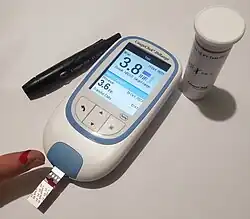
2005年的國際指引指出,患者自我監測國際標準化比值(INR)與劑量管理的成效不亞於,甚至是優於專業抗凝血診所,且市售設備的INR準確度與實驗室檢測相當。[34]於2006年發表的系統綜述報告顯示居家檢測能有效降低血栓與大出血等併發症風險,並顯著增加抗凝血效果,維持在治療範圍內的時間比例。[35]
替代抗凝劑
在某些國家會使用醋硝香豆素或苯丙羥基香豆素等其他香豆素類藥物替代華法林。由於這類香豆素的生物半衰期不同,彼此無法完全互換。多國已批准達比加群、阿哌沙班、艾多沙班與利伐沙班等新型藥物,提供與華法林相當的療效且無需例行監測。針對這些藥物的逆轉劑,目前已有依達賽珠單抗、安得沙奈可供使用(後者針對艾多沙班的逆轉屬仿單標示外使用)。有種能同時逆轉多種新型抗凝劑的藥物 - 希拉帕蘭替 - 則尚在研發中。[36][37]
禁忌症
一般而言,若患者處於凝血功能降低可能導致嚴重且危及生命的出血風險時,應禁忌使用各類抗凝劑。相關情況包括:
妊娠
華法林因可穿過胎盤屏障而導致胎兒出血,常與流產、死產 早產相關,個體於妊娠期間不應使用。[41]此類藥物為致畸劑,胎兒暴露後的畸形率約為5%至30%之間,依暴露時期不同會產生兩類獨特的先天性障礙。[41][42]
第一孕期
第一孕期通常改用無法穿過胎盤的低分子量肝素如依諾肝素鈉)以避免胎兒致畸。若此時(尤指6至9 週)暴露於華法林,可能引發胎兒華法林症候群(FWS),臨床特徵包括鼻部發育不全、脊椎側彎、骨骼鈣化異常(X光呈現點狀陰影)及短指症,亦常伴隨低出生體重與發展障礙。[41][42]
第二孕期及以後
此階段暴露引發畸形的機率較低,且症狀與FWS不同,主要涉及中樞神經系統障礙(如 痙攣、癲癇發作)與眼部缺陷。[41][42]對於須預防中風(如裝有人工心臟瓣膜)的孕婦,用藥決策極具挑戰。華法林可用於進行母乳哺育期間的女性,數據顯示其不會進入母乳,但仍建議監測INR。[43]
不良影響
出血
使用華法林最常見的副作用為出血,嚴重出血年發生率約為1–3%,其中以腦內出血及脊髓出血最為致命。[28]當INR超過4.5時,風險將劇增。[44]臨床常使用HAS-BLED評分系統評分(評估血壓、肝腎功能、中風史、出血史、INR穩定度、年齡及藥物/酒精)或ATRIA評分來預測風險。[45][46]此外,併用氯吡格雷、乙醯柳酸(阿斯匹靈) 或非類固醇抗發炎藥(NSAIDs),以及接受血液透析者,出血風險會顯著提升。[46][47]
華法林壞死
華法林壞死是一種罕見但嚴重的併發症,常發生於蛋白質C缺乏者治療初期。因華法林降低抗凝蛋白質C的速度快於凝血因子,而導致血液暫時處於高凝狀態,引發大面積血栓、皮膚壞死甚至肢體壞疽 。[48]臨床常與肝素並用以預防此現象。
骨質疏鬆症
研究顯示長期使用華法林與發生骨質疏鬆症骨折相關。男性使用者骨折風險可能會增加60%。其機轉涉及維生素K1攝取減少,以及華法林抑制骨蛋白的羧化作用,而讓其失去功能。[49][50]然而,不同研究對於女性受測者的風險結論尚不一致。[51]
紫趾症候群
通常發生於治療後3至8週,因微小膽固醇栓子脫落並阻塞足部皮膚血管,導致腳趾(尤指大拇趾)或足底呈現青紫色並伴隨疼痛。[52]若出現此症狀,可能需停藥。[53]
鈣化
多項研究指出使用華法林與心臟瓣膜及血管的鈣化具有相關性。目前尚無針對此現象的特定療法,但已有數種治療方式正在研究中。[54]
藥物過量
華法林過量的主因為意外、蓄意或是藥物交互作用,導致INR超標,進而增加出血風險 。[25][55]若INR高於治療範圍,但小於10且沒出血,僅需減量或是停藥,並監測即可。[56]面對嚴重出血或緊急手術等須快速逆轉藥效的情況,可使用維生素K1凝血酶原複合濃縮物(PCC)或是新鮮冷凍血漿(FFP)進行處理。[12]
四因子PCC具備給藥速度快、輸液體積小且無需血型系統配對測試等優勢,能迅速止血,並降低體積過負荷風險。然而,若單用維生素K1即有效,則不必使用血液製品。[12]對於INR正常的患者,通常停藥五天就足以讓INR降至1.5以下。[57]
交互作用
華法林與多種藥物及食物間會發生複雜的交互作用,且其代謝率在不同患者之間存在顯著的差異。[25]除代謝會產生干擾外,高蛋白結合率的藥物可能將華法林從血清白蛋白中置換出來,導致INR升高。[25]因此當併用如辛伐他汀等已知具交互作用的藥物時,必須加強INR監測,以調整劑量。此外,若與NSAIDs併用,會因其抗血小板特性及對消化道黏膜的損傷,顯著增加消化道出血風險。[58][59]
許多抗生素(如甲硝唑或巨環內酯)會抑制華法林在體內的代謝,而大幅增強華法林藥效,廣譜抗生素則可能藉由減少腸道內合成維生素K1的正常腸道菌群來強化藥效。[60]相對地,富含維生素K1的食物會削弱其藥效。[25][28]此外,甲狀腺功能亦會影響劑量需求:甲狀腺功能減退會降低藥物反應,[61]而甲狀腺功能亢進則會增強抗凝效果。[62]
過量飲酒會干擾華法林代謝並升高INR,增加出血風險。[63]FDA建議應避免飲酒,或每日嚴格限制飲酒量。[10][64]華法林亦會與多種植物/草藥(如 生薑、蒜、人蔘、銀杏及琉璃苣油)產生作用,增加出血與瘀青風險。[65][66]反之,貫葉連翹(聖約翰草)因會誘導代謝酶,而降低藥效。[67]蔓越莓汁與INR升高的因果關係尚不明確,但仍建議臨床上應警覺其有潛在可能性。[68][69]
化學特性
透過X射線晶體學對華法林的研究,顯示它以互變異構物的形式存在,即由4-羥基香豆素與3位取代基中的酮基結合而成的環狀半縮酮。[70]然而由於許多4-羥基香豆素類抗凝劑(例如苯丙羥基香豆素)在3位取代基上並不具備能形成此類結構的酮基,而顯示華法林必須在半縮酮互變異構回4-羥基形式之後,才能發揮活性 。[71]
立體化學
華法林含有一個立體中心,由兩種對映異構組成。這是一種外消旋體,即 (R)- 型與 (S)- 型以1:1的比例混合而成。[72]
藥理學

藥物動力學
華法林由 (R)-與 (S)-兩種對映異構組成外消旋體,其中 (S)-型效價約為 (R)-型的2到5倍。[23]兩者經不同細胞色素P450代謝,主路徑包括經由CYP2C9代謝 (S)-型,產生7-羥基代謝物,以及經由CYP3A4代謝 (R)-型,產生 10-羥基代謝物。[73]
華法林可經口服,且生物半衰期長,每日僅需給藥一次,而採用肝素,需每日注射,且具誘發血小板減少症的風險。
由於華法林不影響血液中既存的凝血因子(如 凝血酶 ,其半衰期長達數日),因此需要使用數天數天才能達到治療效果。同理,藥效在停藥後亦會持續數日。由於華法林在藥效發揮初期可能導致短暫的促凝狀態,若未同時搭配其他抗凝藥物(如肝素)作為緩衝,反而會增加血栓形成的風險。
作用機轉
華法林並非真正改變血液粘度的血液稀釋劑,而是透過抑制維生素K環氧化物還原酶(VKORC1),阻斷維生素K的循環再生。[74][75]而導致γ-谷氨酰羧化酶缺乏活性的還原態維生素K,使凝血因子II、VII、IX、X以及蛋白質C與蛋白質S無法進行gamma-羧基化。[76]
由於在治療初期,抗凝蛋白C與S濃度下降速度快於凝血因子(尤其是凝血因子II),血液會暫時處於高凝狀態。因此,若起始劑量超過5毫克,建議併用肝素4到5天,直到華法林發揮完全抗血栓效果,以避免誘導血栓形成。[77][78]
藥物基因組學
華法林的劑量需求受基因多態性影響,主因為VKORC1(約有30%差異影響)與CYP2C9(約有10%差異影響)。[79]在VKORC1方面,單倍群A(常見於亞裔)對藥物較敏感,易快速達成INR目標但也易超標出血,單倍群B(常見於非裔)則具相對抵抗性,需較高劑量。[80]
CYP2C9變異主要見於高加索族群,會縮短INR超過4的時間。[81]基因檢測看似具潛力,但臨床應用仍具爭議。於2014年發表的統合分析報告,顯示基於基因型的給藥方案在提升治療達標時間或減少出血/血栓事件方面,並未展現出明顯優於傳統調整方式的效益。[82][83]
發展史
美加地區於1920年初期爆發不明牛隻疾病,牲畜在去角或閹割等小手術後因出血不止而死亡。[84][85]加拿大獸醫病理學家弗蘭克·斯科菲爾德於1921年發現主因為牛隻食用受潮發霉的草木樨所致。1929年,美國獸醫李·M·羅德里克(Lee M. Roderick )證明此病源於功能性凝血因子(凝血酶原)缺乏。[84][86]
威斯康辛大學的卡爾·保羅·林克及其率領的團隊於1940年成功分離出致病物質。他們確認香豆素本身不抗凝,但在黴菌與甲醛作用下會轉化為雙香豆素(dicoumarol),這才是真正的抗凝藥劑。[84][87]
林克隨後致力於開發更強效的香豆素衍生物作為滅鼠劑,並於1948年開發出華法林。其名稱縮寫自威斯康辛大學校友研究基金會(WARF)。[88]一名美國士兵於1951年服用華法林自殺未遂,經接受維生素K而成功救治,促使醫界研究華法林的醫療用途 。[84]華法林於1954年獲准用於人體,德懷特·艾森豪總統於1955心臟病發後也曾使用。此藥物抑制維生素K環氧化物還原酶的機轉於1978年正式被揭曉。[75]此外史上亦有蘇聯領導人約瑟夫·史達林遭以華法林投藥暗殺的傳聞 。[89]
職業安全
用於防治有害生物的華法林是一種危害健康的危險物質。人們在工作場所中可能因吸入、吞食、皮膚吸收及眼睛接觸而暴露於此藥物。美國職業安全與健康管理局(OSHA)已將工作場所華法林暴露的法律限制(容許暴露限值)定為8小時工作日內0.1毫克/立方公尺。美國國立職業安全與健康研究所(NIOSH)則設定8小時工作日內0.1毫克/立方公尺的建議暴露限值。當華法林濃度達到100毫克/立方公尺時,對生命與健康就有即時危險 。[90]根據美國《緊急規劃與社區知情權法案》(42 U.S.C. 11002)第302條的定義,華法林被劃入極度危險物質列表之中。凡是大量生產、儲存或使用該物質的設施,均須遵守嚴格的申報規定。[91]
社會與文化
"warfarin"(華法林)這個名稱源自"Wisconsin Alumni Research Foundation"(威斯康辛大學校友研究基金會)的縮寫,加上後綴"-arin"以表示其與香豆素(coumarin)的聯繫。華法林是雙香豆素的衍生物,而雙香豆素最初是在發霉的草木樨中發現的抗凝劑。雙香豆素則源自香豆素-這是一種存在於"甜"草木樨與香豆樹(又名cumaru,香豆素名稱之由來)中,氣味芳香但無抗凝活性的化學物質。
商品名稱
作為藥物的華法林以許多商品與學名藥名稱銷售,包括Aldocumar、Anasmol、Anticoag、Befarin、Cavamed、Cicoxil、Circuvit、Cofarin、Coumadin、Coumadine、Cumar、Farin、Foley、Haemofarin、Jantoven、Kovar、Lawarin、Maforan、Marevan、Marfarin、Marivanil、Martefarin、Morfarin、Orfarin、Panwarfin、Scheme、Simarc、Varfarin、Varfarins、Varfine、Waran、Warcok、Warf、Warfareks、Warfarin、Warfarina、Warfarine、Warfarinum、Warfen、Warfin、Warik、Warin、Warlin以及Zyfarin。[1]
獸醫用途
有害生物防治
華法林最初是作為滅鼠劑用途,後來才發現其醫療用途,均作為抗凝劑使用。[16]目前將華法林用於老鼠藥的情況正在減少,因為許多老鼠族群已對其產生抗藥性。[93]且已有更多效力更強的毒藥推出。然而截至2023年,華法林仍被視為一種具備價值的滅鼠工具,因為它能將對其他物種的風險降至最低。[94]
齧齒動物

華法林無味,混入毒餌後能誘使齧齒目動物反覆取食以累積致命劑量,亦可與滑石合製成粉劑,讓鼠類透過理毛行為而攝入。[93]然而由於褐鼠染色體變異產生的顯性遺傳抗性已在全球蔓延,促使更強的滅鼠毒劑出現。[93]新一代抗凝毒藥會累積於肝腎,但可能導致捕食中毒鼠類或誤食毒餌的猛禽發生二次中毒。[95]
吸血蝠
華法林在狂犬病盛行,且存在人獸衝突的區域被用於撲殺吸血蝠亞科。實務上會將華法林與凡士林混合塗抹於捕獲的個體上,利用其回巢後的相互理毛行為達成集體毒殺。[96]雖然此法也可直接塗抹於棲息地,但會誤傷其他蝙蝠物種且造成環境殘留。研究指出,透過撲殺吸血蝠來防堵狂犬病擴散的效果存疑,在秘魯的實證顯示這並未顯著降低人類或牲畜的感染率。[97]
商品名稱
作有害生物防治劑用途的華法林以許多商品名稱銷售,例如Cov-R-Tox、Co-Rax、d-Con、Dethmor、Killgerm Sewercide、Mar-Fin、Rattunal、Rax、Rodex、Rodex Blox、Rosex、Sakarat、Sewarin、Solfarin、Sorex Warfarin、Tox-Hid、Warf、warfarin及Warfarat。華法林在法國稱為coumafene,在荷蘭與俄羅斯稱為zoocoumarin,在日本則稱為 coumarin。[2][3]
引用
- ^ 1.0 1.1 1.2 Warfarin international brands. Drugs.com. 2023-02-12. (原始内容存档于2017-04-05).
- ^ 2.0 2.1 Pesticide Information Profiles: WARFARIN. EXTOXNET Extension Toxicology Network. September 1995 [2023 -02-18]. (原始内容存档于2023-06-10).
- ^ 3.0 3.1 Rat poison product list. The Barn Owl Trust. 2021-09-22 [2023-02-18]. (原始内容存档于2023-02-18).
- ^ Warfarin Use During Pregnancy. Drugs.com. 2019-09-04 [2020-02-07]. (原始内容存档于2018-02-09).
- ^ Product information. Health Canada. 200-08-03 [2024 -09-23]. (原始内容存档于2024-09-23).
- ^ Product information. Health Canada. 2020-06-30 [2024-09-23]. (原始内容存档于2024-09-23).
- ^ Summary of Product Characteristics (SmPC). (emc). 2023-11-07 [2024-09-23]. (原始内容存档于2022-08-18).
- ^ 8.0 8.1 8.2 8.3 8.4 Coumadin- warfarin sodium tablet. DailyMed. [2021-12-25]. (原始内容存档于2021-12-26).
- ^ Holford NH. Clinical pharmacokinetics and pharmacodynamics of warfarin. Understanding the dose-effect relationship. Clinical Pharmacokinetics. December 1986, 11 (6): 483–504. PMID 3542339. S2CID 92210077. doi:10.2165/00003088-198611060-00005.
- ^ 10.0 10.1 10.2 10.3 10.4 PRODUCT INFORMATION COUMADIN (PDF). TGA eBusiness Services. Aspen Pharma Pty Ltd. 2010-01-19 [2013-12-11]. (原始内容存档于2015-10-17).
- ^ 11.00 11.01 11.02 11.03 11.04 11.05 11.06 11.07 11.08 11.09 11.10 Warfarin sodium. The American Society of Health-System Pharmacists. 2022-10-13 [2023-02-16]. (原始内容存档于2018-06-12).
- ^ 12.0 12.1 12.2 12.3 12.4 12.5 12.6 Ageno W, Gallus AS, Wittkowsky A, Crowther M, Hylek EM, Palareti G. Oral anticoagulant therapy: Antithrombotic Therapy and Prevention of Thrombosis, 9th ed: American College of Chest Physicians Evidence-Based Clinical Practice Guidelines. Chest. February 2012, 141 (2 Suppl): e44S–e88S. PMC 3278051
 . PMID 22315269. doi:10.1378/chest.11-2292.
- ^ Arcangelo VP, Peterson AM. Pharmacotherapeutics for Advanced Practice: A Practical Approach. Lippincott Williams & Wilkins. 2006: 774. ISBN 978-0-7817-5784-3. (原始内容存档于2017-09-18).
- ^ Dasgupta A, Wahed A. Pharmacogenomics. Clinical Chemistry, Immunology and Laboratory Quality Control. 2014: 353–362. ISBN 978-0-12-407821-5. doi:10.1016/B978-0-12-407821-5.00020-6.
- ^ Ravina E. The Evolution of Drug Discovery: From Traditional Medicines to Modern Drugs. John Wiley & Sons. 2011: 148. ISBN 978-3-527-32669-3. (原始内容存档于2017-09-18).
- ^ 16.0 16.1 16.2 Lim GB. Milestone 2: Warfarin: from rat poison to clinical use. Nature Reviews. Cardiology. December 2017. PMID 29238065. doi:10.1038/nrcardio.2017.172 .
- ^ Lim GB. Milestone 2: Warfarin: from rat poison to clinical use. Nature Reviews. Cardiology. December 2017. PMID 29238065. doi:10.1038/nrcardio.2017.172 .
- ^ The selection and use of essential medicines 2023: web annex A: World Health Organization model list of essential medicines: 23rd list (2023). Geneva: World Health Organization. 2023. hdl:10665/371090 . WHO/MHP/HPS/EML/2023.02.
- ^ Top 300 of 2023. ClinCalc. [2025-08-12]. (原始内容存档于2025-08-12).
- ^ Warfarin Drug Usage Statistics, United States, 2013 - 2023. ClinCalc. [2025-08-18].
- ^ Coumadin. The American Society of Health-System Pharmacists. [2011-04-03]. (原始内容存档于2011-02-03).
- ^ Sanders GD, Lowenstern A, Borre E, Chatterjee R, Goode A, Sharan L, Lapointe NA, Raitz G, Shah B, Yapa R, Davis JK. Stroke Prevention in Patients With Atrial Fibrillation: A Systematic Review Update. AHRQ Comparative Effectiveness Reviews. Agency for Healthcare Research and Quality (US). 2018. PMID 30480925.
- ^ 23.0 23.1 23.2 Hirsh J, Fuster V, Ansell J, Halperin JL. American Heart Association/American College of Cardiology Foundation guide to warfarin therapy. Journal of the American College of Cardiology. May 2003, 41 (9): 1633–1652. PMID 12742309. doi:10.1016/S0735-1097(03)00416-9 .
- ^ Kim IS, Kim HJ, Kim TH, Uhm JS, Joung B, Lee MH, Pak HN. Appropriate doses of non-vitamin K antagonist oral anticoagulants in high-risk subgroups with atrial fibrillation: Systematic review and meta-analysis. Journal of Cardiology. October 2018, 72 (4): 284–291. PMID 29706404. doi:10.1016/j.jjcc.2018.03.009 .
- ^ 25.0 25.1 25.2 25.3 25.4 Holbrook AM, Pereira JA, Labiris R, McDonald H, Douketis JD, Crowther M, Wells PS. Systematic overview of warfarin and its drug and food interactions. Archives of Internal Medicine. May 2005, 165 (10): 1095–1106. PMID 15911722. doi:10.1001/archinte.165.10.1095.
- ^ Perry DJ, Fitzmaurice DA, Kitchen S, Mackie IJ, Mallett S. Point-of-care testing in haemostasis. British Journal of Haematology. September 2010, 150 (5): 501–514. PMID 20618331. S2CID 32069018. doi:10.1111/j.1365-2141.2010.08223.x .
- ^ important information to know when you are taking: Coumadine and vitamine K (PDF). U.S. National Institutes of Health. [2014-03-27]. (原始内容 (PDF)存档于2013-10-20).
- ^ 28.0 28.1 28.2 Holbrook A, Schulman S, Witt DM, Vandvik PO, Fish J, Kovacs MJ, Svensson PJ, Veenstra DL, Crowther M, Guyatt GH. Evidence-based management of anticoagulant therapy: Antithrombotic Therapy and Prevention of Thrombosis, 9th ed: American College of Chest Physicians Evidence-Based Clinical Practice Guidelines. Chest. February 2012, 141 (2 Suppl): e152S–e184S. PMC 3278055 . PMID 22315259. doi:10.1378/chest.11-2295.
- ^ Ebell MH. Evidence-based adjustment of warfarin (Coumadin) doses. American Family Physician. May 2005, 71 (10): 1979–1982. PMID 15926414. (原始内容存档于1 February 2018).
- ^ Warfarin diet: What foods should I avoid?. Mayo Foundation. [9 August 2011]. (原始内容存档于2011-08-24).
- ^ Warfarin diet: What foods should I avoid?. Mayo Foundation. [2011-08-09]. (原始内容存档于2011-08-24).
- ^ Hu YH, Wu F, Lo CL, Tai CT. Predicting warfarin dosage from clinical data: a supervised learning approach. Artificial Intelligence in Medicine. September 2012, 56 (1): 27–34. PMID 22537823. doi:10.1016/j.artmed.2012.04.001.
- ^ Solomon I, Maharshak N, Chechik G, Leibovici L, Lubetsky A, Halkin H, Ezra D, Ash N. Applying an artificial neural network to warfarin maintenance dose prediction. The Israel Medical Association Journal. December 2004, 6 (12): 732–735. PMID 15609884.
- ^ Ansell J, Jacobson A, Levy J, Völler H, Hasenkam JM. Guidelines for implementation of patient self-testing and patient self-management of oral anticoagulation. International consensus guidelines prepared by International Self-Monitoring Association for Oral Anticoagulation (PDF). International Journal of Cardiology. March 2005, 99 (1): 37–45. PMID 15721497. doi:10.1016/j.ijcard.2003.11.008. (原始内容 (PDF)存档于2016-03-03).
- ^ Heneghan C, Alonso-Coello P, Garcia-Alamino JM, Perera R, Meats E, Glasziou P. Self-monitoring of oral anticoagulation: a systematic review and meta-analysis (PDF). Lancet. February 2006, 367 (9508): 404–411. PMID 16458764. S2CID 1494933. doi:10.1016/S0140-6736(06)68139-7. (原始内容 (PDF)存档于2012-03-19).
- ^ Cuker A, Burnett A, Triller D, Crowther M, Ansell J, Van Cott EM, Wirth D, Kaatz S. Reversal of direct oral anticoagulants: Guidance from the Anticoagulation Forum. American Journal of Hematology. June 2019, 94 (6): 697–709. PMID 30916798. doi:10.1002/ajh.25475 .
- ^ Levy JH, Ageno W, Chan NC, Crowther M, Verhamme P, Weitz JI. When and how to use antidotes for the reversal of direct oral anticoagulants: guidance from the SSC of the ISTH. Journal of Thrombosis and Haemostasis. March 2016, 14 (3): 623–627. PMID 26911798. S2CID 27269191. doi:10.1111/jth.13227.
- ^ 38.0 38.1 38.2 38.3 38.4 Brayfield A (ed), Martindale: The Complete Drug Reference [online] London: Pharmaceutical Press [accessed on 24 April 2017]
- ^ 39.0 39.1 39.2 Coumadin (PDF). U.S. Food and Drug Administration (FDA). October 2015 [2017-04-24]. (原始内容 (PDF)存档于2017-06-23).
- ^ Bolognia JL, Jorizzo JL, Rapini RP. Dermatology
 2nd. St. Louis, Mo.: Mosby/Elsevier. 2008: 331, 340. ISBN 978-1-4160-2999-1.
- ^ 41.0 41.1 41.2 41.3 Macina OT, Schardein JL. Warfarin. Human Developmental Toxicants. Boca Raton: CRC Taylor & Francis. 2007: 193–4 [2020-08-26]. ISBN 978-0-8493-7229-2. (原始内容存档于2024-03-05). Retrieved on 2008-12-15 through Google Book Search.
- ^ 42.0 42.1 42.2 Loftus CM. Fetal toxicity of common neurosurgical drugs. Neurosurgical Aspects of Pregnancy. Park Ridge, Ill: American Association of Neurological Surgeons. 1995: 11–3 [2020-08-26]. ISBN 978-1-879284-36-4. (原始内容存档于2024-03-05).
- ^ Bates SM, Greer IA, Middeldorp S, Veenstra DL, Prabulos AM, Vandvik PO. VTE, thrombophilia, antithrombotic therapy, and pregnancy: Antithrombotic Therapy and Prevention of Thrombosis, 9th ed: American College of Chest Physicians Evidence-Based Clinical Practice Guidelines. Chest. February 2012, 141 (2 Suppl): e691S–e736S. PMC 3278054 . PMID 22315276. doi:10.1378/chest.11-2300.
- ^ Brown DG, Wilkerson EC, Love WE. A review of traditional and novel oral anticoagulant and antiplatelet therapy for dermatologists and dermatologic surgeons. Journal of the American Academy of Dermatology. March 2015, 72 (3): 524–534. PMID 25486915. doi:10.1016/j.jaad.2014.10.027.
- ^ Camm AJ, Lip GY, De Caterina R, Savelieva I, Atar D, Hohnloser SH, Hindricks G, Kirchhof P. 2012 focused update of the ESC Guidelines for the management of atrial fibrillation: an update of the 2010 ESC Guidelines for the management of atrial fibrillation. Developed with the special contribution of the European Heart Rhythm Association. European Heart Journal (PDF) https://boris.unibe.ch/15016/1/ehs253.pdf
|url=缺少标题 (帮助). November 2012, 33 (21): 2719–2747 [2024-03-05]. PMID 22922413. doi:10.1093/eurheartj/ehs253. (原始内容存档 (PDF)于2024-01-27).
- ^ 46.0 46.1 Elliott MJ, Zimmerman D, Holden RM. Warfarin anticoagulation in hemodialysis patients: a systematic review of bleeding rates. American Journal of Kidney Diseases. September 2007, 50 (3): 433–440. PMID 17720522. doi:10.1053/j.ajkd.2007.06.017.
- ^ Delaney JA, Opatrny L, Brophy JM, Suissa S. Drug drug interactions between antithrombotic medications and the risk of gastrointestinal bleeding. CMAJ. August 2007, 177 (4): 347–351. PMC 1942107 . PMID 17698822. doi:10.1503/cmaj.070186.
- ^ Chan YC, Valenti D, Mansfield AO, Stansby G. Warfarin induced skin necrosis. The British Journal of Surgery. March 2000, 87 (3): 266–272. PMC 4928566 . PMID 10718793. doi:10.1046/j.1365-2168.2000.01352.x.
- ^ Caraballo PJ, Heit JA, Atkinson EJ, Silverstein MD, O'Fallon WM, Castro MR, Melton LJ. Long-term use of oral anticoagulants and the risk of fracture. Archives of Internal Medicine. 1999, 159 (15): 1750–1756. PMID 10448778. doi:10.1001/archinte.159.15.1750.
- ^ Gage BF, Birman-Deych E, Radford MJ, Nilasena DS, Binder EF. Risk of osteoporotic fracture in elderly patients taking warfarin: results from the National Registry of Atrial Fibrillation 2. Archives of Internal Medicine. January 2006, 166 (2): 241–246. PMID 16432096. doi:10.1001/archinte.166.2.241.
- ^ Pilon D, Castilloux AM, Dorais M, LeLorier J. Oral anticoagulants and the risk of osteoporotic fractures among elderly. Pharmacoepidemiology and Drug Safety. May 2004, 13 (5): 289–294. PMID 15133779. S2CID 45496277. doi:10.1002/pds.888.
- ^ O'Keeffe ST, Woods BO, Breslin DJ, Tsapatsaris NP. Blue toe syndrome. Causes and management. Archives of Internal Medicine. November 1992, 152 (11): 2197–2202. PMID 1444678. doi:10.1001/archinte.1992.00400230023004.
- ^ Talmadge DB, Spyropoulos AC. Purple toes syndrome associated with warfarin therapy in a patient with antiphospholipid syndrome. Pharmacotherapy. May 2003, 23 (5): 674–677. PMID 12741443. S2CID 28632135. doi:10.1592/phco.23.5.674.32200.
- ^ {}
- ^ Garcia D, Crowther MA, Ageno W. Practical management of coagulopathy associated with warfarin. BMJ. April 2010, 340. PMID 20404060. S2CID 37076001. doi:10.1136/bmj.c1813. 已忽略未知参数
|article-number=(帮助) - ^ Abimbola Farinde. Warfarin Overanticoagulation. Medscape. 2019-04-18 [2022-08-19]. (原始内容存档于2022-08-19).
- ^ Crowther MA, Douketis JD, Schnurr T, Steidl L, Mera V, Ultori C, Venco A, Ageno W. Oral vitamin K lowers the international normalized ratio more rapidly than subcutaneous vitamin K in the treatment of warfarin-associated coagulopathy. A randomized, controlled trial. Annals of Internal Medicine. August 2002, 137 (4): 251–254. PMID 12186515. S2CID 10450603. doi:10.7326/0003-4819-137-4-200208200-00009.
- ^ Ament PW, Bertolino JG, Liszewski JL. Clinically significant drug interactions. American Family Physician. March 2000, 61 (6): 1745–1754 [2023-08-22]. PMID 10750880. (原始内容存档于2016-05-07).
- ^ Carpenter M, Berry H, Pelletier AL. Clinically Relevant Drug-Drug Interactions in Primary Care. American Family Physician. May 2019, 99 (9): 558–564 [2023-08-22]. PMID 31038898. (原始内容存档于2023-08-23).
- ^ Juurlink DN. Drug interactions with warfarin: what clinicians need to know. CMAJ. August 2007, 177 (4): 369–371. PMC 1942100 . PMID 17698826. doi:10.1503/cmaj.070946.
- ^ Stephens MA, Self TH, Lancaster D, Nash T. Hypothyroidism: effect on warfarin anticoagulation. Southern Medical Journal. December 1989, 82 (12): 1585–1586. PMID 2595433. doi:10.1097/00007611-198912000-00035.
- ^ Chute JP, Ryan CP, Sladek G, Shakir KM. Exacerbation of warfarin-induced anticoagulation by hyperthyroidism. Endocrine Practice. 1997, 3 (2): 77–79. PMID 15251480. doi:10.4158/EP.3.2.77.
- ^ Weathermon R, Crabb DW. Alcohol and medication interactions. Alcohol Research & Health. 1999, 23 (1): 40–54. PMC 6761694 . PMID 10890797.
- ^ Warfarin Anticoagulant Medication. [2020-06-30]. (原始内容存档于2020-07-01).
- ^ Austin S, Batz F. Lininger SW , 编. A-Z guide to drug-herb-vitamin interactions: how to improve your health and avoid problems when using common medications and natural supplements together. Roseville, Calif: Prima Health. 1999: 224. ISBN 978-0-7615-1599-9.
- ^ Heck AM, DeWitt BA, Lukes AL. Potential interactions between alternative therapies and warfarin. American Journal of Health-System Pharmacy. July 2000, 57 (13): 1221–1227; quiz 1228–1230. PMID 10902065. doi:10.1093/ajhp/57.13.1221 .
- ^ Chute JP, Ryan CP, Sladek G, Shakir KM. Exacerbation of warfarin-induced anticoagulation by hyperthyroidism. Endocrine Practice. 1997, 3 (2): 77–79. PMID 15251480. doi:10.4158/EP.3.2.77.
- ^ Cranberry juice clot drug warning. BBC News. 18 September 2003 [18 May 2008]. (原始内容存档于9 February 2008).
- ^ Pham DQ, Pham AQ. Interaction potential between cranberry juice and warfarin. American Journal of Health-System Pharmacy. March 2007, 64 (5): 490–494. PMID 17322161. doi:10.2146/ajhp060370.
- ^ Valente EJ, Trager, Jensen LH. The crystal and molecular structure and absolute configuration of (−)-(S)-warfarin. Acta Crystallographica Section B. 1975, 31 (4): 954–960. Bibcode:1975AcCrB..31..954V. doi:10.1107/S056774087500427X. (原始内容
 存档于2015-10-20).
- ^ Karlsson BC, Rosengren AM, Andersson PO, Nicholls IA. The spectrophysics of warfarin: implications for protein binding. The Journal of Physical Chemistry B. September 2007, 111 (35): 10520–10528. Bibcode:2007JPCB..11110520K. PMID 17691835. doi:10.1021/jp072505i.
- ^ Rote Liste 2017 – Arzneimittelverzeichnis für Deutschland (einschließlich EU-Zulassungen und bestimmter Medizinprodukte). Frankfurt/Main: Rote Liste Service GmbH. 2017: 226. ISBN 978-3-946057-10-9.
- ^ Shaik AN, Grater R, Lulla M, Williams DA, Gan LL, Bohnert T, LeDuc BW. Comparison of enzyme kinetics of warfarin analyzed by LC-MS/MS QTrap and differential mobility spectrometry. Journal of Chromatography. B, Analytical Technologies in the Biomedical and Life Sciences. January 2016, 1008 (1): 164–173. PMID 26655108. doi:10.1016/j.jchromb.2015.11.036.
- ^ X-Ray Vision: The Evolution of Medical Imaging and Its Human Significance. Oxford University Press. 2012-11-28 [20 March 2023]. ISBN 978-0-19-997624-9. (原始内容存档于2023-06-30).
- ^ 75.0 75.1 Whitlon DS, Sadowski JA, Suttie JW. Mechanism of coumarin action: significance of vitamin K epoxide reductase inhibition. Biochemistry. April 1978, 17 (8): 1371–1377. PMID 646989. doi:10.1021/bi00601a003.
- ^ Ansell J, Hirsh J, Hylek E, Jacobson A, Crowther M, Palareti G. Pharmacology and management of the vitamin K antagonists: American College of Chest Physicians Evidence-Based Clinical Practice Guidelines (8th Edition). Chest. June 2008, 133 (6 Suppl): 160S–198S. PMID 18574265. S2CID 12305488. doi:10.1378/chest.08-0670.
- ^ Litin SC, Gastineau DA. Current concepts in anticoagulant therapy. Mayo Clinic Proceedings. March 1995, 70 (3): 266–272. PMID 7861815. doi:10.4065/70.3.266 .
- ^ Wittkowsky AK. Why warfarin and heparin need to overlap when treating acute venous thromboembolism. Disease-a-Month. 2005, 51 (2–3): 112–115. PMID 15900262. doi:10.1016/j.disamonth.2005.03.005.
- ^ Wadelius M, Chen LY, Downes K, Ghori J, Hunt S, Eriksson N, Wallerman O, Melhus H, Wadelius C, Bentley D, Deloukas P. Common VKORC1 and GGCX polymorphisms associated with warfarin dose. The Pharmacogenomics Journal. 2005, 5 (4): 262–270. PMID 15883587. doi:10.1038/sj.tpj.6500313.
- ^ Rieder MJ, Reiner AP, Gage BF, Nickerson DA, Eby CS, McLeod HL, Blough DK, Thummel KE, Veenstra DL, Rettie AE. Effect of VKORC1 haplotypes on transcriptional regulation and warfarin dose. The New England Journal of Medicine. June 2005, 352 (22): 2285–2293. PMID 15930419. doi:10.1056/NEJMoa044503 .
- ^ Sanderson S, Emery J, Higgins J. CYP2C9 gene variants, drug dose, and bleeding risk in warfarin-treated patients: a HuGEnet systematic review and meta-analysis. Genetics in Medicine. February 2005, 7 (2): 97–104. PMID 15714076. doi:10.1097/01.GIM.0000153664.65759.CF.
- ^ Jensen TS, Jacques LB, Ciccanti M, Long K, Eggleston L, Roche J. Decision Memo for Pharmacogenomic Testing for Warfarin Response (CAG-00400N). Centers for Medicare and Medicaid Services. 2009-08-03 [2018-04-14]. (原始内容存档于2018-04-14).
- ^ Stergiopoulos K, Brown DL. Genotype-guided vs clinical dosing of warfarin and its analogues: meta-analysis of randomized clinical trials. JAMA Internal Medicine. August 2014, 174 (8): 1330–1338. PMID 24935087. doi:10.1001/jamainternmed.2014.2368.
- ^ 84.0 84.1 84.2 84.3 Rajagopalan R. A Study in Scarlet. Distillations. 2018, 4 (1): 26–35 [2018-06-27]. (原始内容存档于2019-06-23).
- ^ Laurence DR, Kneebone P. Clinical Pharmacology. Edinburgh, London and New York: Churchill Livingstone. 1973: 23.4–23.5. ISBN 978-0-443-04990-3.
- ^ Roderick LM. A problem in the coagulation of the blood; "sweet clover disease of the cattle". Am J Physiol. 1931, 96 (2): 413–425. doi:10.1152/ajplegacy.1931.96.2.413.
- ^ Stahmann MA, Huebner CF, Link KP. Studies on the hemorrhagic sweet clover disease. V. Identification and synthesis of the hemorrhagic agent. J Biol Chem. 1 April 1941, 138 (2): 513–27. doi:10.1016/S0021-9258(18)51377-6 .
- ^ Link KP. The discovery of dicumarol and its sequels. Circulation. January 1959, 19 (1): 97–107. Bibcode:1959Circu..19...97L. PMID 13619027. doi:10.1161/01.CIR.19.1.97 .
- ^ Naumov VP, Brent J. Stalin's last crime: the plot against the Jewish doctors, 1948–1953. London: HarperCollins. 2003. ISBN 978-0-06-019524-3.
- ^ CDC – NIOSH Pocket Guide to Chemical Hazards – Warfarin. www.cdc.gov. [2015-11-27]. (原始内容存档于2015-12-08).
- ^ 40 C.F.R.: Appendix A to Part 355—The List of Extremely Hazardous Substances and Their Threshold Planning Quantities 2023-08-21. Government Printing Office. [2023-08-22]. (原始内容存档于2023-01-09).
- ^ Eason CT, Wickstrom M. 2. Anticoagulant poisons (PDF). Vertebrate pesticide toxicology manual (poisons). New Zealand Department of Conservation. 2001: 41–74. ISBN 978-0-478-22035-3. (原始内容存档 (PDF)于2008-10-17).
- ^ 93.0 93.1 93.2 Endepols S, Buckle A, Eason C, Pelz HJ, Meyer A, Berny P, Baert K, Prescott C. RRAC guidelines on Anticoagulant Rodenticide Resistance Management (PDF). RRAC. Brussels: CropLife: 1–29. September 2015 [2021-10-23]. (原始内容存档 (PDF)于2021-11-04).
- ^ Warfarin - A valuable tool for successful rodent control whilst minimising risk to non-target species. National Pest Technicians Association. 21 October 2019 [2023-02-18]. (原始内容存档于2023-02-17).
- ^ United States Occupational Safety and Health Administration (OSHA). Documentation for Immediately Dangerous To Life or Health Concentrations (IDLHs): Warfarin. Centers for Disease Control and Prevention. 1996-08-16 [2008-07-07]. (原始内容存档于2008-07-26).
- ^ Johnson N, Aréchiga-Ceballos N, Aguilar-Setien A. Vampire bat rabies: ecology, epidemiology and control. Viruses //www.ncbi.nlm.nih.gov/pmc/articles/PMC4036541
|PMC=缺少标题 (帮助). April 2014, 6 (5): 1911–1928. PMC 4036541. PMID 24784570. doi:10.3390/v6051911 .
- ^ Streicker DG, Recuenco S, Valderrama W, Gomez Benavides J, Vargas I, Pacheco V, Condori Condori RE, Montgomery J, Rupprecht CE, Rohani P, Altizer S. Ecological and anthropogenic drivers of rabies exposure in vampire bats: implications for transmission and control. Proceedings. Biological Sciences. September 2012, 279 (1742): 3384–3392. Bibcode:2012PBioS.279.3384S. PMC 3396893 . PMID 22696521. doi:10.1098/rspb.2012.0538.
延伸閱讀
- Dean L. Warfarin Therapy and VKORC1 and CYP Genotype. Pratt VM, McLeod HL, Rubinstein WS, Scott SA, Dean LC, Kattman BL, et al (编). Medical Genetics Summaries. National Center for Biotechnology Information (NCBI). 2012. PMID 28520347. Bookshelf ID: NBK84174.
外部連結
- 华法林 in the Pesticide Properties DataBase (PPDB)
- Warfarin pesticide profile from US Department of Agriculture
- Warfarin factsheet from the Royal Society of Chemistry