小行星28978
 | |
| 发现 | |
|---|---|
| 發現者 | 深度黃道巡天 |
| 發現日期 | 2001年5月22日 |
| 編號 | |
| 小行星分類 | 冥族小天體 |
| 軌道參數 | |
| 曆元 2017年9月4日 | |
| 不確定參數 3 | |
| 觀測弧 | 31.94 年 (11,665 日) |
| 遠日點 | 49.256 AU |
| 近日點 | 30.071 AU |
| 半長軸 | 39.664 AU |
| 離心率 | 0.2418 |
| 軌道週期 | 249.80 年 (91,240 日) |
| 平近點角 | 283.89° |
| 軌道傾角 | 19.587° |
| 升交點黃經 | 70.996° |
| 近日點參數 | 298.84° |
| 物理特徵 | |
| 大小 | 696.78+10.75 −8.87 km (直徑)[1] |
| 自轉週期 | 12.4±0.3 h[2] |
| 反照率 | 0.106±0.003[1] |
| 光譜類型 | B–V = 1.009±0.051[3] V–R = 0.610±0.030[3] V–I = 1.146±0.086[3] |
| 視星等 | 19.84[4] |
| 絕對星等(H) | 3.845±0.006[1] |

伊克西翁(28978 Ixion)是一柯伊伯带天体,於2001年5月22日被發現,小行星編號為28978,臨時編號為2001 KX76。它與海王星的軌道共振為3:2,因此被分類為冥族小天體。雖然國際天文學聯合會(IAU)認為現有的數據未能確定其為矮行星,但該天體將來很有可能被認定為類冥矮行星。該天體以希臘神話中狂妄的拉皮斯人国王伊克西翁來命名。
伊克西翁的光變曲線分析顯示其亮度變化只有很小的偏差,表示它是一個橢球體,接近於矮行星的形狀,表面則佈滿著反照率較小的暗點[5]。它的直徑約為697公里[1],是第五大的冥族小天體。它在可見光下呈中度紅色,並具有由托林和水冰混合物製成的表面。
物理特徵
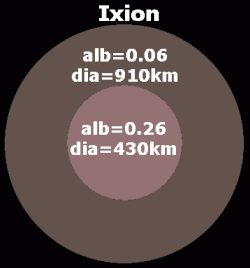
伊克西翁是除冥王星之外第一個當時估計比穀神星大的海王星外天體(TNO)[6],即使在發現一年後的2002年,估計直徑仍然超過1000公里[7],雖然此估計是250 GHz的虛假檢測結果,但後來的觀察並未證實這一點[8]。最近的估計顯示伊克西翁具有高反照率[9],比穀神星小。2020年至2023年間的恆星掩星觀測表明,伊克西翁是一個近乎球形的天體,平均直徑為697公里[1]。
伊克西翁在可見光下呈中度紅色(略微紅色,比創神星更紅)[10]。相較其他中型紅色QB1天體,其有更高的反照率(> 0.15)[8]。在其光譜中波長為0.8μm時可能存在吸收特徵,這通常與水對表面材料的改變有關[10]。在近紅外線中,伊克西翁的光譜平坦而無特徵,並沒有1.5和2μm的水冰吸收帶。這與伐樓拿相反,伐樓拿在近紅外線中具有紅色光譜斜坡以及突出的吸水帶[11]。可見光和紅外光譜結果都表明,伊克西翁的表面由水冰、黑碳和托林混合物(它是通過照射水和有機化合物的包合物形成的共聚物)組成[12]。甚大望遠鏡(VLT)對伊克西翁的彗星活動進行了檢測,但並沒有發現彗髮[13] 。伊克西翁目前距離太陽大約41天文單位[4],當伊克西翁接近近日點時,或許會形成彗髮和暫時性大氣層。
參考資料
- ^ 1.0 1.1 1.2 1.3 1.4 Kilic, Y.; Braga-Ribas, F.; Pereira, C. L.; Ortiz, J. L.; Sicardy, B.; Santos-Sanz, P.; et al. Constraining the size, shape, and albedo of the large Trans-Neptunian Object (28978) Ixion with multi-chord stellar occultations. Astronomy & Astrophysics. January 2026,. forthcoming. arXiv:2601.09639
 .
- ^ Galiazzo, M.; de la Fuente Marcos, C.; de la Fuente Marcos, R.; Carraro, G.; Maris, M.; Montalto, M. Photometry of Centaurs and trans-Neptunian objects: 2060 Chiron (1977 UB), 10199 Chariklo (1997 CU26), 38628 Huya (2000 EB173), 28978 Ixion (2001 KX76), and 90482 Orcus (2004 DW) (PDF). Astrophysics and Space Science. July 2016, 361 (7): 15 [26 April 2017]. Bibcode:2016Ap&SS.361..212G. arXiv:1605.08251 . doi:10.1007/s10509-016-2801-5. (原始内容存档 (PDF)于2020-10-04).
- ^ 3.0 3.1 3.2 Hainaut, O. R.; Boehnhardt, H.; Protopapa, S. Colours of minor bodies in the outer solar system. II. A statistical analysis revisited. Astronomy and Astrophysics. October 2012, 546: 20 [26 April 2017]. Bibcode:2012A&A...546A.115H. arXiv:1209.1896 . doi:10.1051/0004-6361/201219566.
- ^ 4.0 4.1 AstDys (28978) Ixion Ephemerides. University of Pisa, Department of Mathematics. [26 April 2017]. (原始内容存档于2012-06-23).
- ^ Tancredi, G., & Favre, S. (2008) Which are the dwarfs in the Solar System? (页面存档备份,存于互联网档案馆). Depto. Astronomía, Fac. Ciencias, Montevideo, Uruguay; Observatorio Astronómico Los Molinos, MEC, Uruguay. Retrieved 10-08-2011
- ^ R. Stenger. New object deemed largest minor planet. CNN. 24 August 2001 [26 April 2017]. (原始内容存档于2016-03-03).
- ^ F. Bertoldi; W. Altenhoff; N. Junkes. Beyond Pluto: Max-Planck radioastronomers measure the sizes of distant minor planets. SpaceRef.com. 7 October 2002 [26 April 2017]. (原始内容存档于2019-09-25).
- ^ 8.0 8.1 Altenhoff, W. J.; Bertoldi, F.; Menten, K. M. Size estimates of some optically bright KBOs. Astronomy and Astrophysics. February 2004: 771–775 [26 April 2017]. Bibcode:2004A&A...415..771A. doi:10.1051/0004-6361:20035603.
- ^ W. R. Johnston. TNO/Centaur diameters, albedos, and densities. Johnston's Archive. 5 September 2016 [26 April 2017]. (原始内容存档于2015-11-05).
- ^ 10.0 10.1 Marchi, S.; Lazzarin, M.; Magrin, S.; Barbieri, C. Visible spectroscopy of the two largest known trans-Neptunian objects: Ixion and Quaoar. Astronomy and Astrophysics. September 2003, (3): L17–L19 [26 April 2017]. Bibcode:2003A&A...408L..17M. doi:10.1051/0004-6361:20031142.
- ^ Licandro, J.; Ghinassi, F.; Testi, L. Infrared spectroscopy of the largest known trans-Neptunian object 2001 KX75. Astronomy and Astrophysics. June 2002: L9–L12 [26 April 2017]. Bibcode:2002A&A...388L...9L. arXiv:astro-ph/0204104 . doi:10.1051/0004-6361:20020533.
- ^ Boehnhardt, H.; Bagnulo, S.; Muinonen, K.; Barucci, M. A.; Kolokolova, L.; Dotto, E.; et al. Surface characterization of 28978 Ixion (2001 KX76). Astronomy and Astrophysics. February 2004: L21–L25 [26 April 2017]. Bibcode:2004A&A...415L..21B. doi:10.1051/0004-6361:20040005.
- ^ Lorin, O.; Rousselot, P. Search for cometary activity in three Centaurs (60558) Echeclus, 2000 FZ53 and 2000 GM137 and two trans-Neptunian objects [(29981) 1999 TD10 and (28978) Ixion]. Monthly Notices of the Royal Astronomical Society. April 2007, 376 (2): 881–889 [26 April 2017]. Bibcode:2007MNRAS.376..881L. doi:10.1111/j.1365-2966.2007.11487.x.
引用错误:在<references>标签中name属性为“jpldata”的参考文献没有在文中使用
引用错误:在<references>标签中name属性为“lcdb”的参考文献没有在文中使用
<references>标签中name属性为“Lellouch-2013”的参考文献没有在文中使用