此條目介紹的是布朗运动。关于随机的过程,请见「
维纳过程 」。关于热力学的角度的定义,请见「
热力学温度 」。关于内部能量,请见「
能量均分定理 」。关于数学模型,请见「
随机游走 」。
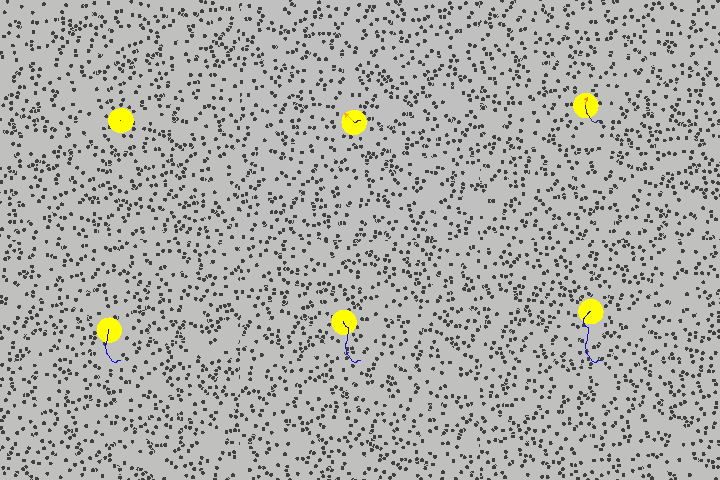
模擬的大顆粒塵埃粒子碰撞到更小的粒子,而其以不同的速度在不同方向移動的布朗運動 。 粒子的立體空間進行布朗運動的示意圖。 布朗运动 (英語:Brownian motion )是微小粒子或者颗粒在流体 中做的无规则运动。布朗运动过程是一种正态分布 的独立增量连续随机过程 。它是随机分析中基本概念之一。其基本性质为:布朗运动W(t)是期望为0、方差 为t(时间)的正态随机变量。对于任意的r小于等于s,W(t)-W(s)独立于的W(r),且是期望为0、方差 为t-s的正态随机变量。可以证明布朗运动是马尔可夫过程、鞅过程和伊藤过程。
它是在西元1827年[ 1] 罗伯特·布朗 利用一般的顯微鏡 觀察懸浮於水中由花粉 所迸裂出之微粒時,發現微粒會呈現不規則狀的運動,因而稱它布朗運動。布朗運動也能測量原子 的大小,因為就是由水 中的水分子對微粒的碰撞產生的,而不規則的碰撞越明顯,就是原子愈小,因此根據布朗運動,定義原子的直徑為10−8 厘米。
自1860年以來,許多科學家 都在研究此種現象,後來發現布朗運動有下列的主要特性:[ 2]
粒子的運動由平移 及轉移 所構成,顯得非常沒規則而且其軌跡幾乎是處處沒有切線。
粒子之移動顯然互不相關,甚至於當粒子互相接近至比其直徑小的距離時也是如此。
粒子越小或液體粘性越低或溫度越高時,粒子的運動越活潑。
粒子的成分及密度對其運動沒有影響。
粒子的運動永不停止。
在1905年,爱因斯坦 提出了相关理论。他的理論有兩個部分:第一部分定義布朗粒子擴散方程式,其中的擴散係數與布朗粒子平均平方位移相關,而第二部分連結擴散係數與可測量的物理量。以此方式,愛因斯坦的理論可決定原子的大小,一莫耳 有多少原子,或氣體的克分子量。根據阿伏伽德罗定律 ,所有理想氣體在標準溫度和壓力下體積為22.414升,其中包含的原子的數目被稱為「阿伏伽德罗常数 」。由氣體的莫耳質量除以阿伏伽德罗常数等同原子量。
爱因斯坦论证的第一部分是,确定布朗粒子在一定的时间内运动的距离。[ 3] 14 次撞击。[ 4]
他把粒子在一个的空间中,把布朗粒子在一维方向上的运动增量 (x) 视作一个随机值(
Δ
{\displaystyle \Delta }
x, 并对其坐标进行变换,让原点成为粒子运动的初始位置)并给出概率密度函数
φ
(
Δ
)
{\displaystyle \varphi (\Delta )}
ρ
(
x
,
t
)
+
τ
∂
ρ
(
x
)
∂
t
+
⋯
=
ρ
(
x
,
t
+
τ
)
=
∫
−
∞
+
∞
ρ
(
x
+
Δ
,
t
)
⋅
φ
(
Δ
)
d
Δ
=
ρ
(
x
,
t
)
⋅
∫
−
∞
+
∞
φ
(
Δ
)
d
Δ
+
∂
ρ
∂
x
⋅
∫
−
∞
+
∞
Δ
⋅
φ
(
Δ
)
d
Δ
+
∂
2
ρ
∂
x
2
⋅
∫
−
∞
+
∞
Δ
2
2
⋅
φ
(
Δ
)
d
Δ
+
⋯
=
ρ
(
x
,
t
)
⋅
1
+
0
+
∂
2
ρ
∂
x
2
⋅
∫
−
∞
+
∞
Δ
2
2
⋅
φ
(
Δ
)
d
Δ
+
⋯
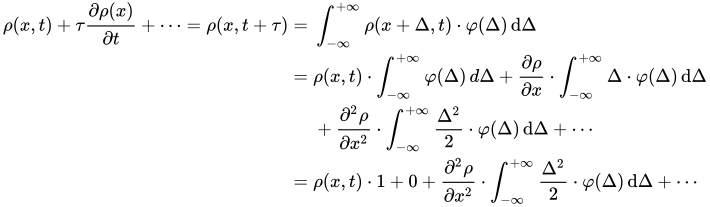
{\displaystyle {\begin{aligned}\rho (x,t)+\tau {\frac {\partial \rho (x)}{\partial t}}+\cdots =\rho (x,t+\tau )={}&\int _{-\infty }^{+\infty }\rho (x+\Delta ,t)\cdot \varphi (\Delta )\,\mathrm {d} \Delta \\={}&\rho (x,t)\cdot \int _{-\infty }^{+\infty }\varphi (\Delta )\,d\Delta +{\frac {\partial \rho }{\partial x}}\cdot \int _{-\infty }^{+\infty }\Delta \cdot \varphi (\Delta )\,\mathrm {d} \Delta \\&{}+{\frac {\partial ^{2}\rho }{\partial x^{2}}}\cdot \int _{-\infty }^{+\infty }{\frac {\Delta ^{2}}{2}}\cdot \varphi (\Delta )\,\mathrm {d} \Delta +\cdots \\={}&\rho (x,t)\cdot 1+0+{\frac {\partial ^{2}\rho }{\partial x^{2}}}\cdot \int _{-\infty }^{+\infty }{\frac {\Delta ^{2}}{2}}\cdot \varphi (\Delta )\,\mathrm {d} \Delta +\cdots \end{aligned}}}
第一行中的第二个等式是被
φ
{\displaystyle \varphi }
∂
ρ
∂
t
=
∂
2
ρ
∂
x
2
⋅
∫
−
∞
+
∞
Δ
2
2
τ
⋅
φ
(
Δ
)
d
Δ
+
(更 高 阶 的 项 )
{\displaystyle {\frac {\partial \rho }{\partial t}}={\frac {\partial ^{2}\rho }{\partial x^{2}}}\cdot \int _{-\infty }^{+\infty }{\frac {\Delta ^{2}}{2\,\tau }}\cdot \varphi (\Delta )\,\mathrm {d} \Delta +{\text{(更 高 阶 的 项 )}}}
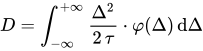
拉普拉斯算子之前的系数,是下一刻的随机位移量
Δ
{\displaystyle \Delta }
D
=
∫
−
∞
+
∞
Δ
2
2
τ
⋅
φ
(
Δ
)
d
Δ
{\displaystyle D=\int _{-\infty }^{+\infty }{\frac {\Delta ^{2}}{2\,\tau }}\cdot \varphi (\Delta )\,\mathrm {d} \Delta }
那么在 t 时刻 x 处的布朗粒子密度 ρ 满足扩散方程:
∂
ρ
∂
t
=
D
⋅
∂
2
ρ
∂
x
2
,
{\displaystyle {\frac {\partial \rho }{\partial t}}=D\cdot {\frac {\partial ^{2}\rho }{\partial x^{2}}},}
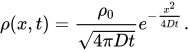
假設在初始時刻t = 0時,所有的粒子從原點開始運動,擴散方程的解
ρ
(
x
,
t
)
=
ρ
0
4
π
D
t
e
−
x
2
4
D
t
.
{\displaystyle \rho (x,t)={\frac {\rho _{0}}{\sqrt {4\pi Dt}}}e^{-{\frac {x^{2}}{4Dt}}}.}
满足下列条件的鞅我们称之为布朗运动
这个鞅是关于时间连续的。
他的平方减去时间项也是一个鞅。
(
M
t
)
{\displaystyle (M_{t})}
(
M
t
)
{\displaystyle (M_{t})}
(
M
t
2
−
t
)
{\displaystyle (M_{t}^{2}-t)}
3000步的2维布朗运动的模拟。 一维的定义
一维布朗运动
(
B
t
)
t
≥
0
{\displaystyle \scriptstyle (B_{t})_{t\geq 0}}
t 的一个随机过程,他满足 :
(独立增量)设时间t 和s 满足t > s ,增量
B
t
−
B
s
{\displaystyle \scriptstyle B_{t}-B_{s}}
s 前的过程
(
B
u
)
0
≤
u
≤
s
{\displaystyle \scriptstyle (B_{u})_{0\leq u\leq s}}
(稳定增量和正态性)设时间t 和s 满足t > s ,增量
B
t
−
B
s
{\displaystyle \scriptstyle B_{t}-B_{s}}
t −s 的正态分布。
(
B
t
)
t
≥
0
{\displaystyle \scriptstyle (B_{t})_{t\geq 0}}
t
↦
B
t
(
ω
)
{\displaystyle \scriptstyle t\mapsto B_{t}(\omega )}
通常假设
B
0
=
0
{\displaystyle \scriptstyle B_{0}=0}
等价定义
一维布朗运动
(
B
t
)
t
≥
0
{\displaystyle \scriptstyle (B_{t})_{t\geq 0}}
t 的一个随机过程,他满足 :
(
B
t
)
t
≥
0
{\displaystyle \scriptstyle (B_{t})_{t\geq 0}}
t
1
≤
t
2
≤
.
.
.
≤
t
n
{\displaystyle \scriptstyle t_{1}\leq t_{2}\leq ...\leq t_{n}}
(
B
t
1
,
B
t
2
,
.
.
.
,
B
t
n
)
{\displaystyle \scriptstyle (B_{t_{1}},B_{t_{2}},...,B_{t_{n}})}
(
B
t
)
t
≥
0
{\displaystyle \scriptstyle (B_{t})_{t\geq 0}}
对于所有s 和t ,均值
E
[
B
t
]
=
0
{\displaystyle \scriptstyle \mathbb {E} [B_{t}]=0}
协方差
E
[
B
s
B
t
]
=
m
i
n
(
s
,
t
)
{\displaystyle \scriptstyle E[B_{s}B_{t}]=min(s,t)}
高维定义
(
B
t
)
t
≥
0
:=
(
B
t
1
,
B
t
2
,
.
.
.
,
B
t
d
)
t
≥
0
{\displaystyle \scriptstyle (B_{t})_{t\geq 0}:=\left(B_{t}^{1},B_{t}^{2},...,B_{t}^{d}\right)_{t\geq 0}}
d 维布朗运动,只需满足
B
1
,
B
2
,
.
.
.
,
B
d
{\displaystyle \scriptstyle B^{1},B^{2},...,B^{d}}
换句话说,d 维布朗运动 取值于
R
d
{\displaystyle \scriptstyle \mathbb {R} ^{d}}
R
,
R
2
,
.
.
.
,
R
d
−
1
{\displaystyle \scriptstyle \mathbb {R} ,\mathbb {R} ^{2},...,\mathbb {R} ^{d-1}}
Wiener测度的定义
设
C
(
R
+
,
R
)
{\displaystyle \scriptstyle {\mathcal {C}}(\mathbb {R} ^{+},\mathbb {R} )}
R
+
{\displaystyle \scriptstyle \mathbb {R} ^{+}}
R
{\displaystyle \scriptstyle \mathbb {R} }
(
Ω
,
T
,
P
)
{\displaystyle \scriptstyle (\Omega ,{\mathcal {T}},\mathbb {P} )}
B
:
Ω
⟶
C
(
R
+
,
R
)
{\displaystyle B:\Omega \longrightarrow C(\mathbb {R} ^{+},\mathbb {R} )}
ω
↦
(
t
↦
B
t
(
ω
)
)
{\displaystyle \omega \mapsto \left(t\mapsto B_{t}(\omega )\right)}
Wiener测度 (或称为布朗运动的分布)设为
W
(
d
ω
)
{\displaystyle \scriptstyle W(d\omega )}
B 关于
P
(
d
ω
)
{\displaystyle \scriptstyle \mathbb {P} (d\omega )}
换句话说, W 是
C
(
R
+
,
R
)
{\displaystyle \scriptstyle {\mathcal {C}}(\mathbb {R} ^{+},\mathbb {R} )}
A
⊂
C
(
R
+
,
R
)
{\displaystyle \scriptstyle A\subset {\mathcal {C}}(\mathbb {R} ^{+},\mathbb {R} )}
W
(
A
)
=
P
(
(
B
t
)
t
≥
0
∈
A
)
{\displaystyle W(A)=\mathbb {P} ((B_{t})_{t\geq 0}\in A)}
备忘
布朗运动是一种增量服从正态分布的萊維過程。
这个定义可以帮助我们证明布朗运动的很多特性,比如几乎处处连续,轨迹几乎处处不可微等等。
我们可以利用二次变差的期望为时间来等价定义布朗运动。这个定义由Levy定理演化而来, 即: 轨迹连续且二次变差为
t
{\displaystyle t}
布朗运动的轨道几乎处处不可微:对于任何
ω
∈
Ω
{\displaystyle \scriptstyle \omega \in \Omega }
t
↦
B
t
(
ω
)
{\displaystyle \scriptstyle t\mapsto B_{t}(\omega )}
协方差
E
[
B
s
B
t
]
=
m
i
n
(
s
,
t
)
{\displaystyle \scriptstyle \mathbb {E} [B_{s}B_{t}]=min(s,t)}
布朗运动具有强马氏性: 对于停时T ,取条件
[
T
<
∞
]
{\displaystyle \scriptstyle [T<\infty ]}
(
B
t
T
)
t
≥
0
:=
(
B
T
+
t
−
B
T
)
t
≥
0
{\displaystyle \scriptstyle (B_{t}^{T})_{t\geq 0}:=(B_{T+t}-B_{T})_{t\geq 0}}
(
B
s
)
0
≤
s
<
T
{\displaystyle \scriptstyle (B_{s})_{0\leq s<T}}
它的Fourier变换 或特征函数为
E
[
e
i
u
B
t
]
=
e
−
t
u
2
2
{\displaystyle \scriptstyle \mathbb {E} \left[e^{iuB_{t}}\right]=e^{-{\frac {tu^{2}}{2}}}}
布朗运动关于时间是齐次的: 对于s > 0,
(
B
t
+
s
−
B
s
)
t
≥
0
{\displaystyle \scriptstyle (B_{t+s}-B_{s})_{t\geq 0}}
(
B
u
)
0
≤
u
≤
s
{\displaystyle \scriptstyle (B_{u})_{0\leq u\leq s}}
-B 是一个布朗运动。
(稳定性) 对于c > 0,
(
c
B
t
c
2
)
t
≥
0
{\displaystyle \scriptstyle \left(cB_{\frac {t}{c^{2}}}\right)_{t\geq 0}}
(时间可逆性)
(
t
B
1
t
)
t
>
0
{\displaystyle \scriptstyle \left(tB_{\frac {1}{t}}\right)_{t>0}}
t =0之外是布朗运动。
(常返性)只有1维和2维布朗运动是常返的: 如果
d
∈
{
1
,
2
}
{\displaystyle \scriptstyle d\in \{1,2\}}
{
t
≥
0
,
B
t
=
x
}
{\displaystyle \scriptstyle \{t\geq 0,B_{t}=x\}}
x
∈
R
d
{\displaystyle \scriptstyle x\in \mathbb {R} ^{d}}
如果
d
≥
3
,
lim
t
→
∞
|
|
B
t
|
|
=
+
∞
{\displaystyle \scriptstyle d\geq 3,\,\,\,\lim _{t\rightarrow \infty }||B_{t}||=+\infty }
P
[
sup
0
≤
s
≤
t
B
s
≥
a
]
=
2
P
[
B
t
≥
a
]
=
P
[
|
B
t
|
≥
a
]
.
{\displaystyle \mathbb {P} [\sup _{0\leq s\leq t}B_{s}\geq a]=2\mathbb {P} [B_{t}\geq a]=\mathbb {P} [|B_{t}|\geq a].}
设
(
f
t
)
t
∈
R
+
{\displaystyle (f_{t})_{t\in {\mathbb {R} }_{+}}}
L
2
(
R
+
)
{\displaystyle L^{2}({\mathbb {R} }_{+})}
∀
(
u
,
v
)
∈
R
+
,
s
(
u
,
v
)
=
⟨
f
u
,
f
v
⟩
L
2
(
R
+
)
=
∫
R
+
f
u
(
x
)
f
v
(
x
)
d
x
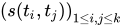
{\displaystyle \forall (u,v)\in {\mathbb {R} }_{+}{\text{, }}s(u,v)={\langle f_{u},f_{v}\rangle }_{L^{2}({\mathbb {R} }_{+})}=\int _{\mathbb {R} _{+}}f_{u}(x)f_{v}(x)dx}
这列函数满足:
∀
k
∈
N
∗
{\displaystyle \forall k\in \mathbb {N} ^{*}}
t
1
,
.
.
.
,
t
k
∈
R
+
{\displaystyle t_{1},...,t_{k}\in \mathbb {R} _{+}}
(
s
(
t
i
,
t
j
)
)
1
≤
i
,
j
≤
k
{\displaystyle \left(s(t_{i},t_{j})\right)_{1\leq i,j\leq k}}
利用Kolmogorov一致性定理,我们可以构造高斯过程
{
Y
t
}
t
∈
R
+
{\displaystyle \{Y_{t}\}_{t\in \mathbb {R} _{+}}}
m
{\displaystyle m}
s
{\displaystyle s}
当
(
f
t
)
t
∈
R
+
=
(
c
.1
1
[
0
,
t
]
)
t
∈
R
+
{\displaystyle (f_{t})_{t\in {\mathbb {R} }_{+}}=\left({\sqrt {c}}.1\!\!1_{[0,t]}\right)_{t\in \mathbb {R} _{+}}}
c
>
0
{\displaystyle c>0}
1
1
[
0
,
t
]
{\displaystyle 1\!\!1_{[0,t]}}
[
0
,
t
]
{\displaystyle [0,t]}
s
(
u
,
v
)
=
c
∫
R
1
1
[
0
,
u
]
(
s
)
1
1
[
0
,
v
]
(
s
)
d
s
=
c.min
(
u
,
v
)
{\displaystyle s(u,v)=c\int \limits _{\mathbb {R} }1\!\!1_{[0,u]}(s)1\!\!1_{[0,v]}(s)ds={\text{c.min}}(u,v)}
在这个情况下,矩阵
(
s
(
t
i
,
t
j
)
)
1
≤
i
,
j
≤
k
{\displaystyle \left(s(t_{i},t_{j})\right)_{1\leq i,j\leq k}}
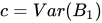
我们称一个高斯过程为 布朗运动 当且仅当均值为0,协方差为s。
c
=
V
a
r
(
B
1
)
{\displaystyle c=Var(B_{1})}
c
=
1
{\displaystyle c=1}
标准的布朗运动 .
Donsker定理(1951)证明了逐渐归一化的随机游走弱收敛于布朗运动。
(
1
σ
n
(
∑
k
=
1
[
n
t
]
U
k
+
(
n
t
−
[
n
t
]
)
U
[
n
t
]
+
1
)
)
0
≤
t
≤
1
⟹
n
→
∞
(
B
t
)
0
≤
t
≤
1
{\displaystyle \left({\frac {1}{\sigma {\sqrt {n}}}}\left(\sum _{k=1}^{[nt]}U_{k}+(nt-[nt])U_{[nt]+1}\right)\right)_{0\leq t\leq 1}{\underset {n\rightarrow \infty }{\Longrightarrow }}(B_{t})_{0\leq t\leq 1}}
其中(U n n ≥ 1) 独立同分布, 均值为0,方差为σ 的随机变量序列。
设2列独立的正态
N
(
0
,
1
)
{\displaystyle \scriptstyle {\mathcal {N}}(0,1)}
(
N
k
,
k
∈
N
)
{\displaystyle \scriptstyle (N_{k},k\in \mathbb {N} )}
(
N
k
′
,
k
∈
N
)
{\displaystyle \scriptstyle (N'_{k},k\in \mathbb {N} )}
(
B
t
)
t
≥
0
{\displaystyle \scriptstyle (B_{t})_{t\geq 0}}
B
t
:=
t
N
0
+
∑
k
=
1
+
∞
2
2
π
k
(
N
k
cos
(
2
π
k
t
−
1
)
+
N
k
′
sin
(
2
π
k
t
)
)
{\displaystyle B_{t}:=tN_{0}+\sum _{k=1}^{+\infty }{\frac {\sqrt {2}}{2\pi k}}\left(N_{k}\cos(2\pi kt-1)+N_{k}'\sin(2\pi kt)\right)}
为布朗运动。
值得注意的是,布朗运动指的是花粉迸出的微粒的随机运动,而不是分子的随机运动。但是通过布朗运动的现象可以间接证明分子的无规则运动。
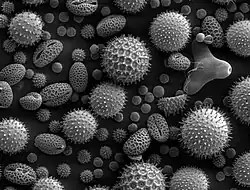
一般而言,花粉 之直徑分布於30~50μm 、最小亦有10μm之譜,相較之下,水分子直徑約0.3nm (非球形,故依部位而有些許差異。),略為花粉的十萬分之一。因此,花粉難以產生不規則振動,事實上花粉幾乎不受布朗運動之影響。在罗伯特·布朗 的手稿中,「tiny particles from the pollen grains of flowers」意味著「自花粉粒中迸出之微粒子」,而非指花粉本身。然而在翻譯為諸國語言時,時常受到誤解,以為是「水中的花粉受布朗運動而呈現不規則運動」。積非成是之下,在大眾一般觀念中,此誤會已然根深蒂固。
花粉具備足夠大小,幾乎無法觀測到布朗運動。 在日本 ,以鶴田憲次『物理学叢話』為濫觴,岩波書店『岩波理科辞典』[ 5] 湯川秀樹 『素粒子』、坂田昌一『物理学原論(上)』、平凡社『理科辞典』、福岡伸一著『生物與無生物之間』,甚至日本的理科課本等等,皆呈現錯誤之敘述。
直到1973年横浜市立大学名誉教授植物学 者岩波洋造在著書『植物之SEX‐不為人知的性之世界』中,點出此誤謬之前,鮮少有人注意。国立教育研究所物理 研究室長板倉聖宣在參與製作岩波電影『迴動粒子』(1970年)時,實際攝影漂浮在水中之花粉,卻發現花粉完全沒有布朗運動。遂於1975年3月,以「外行人與專家之間」為題,解說有關布朗運動之誤會。
^ 部分紀錄為1828年。
^ 李育嘉. 漫談布朗運動 . [2012-12-14 ] . (原始内容存档 于2019-07-18). ^ BROWNIAN MOTION. : 5. ^ Feynman, R. The Brownian Movement . The Feynman Lectures of Physics, Volume I. 1964: 41-1 [2018-02-05 ] . (原始内容存档 于2021-02-14). ^ 該辭典已於1987年所發行之第四版中修正。
特性
分形维数
Assouad 维数 关联维数 豪斯多夫维数
计盒维数
填充维数 拓撲維數
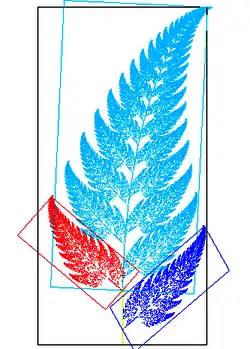
递归 自相似 Barnsley fern 迭代函数系统
巴恩斯利蕨葉 康托尔集 龍形曲線
科赫雪花
门格海绵
谢尔宾斯基地毯
謝爾賓斯基三角形
空間填充曲線
T型方間 魏尔斯特拉斯函数
逻辑斯谛映射
萊維C形曲線
希爾伯特曲線 奇異吸子 L系統 逃逸時間分形
曼德博集合 朱利亚集合
李亞普諾夫分形 牛頓分形
燃燒巨輪分形 三角帽分形 渲染技术 隨機分形
布朗运动
分形地形 擴散限制凝聚 萊維飛行 曼德尔盒 曼德尔球
渗流理论
自避行走 學者
格奥尔格·康托尔 费利克斯·豪斯多夫
加斯東·朱利亞 海里格·馮·科赫
保羅·皮埃爾·萊維
亞歷山大·李亞普諾夫
本華·曼德博 刘易斯·弗赖伊·理查森
瓦茨瓦夫·谢尔宾斯基 其他相關
《英國的海岸線有多長?統計自相似和分數維度》
以豪斯多夫維數排列的分形列表 《分形之美
分形艺术 《混沌学传奇
《大自然的分形几何学》 (1982)
分形压缩
仿射变换
貢獻 著作
《奇蹟年論文》(1905)
《論動體的電動力學》(1905)
《熱的分子運動論所要求的靜止液體中懸浮粒子的運動
《相對論入門:狹義和廣義相對論
《相对论的意义》(1922)
《我的世界觀
《物理学的进化》(1938)
《为什么要社会主义?》(1949)
《罗素—爱因斯坦宣言》(1955) 獎項
阿尔伯特·爱因斯坦奖
阿爾伯特·愛因斯坦獎章
卡林加獎 阿尔伯特·爱因斯坦和平奖
阿尔伯特·爱因斯坦世界科学奖
爱因斯坦激光科學奖 爱因斯坦奖 (美国物理学会) 家族
波琳·科赫(母亲)
赫尔曼·爱因斯坦(父亲)
瑪雅·愛因斯坦 米列娃·馬利奇(第一任妻子)
爱尔莎·爱因斯坦(第二任妻子及表姊)
麗瑟爾·愛因斯坦 汉斯·爱因斯坦(兒子)
愛德華·愛因斯坦 伯恩哈德·凯撒·爱因斯坦(孫子)
艾弗琳·爱因斯坦(養孫女)
羅伯特·愛因斯坦 西格貝特·愛因斯坦 相關
獎章與榮譽
爱因斯坦的大脑
美國故居 雕像 政治觀
宗教观
以阿爾伯特·愛因斯坦命名的事物 阿爾伯特·愛因斯坦檔案館 阿尔伯特·爱因斯坦广场
爱因斯坦论文项目
愛因斯坦冰箱 瑞士故居 锿 馬克斯·塔爾梅 愛因斯坦黑板 爱因斯坦十字
爱因斯坦水槽
爱因斯坦望远镜
阿尔伯特·爱因斯坦研究所
愛因斯坦-西拉德信件
愛因斯坦與中國
大眾文化
分類






































 Barnsley fern

