M72 (球狀星團)
| 梅西耶 72 | |
|---|---|
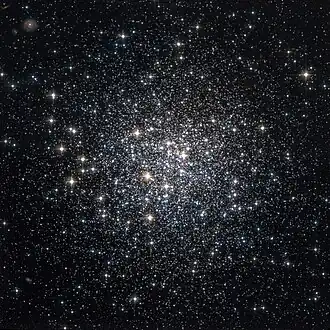 哈伯太空望遠鏡拍攝的M72。(視場3.44′) | |
| 觀測數據(J2000 曆元) | |
| 分類 | IX[1] |
| 星座 | 寶瓶座 |
| 赤經 | 20h 53m 27.70s[2] |
| 赤緯 | –12° 32′ 14.3″[2] |
| 距離 | 54.57 ± 1.17 kly(16.73 ± 0.36 kpc)[3] |
| 視星等(V) | 9.3[4] |
| 視直徑(V) | 6.6' |
| 物理性質 | |
| Mass | 1.68×10⁵[5] M☉ |
| 金屬量 | –1.48 ± 0.03[3] dex |
| 估計年齡 | 9.5 Gyr[6] |
| 其它名稱 | NGC 6981、GCl 118[7] |

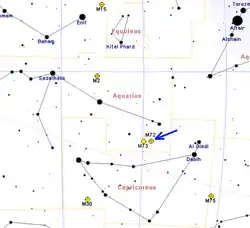
梅西耶72,也稱為M72或NGC 6981,是在黃道星座寶瓶座西南邊陲的一個球狀星團。
觀測歷史與指南
梅西耶72是皮埃爾·梅尚在1780年8月29日發現的。她的同鄉梅西耶在36天之後的10月4日和5日觀測確認後,將之編入星表中的第72號[8]。當時,兩者都選擇了較為主導的競爭術語,認為它是一個黯淡的星雲,而非星團。天文學家約翰·赫歇爾稱其為較大型的「圓形恆星群」;天文學家哈羅·沙普利注意到M72與梅西耶4 4和梅西耶12有相似之處[9]。 在良夜天空]中,它以微弱星雲的形式在。雖然口徑 6 cm(2.4英寸)望遠鏡就可以看見,要看清楚周圍的場星則要口徑15 cm(5.9英寸)才辦得到。25 cm(9.8英寸)可以觀測 角直徑2.5′的範圍;30 cm(12英寸)的就可以清楚的觀測這個星團的核心:1.25′ 的直徑,意指恆星分布廣泛的區域,但在南方和東方的恆星則極少[10]。M72距離地球大約53,000光年,與銀心也有一段的距離。但也有資料認為M72與地球的距離是62,000光年,直徑為42光年。雖然一般的星團都有一些最老年的恆星,但M72擁有一些藍巨星,因而被認為是一個年輕的星團。
性質
根據2011年的變星普查,該星團與太陽的距離為54.57 ± 1.17 kly(16.73 ± 0.36 kpc)[3]。估計總質量為168,000[5]太陽質量(M☉),大約已有95億年的歷史。核心區域的恆星密度為每立方秒差距輻射2.26倍的太陽光度(L☉)[6]。星團中已確認有43顆變星[3]。
圖片集
-
 哈伯太空望遠鏡拍攝的M72影像。
相關條目
參考文獻
- ^ Shapley, Harlow; Sawyer, Helen B., A Classification of Globular Clusters, Harvard College Observatory Bulletin, August 1927, 849 (849): 11–14, Bibcode:1927BHarO.849...11S.
- ^ 2.0 2.1 Goldsbury, Ryan; et al, The ACS Survey of Galactic Globular Clusters. X. New Determinations of Centers for 65 Clusters, The Astronomical Journal, December 2010, 140 (6): 1830–1837, Bibcode:2010AJ....140.1830G, S2CID 119183070, arXiv:1008.2755
 , doi:10.1088/0004-6256/140/6/1830.
- ^ 3.0 3.1 3.2 3.3 Figuera Jaimes, R.; et al, Henney, W. J.; Torres-Peimbert, S. , 编, XIII Latin American Regional IAU Meeting: (item) The Globular Cluster NGC 6981: Variable stars population, physical parameters and astrometry, Revista Mexicana de Astronomía y Astrofísica, Serie de Conferencias 40, October 2011, 40: 235–236, Bibcode:2011RMxAC..40..235F.
- ^ Messier 72. SEDS Messier Catalog. [30 April 2022]. (原始内容存档于1 July 2022).
- ^ 5.0 5.1 Boyles, J.; et al, Young Radio Pulsars in Galactic Globular Clusters, The Astrophysical Journal, November 2011, 742 (1): 51, Bibcode:2011ApJ...742...51B, S2CID 118649860, arXiv:1108.4402 , doi:10.1088/0004-637X/742/1/51.
- ^ 6.0 6.1 Sollima, A.; et al, The correlation between blue straggler and binary fractions in the core of Galactic globular clusters, Astronomy and Astrophysics, April 2008, 481 (3): 701–704, Bibcode:2008A&A...481..701S, S2CID 3088769, arXiv:0801.4511 , doi:10.1051/0004-6361:20079082
- ^ NGC 6981. SIMBAD. 斯特拉斯堡天文資料中心.
- ^ Garfinkle, Robert A., Star-Hopping: Your Visa to Viewing the Universe, Cambridge University Press: 266, 1997, ISBN 978-0521598897
- ^ Burnham, Robert, Burnham's Celestial Handbook: An Observer's Guide to the Universe Beyond the Solar System, Dover Books on Astronomy Series 1 2nd, Courier Dover Publications: 188–189, 1978, ISBN 978-0486235677
- ^ Luginbuhl, Christian B.; Skiff, Brian A., Observing Handbook and Catalogue of Deep-Sky Objects 2nd, Cambridge University Press: 25, 1998, ISBN 978-0521625562
外部連結
- Messier 72, SEDS Messier pages
- Messier 72, Galactic Globular Clusters Database page
- Messier 72, LRGB CCD image based on two hours total exposure
- M-72 Information
- WikiSky上关于M72 (球狀星團)的内容:DSS2, SDSS, GALEX, IRAS, 氢α, X射线, 天文照片, 天图, 文章和图片
| 天文學目錄 | ||
|---|---|---|
| NGC天體表: | NGC 6979 - NGC 6980 - NGC 6981 - NGC 6982 - NGC 6983 | |
| 傳統梅西耶天体 |
| ||||||||||||||||||
|---|---|---|---|---|---|---|---|---|---|---|---|---|---|---|---|---|---|---|---|
| 补充的梅西耶天体 | |||||||||||||||||||
| 按分类 |
| ||||||||||||||||||
| 参见 | |||||||||||||||||||
| |||||||||||||||||||


