Battle of Leuctra
| Battle of Leuctra | |||||||
|---|---|---|---|---|---|---|---|
| Part of the post–Peloponnesian War conflicts and the Theban–Spartan War | |||||||
 Pelopidas leading the Thebans at the battle of Leuctra | |||||||
| |||||||
| Belligerents | |||||||
| |||||||
| Commanders and leaders | |||||||
|
Epaminondas Pelopidas | Cleombrotus I † | ||||||
| Strength | |||||||
|
7,000 hoplites 700 cavalry |
10,000 hoplites 1,000 cavalry | ||||||
| Casualties and losses | |||||||
| 47–300[2] | 1,000–4,000+[3] | ||||||
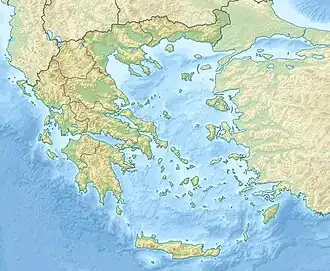  Location of the Battle of Leuctra | |||||||
The Battle of Leuctra (Ancient Greek: Λεῦκτρα, Ancient Greek: [lêu̯k.tra]) was fought on 6 July 371 BC between the Boeotians led by the Thebans, and the Spartans along with their allies. The battle occurred in the context of the King's Peace, or Peace of Antalcidas, which had ended the Corinthian War in 386 BC. The Peace was formally renewed in 375 BC, but a disagreement between the Spartans and the Thebans over the protocol for renewing the Peace again in 371 led directly to the battle, which took place in the vicinity of Leuctra, a village in Boeotia in the territory of Thespiae. The mainly Theban victory shattered Sparta's immense influence over the Greek peninsula, and the wider Aegean Greek world, which Sparta had gained with its victory in the Peloponnesian War a generation earlier.
Prelude
The Corinthian War, between Sparta and a Persian-backed coalition of Thebes, Athens, Corinth, Argos and other Greek allies, had ended in 387/6 BC with the King's Peace[4] (also called the Peace of Antalcidas, or the Common Peace), under the terms of which the autonomy of all Greek cities not under Persian control was guaranteed.[5] Sparta, as the guarantor of the King's Peace in Greece, immediately used this autonomy clause to force the Thebes-dominated Boeotian League to disband.[6] In 382 BC, the Spartan general Phoebidas seized Thebes' acropolis, the Cadmea, thereby assisting the pro-Spartan Leontiades and his oligarchic supporters in taking control of Thebes, a clear violation of Theban autonomy.[7]
In late 379 BC, an anti-Spartan Theban exile faction overthrew Leontiades,[8] and immediately signaled their intent to reconstitute the Boeotian League by electing four of the leaders of their revolt as Boeotarchs, the traditional title of the leaders of the Boeotian League.[9] This resulted in the Boeotian War in 378 BC, and Sparta's failed attempts to regain control of Thebes and Boeotia.[10]
A short lived peace, was agreed to again in 375 BC, with renewed conflict in 373 BC. Throughout the Boeotian War, Thebes had continued to expand its dominance over Boeotia. It captured and severely damaged both Plataea, long an ally of Athens, and Thespiae, and forced their citizens into exile.[11] By 371 BC, having engaged in costly naval campaigns, both Sparta and Thebes' ally Athens, were ready for peace. Thebes, faced with the prospect of fighting Sparta alone, was likewise prepared to agree to a new peace treaty, which, like those of 386 and 375, promised the independence of all Greek cities. When it came time to sign the new treaty, the Theban ambassadors came forward wishing to sign on behalf of the whole Boeotian League, but the Spartans demanded instead that each Boeotian city sign independently, which the Thebans refused.[12]
With Thebes now isolated, Sparta saw an opportunity to reassert its supremacy in central Greece, and the Spartans immediately sent king Cleombrotus I marching, from his position in Phocis in central Greece, into Boeotia. Rather than take the expected and easier route into Boeotia along the northern side of Mount Helicon, the Spartans instead marched over the hills to the south of Helicon, and then proceeded to Leuctra where they were confronted by a hastily repositioned Boeotian army.[13]
Force sizes and commanders
Several ancient sources give numbers for the sizes of the two armies, but none of these sources gives all the numbers involved, and they nearly all disagree. The general modern consensus is that the Spartan commander King Cleombrotus led approximately 10,000 Peloponnesian infantry, including 700 Spartiates (i.e. full Spartan citizens), and 1,000 cavalry, against 7,000 Boeotian infantry, and 700 cavalry, led by the Theban commander Epaminondas.[14]
According to Xenophon, 700 Spartiates fought at Leuctra,[15] while according to Plutarch, Cleombrotus' Peloponnesian army consisted of 2,000 infantry and 1,000 cavalry,[16] Diodorus Siculus reports that Epameinondas led a force (which included all Thebans of military age) numbering no more than 6,000, to be joined later by a Thessalian force of 1,500 infantry and 500 calvary.[17] Other, even later sources give much higher numbers for the Peloponnesians, which are harder to believe. According to Polyaenus, the Peloponnesians numbered 40,000 (against only 6,000 "Thebans"), while Frontinus specifies 24,000 infantry and 1,600 cavalry, (against only 3,600 infantry and 400 cavalry).[18] In any case, the similar force ratios (~ 6.5 to 1), given by Polyaenus and Frontinus, are perhaps meant simply to emphasize the difference in the sizes of the two armies.[19]
Battle

Top: Traditional hoplite order of battle and advance.
Bottom: Epaminondas's strategy at Leuctra. The strong left wing advanced more than the weaker right wing.
The battle opened with the Spartans' mercenary peltasts (slingers, javelinieers, and/or light-armed skirmishers) attacking and driving back the Boeotian camp followers and others who, according to Xenophon, did not intend to fight. This Spartan action drove them back into the Theban army, inadvertently making the Theban force stronger.[20] There followed a cavalry engagement, in which the Thebans drove their enemies off the field.[21] Initially, the Spartan infantry were sent into disarray when their retreating cavalry hopelessly disrupted Cleombrotus's attempt to outflank the Theban left column. At this point the Theban left hit the Spartan right with the Sacred Band of Thebes, a troop made up of all male lovers, led by Pelopidas,[22] at its head. The decisive engagement was then fought between the Theban and Spartan infantry.[21]
The normal practice of the Spartans (and, indeed, the Greeks in general) was to establish their heavily armed infantry in a solid mass, or phalanx, some eight to twelve men deep. This was considered to allow for the best balance between depth (the pushing power it provided) and width (i.e., area of coverage of the phalanx's front battle line). The infantry would advance together so that the attack flowed unbroken against their enemy. In order to combat the phalanx's famous right-hand drift, Greek commanders traditionally placed their most experienced, highly regarded and, generally, deadliest troops on the right wing, as this was the place of honor. By contrast, the shakiest and/or least influential troops were often placed on the left wing. In the Spartan battleplan, therefore, the hippeis (an elite force numbering 300 men) and the king of Sparta would stand on the right wing of the phalanx.

In a major break with tradition, Epaminondas massed his cavalry and a fifty-deep column of Theban infantry on his left wing,[21] and sent forward this body against the Spartan right. His shallower and weaker center and right wing columns were drawn up so that they were progressively further to the right and rear of the proceeding column, in an Echelon formation. The Theban center and right were held back, screened by skirmishers and cavalry. The infantry engaged, and the Thebans smashed the Spartan right wing. The Spartans' twelve-deep formation on their right wing could not sustain the heavy impact of their opponents' 50-deep column. The Spartan right was hurled back with a loss of about 1,000 men, of whom 400 were some of Sparta's most experienced soldiers, including King Cleombrotus I.[21]
Wilhelm Rüstow and Hermann Köchly, writing in the 19th century, believed that Pelopidas led the Sacred Band out from the column to attack the Spartans in the flank. Hans Delbrück considered this to be a mere misreading of Plutarch. Plutarch does indeed describe Pelopidas leading the Band and catching the Spartans in disorder, but there is nothing in his account that conveys anything other than the Sacred Band being the head of the column, and the Spartans were disordered not because they were taken in the flank but because they were caught in mid-maneuver, extending their line.[23]
Seeing their right wing beaten, the rest of the Peloponnesians, who were essentially unwilling participants, retired and left the enemy in possession of the field.[21]
Aftermath

The arrival of a Thessalian army under Jason of Pherae[21] persuaded a relieving Spartan force under Archidamus not to heap folly on folly and to withdraw instead, while the Thebans were persuaded not to continue the attack on the surviving Spartans. The Thebans somewhat bent the rules by insisting on conditions under which the Spartans and allies recovered the dead and by erecting a permanent rather than perishable trophy – something that was scrutinized by later writers.[24] Diodorus claimed the Spartan loss was believed by some to have been foretold by a comet.[25]
Historical significance

The battle is of great significance in Greek history.[21]
The use of these tactics by Epaminondas was, perhaps, a direct result of the use of some similar maneuvers by Pagondas, his countryman, during the Battle of Delium. Further, Philip II of Macedon, who studied and lived in Thebes, was no doubt heavily influenced by the battle to develop his own, highly effective approach to tactics and armament. In turn, his son, Alexander, would go on to develop his father's theories to an entirely new level. Many innovations of Philip and Alexander are traced to this battle. Concentration of force, refused flank, and combined arms were tactics that they used in many of their battles. Philip's victories against the Illyrians and at Chaeronea and Alexander's triumphs at the Granicus, Issus, Gaugamela, and the Hydaspes owe credit to the tactical maneuver used to vanquish the Spartans.
Historians Victor Davis Hanson and Donald Kagan have argued that Epaminondas' oblique formation was not an intentional and preconceived innovation in infantry tactics, but was rather a clever response to circumstances. Because Epaminondas had stacked his left wing to a depth of fifty shields, the rest of his units were naturally left with far fewer troops than normal. This means that their maintenance of a depth of eight to twelve shields had to come at the expense of either number of companies or their width. Because Epaminondas was already outnumbered, he had no choice but to form fewer companies and march them diagonally toward the much longer Spartan line in order to engage as much of it as possible. Hanson and Kagan's argument is therefore that the tactic was more dilatory than anything else. Whatever its motivation, the fact remains that the tactic did represent an innovation and was undoubtedly highly effective.
The battle's political effects were far-reaching: the losses in material strength and prestige (prestige being an inestimably important factor in the Peloponnesian War) sustained by the Spartans at Leuctra and subsequently at the Battle of Mantinea were key in depriving them forever of their supremacy in Greece.[21] Therefore, the battle permanently altered the Greek balance of power, as Sparta was deprived of its former prominence and was reduced to a second-rate power among the Greek city-states.
Theban supremacy in Greece was short-lived, as it was subsequently lost to the Macedonians, led by Philip II.[26]
In popular culture
The battle is fictionalized, though in some detail, in David Gemmell's book, Lion of Macedon, which includes the significant deviation from historical canon in that it is credited to a young Parmenio(n) instead of Epaminondas, who serves merely to gain permission to carry out the echelon tactic.
The battle is the subject of Victor Davis Hanson's 2011 historical fiction novel, The End of Sparta. The battle was featured in an episode of the BBC's Time Commanders. It was featured in the historical fiction graphic novel Serpent and Prey, which takes few creative liberties with the battle's portrayal.
In The Expanse: Persepolis Rising by James S.A. Corey, the final major engagement is referred to as the "Battle of Point Leuctra" in a literary homage to the historical battle. The name was chosen within the novel because the invading force called their solar system Laconia.
Notes
- ↑ Dahm 2021, p. 115; Plutarch, Agesilaus 28.5 ("fifth of Hecatombaeon").
- ↑ Dahm 2021, p. 168; Diodorus Siculus, 15.56.4 ("about" 300); Pausanias, 9.13.12 (47).
- ↑ Dahm 2021, p. 168; Xenophon, 6.4.15 ("almost" 1,000); Diodorus Siculus, 15.56.4 (4,000+); Plutarch, Agesilaus 28.5 (1000); Plutarch, Moralia 193B ("over" 1,000); Pausanias, 9.13.12 (1,000+).
- ↑ The "King" here referring to the Persian king Artaxerxes II.
- ↑ Hamilton 1997, p. 41; Buckler and Beck 2009, pp. 39, 71–72; Xenophon, Hellenica 5.1.31, 35–36; Diodorus Siculus, 14.110.3–4; Plutarch, Artaxerexes 21.4–5.
- ↑ Hamilton 1997, p. 53; Buckler and Beck 2009, pp. 72, 87; Xenophon, Hellenica 5.1.36.
- ↑ Hamilton 1997, p. 54; Munn 1997, pp. 75–76; Buckler and Beck 2009, pp. 76–77; Xenophon, Hellenica 5.4.1.
- ↑ Hamilton 1997, p. 54; Munn 1997, p. 77; Buckler and Beck 2009, pp. 89–90; Xenophon, Hellenica 5.4.2–12; Plutarch, Pelopidas 8–12; Diodorus Siculus, 15.53.2–3.
- ↑ Munn 1997, p. 80; Buckler and Beck 2009, pp. 89–90, 98; Plutarch, Pelopidas 13.1, 14.1.
- ↑ Hamilton 1997, pp. 41, 54; Munn 1997, pp. 78–81.
- ↑ Buckler 1980, p. 46; Munn 1997, pp. 80–81; Buckler and Beck 2009, pp. 97–98; Xenophon, Hellenica 6.3.1, 6.3.5; Pausanias, 9.1.8.
- ↑ Munn, p. 81; Buckler and Beck 2009, pp.41–42; Xenophon, Hellenica 6.3; Diodorus Siculus, 11.50.4–5.
- ↑ Munn, pp. 81–83; Xenophon, Hellenica 6.4.1–4; Diodorus Siculus, 15.51, 15.53.1–3.
- ↑ Dahm 2021, pp. 59–61.
- ↑ Dahm 2021, p. 61; Xenophon, Hellenica 6.4.15.
- ↑ Dahm 2021. p. 61; Plutarch, Pelopidas 20.1.
- ↑ Dahm 2021, p. 62; Diodorus Siculus, 15.52.2, 15.54.5.
- ↑ Dahm 2021, pp. 61–62; Polyaenus, 2.3.12; Frontinus, 4.2.6.
- ↑ Dahm 2021, p. 62.
- ↑ Xenophon Hellenica 6.4.9.
- 1 2 3 4 5 6 7 8 Caspari, Maximilian (1911). . In Chisholm, Hugh (ed.). Encyclopædia Britannica. Vol. 16 (11th ed.). Cambridge University Press. p. 504.
- ↑ Cornelius Nepos: Lives of Eminent Commanders, Pelopidas
- ↑ The History of the Art of War, Hans Delbrück p. 167
- ↑ Greek Warfare, Myths and Realities, Hans van Wees p. 136
- ↑ Siculus, Diodorus. "Bibliotheca historica, Book XV".
- ↑ The Battle of Leuktra, retrieved 07-07-2010 Archived June 13, 2013, at the Wayback Machine
References
- Buckler, John (1980), The Theban Hegemony; 371–362 BC, Cambridge, Harvard University Press, 1980. ISBN 0-674-87645-8. Internet Archive.
- Buckler, John, and Hans Beck (2009), Central Greece and the Politics of Power in the Fourth Century BC, Cambridge University Press, 2009. ISBN 9780511482717. doi:10.1017/CBO9780511482717.
- Dahm, Murray, (2021), Leuctra 371 BC: The Destruction of Spartan Dominance (Campaign, 363), Bloomsbury Publishing (Kindle Edition), 2021. ISBN 9781472843487 (eBook), ISBN 978-1472843517 (pbk.).
- Diodorus Siculus, Library of History, Volume IV: Books 9-12.40, translated by C. H. Oldfather, Loeb Classical Library 375. Cambridge, Massachusetts, Harvard University Press, 1946. ISBN 978-0-674-99413-3. Online version at Harvard University Press. Online version at Perseus Digital Library. Online version by Bill Thayer.
- Frontinus, Stratagems, in Frontinus. Stratagems. Aqueducts of Rome., translated by C. E. Bennett, Mary B. McElwain, Loeb Classical Library No. 174, Cambridge, Massachusetts, Harvard University Press, 1925. ISBN 978-0-674-99192-7. Online version at Harvard University Press.
- Hamilton, Charles D. (1997), "Sparta", in The Greek World In The Fourth Century: From the Fall of the Athenian Empire to the Successors of Alexander, Lawrence A. Tritle (ed.), (1997) Routledge. ISBN 0-415-10582-X (hbk). ISBN 0-415-10583-8 (pbk). ISBN 978-1-134-52467-9 (ebk).
- Munn, Mark, "Thebes and Central Greece" (1997), The Greek World In The Fourth Century: From the Fall of the Athenian Empire to the Successors of Alexander, Lawrence A. Tritle (ed.), (1997) Routledge. ISBN 0-415-10582-X (hbk). ISBN 0-415-10583-8 (pbk). ISBN 978-1-134-52467-9 (ebk).
- Pausanias, Description of Greece with an English Translation by W.H.S. Jones, Litt.D., and H.A. Ormerod, M.A., in 4 Volumes. Cambridge, Massachusetts, Harvard University Press; London, William Heinemann Ltd. 1918. Online version at the Perseus Digital Library.
- Plutarch, Agesilaus, in Plutarch, Lives, Volume V: Agesilaus and Pompey. Pelopidas and Marcellus, translated by Bernadotte Perrin, Loeb Classical Library No. 87. Cambridge, Massachusetts, Harvard University Press, 1917. ISBN 978-0-674-99097-5. Online version at Harvard University Press.
- Plutarch, Artaxerxes, in Plutarch, Lives, Volume XI: Aratus, Artaxerxes, Galba, Otho, General Index, translated by Bernadotte Perrin, Loeb Classical Library No. 103. Cambridge, Massachusetts, Harvard University Press, 1926. ISBN 978-0-674-99114-9. Online version at Harvard University Press.
- Plutarch, Moralia, Volume III: Sayings of Kings and Commanders. Sayings of Romans. Sayings of Spartans. The Ancient Customs of the Spartans. Sayings of Spartan Women. Bravery of Women, translated by Frank Cole Babbitt. Loeb Classical Library No. 245, Cambridge, Massachusetts, Harvard University Press, 1928. ISBN 978-0-674-99270-2. Online version at Harvard University Press.
- Plutarch, Pelopidas, in Plutarch, Lives, Volume V: Agesilaus and Pompey. Pelopidas and Marcellus, translated by Bernadotte Perrin, Loeb Classical Library No. 87. Cambridge, Massachusetts, Harvard University Press, 1917. ISBN 978-0-674-99097-5. Online version at Harvard University Press.
- Polyaenus, Strategems of War, Volume I (Books I-V), edited and Translated by Peter Krentz and Everett L. Wheeler, Ares Publishers, Chicago, 1994. ISBN 0-89005-503-3. Internet Archive.
- Xenophon, Hellenica, Volume II: Books 5-7, translated by Carleton L. Brownson, Loeb Classical Library No. 89, Cambridge, Massachusetts, Harvard University Press, 1921. ISBN 978-0-674-99098-2. Online version at Harvard University Press.
External links
- Battle of Leuctra from Encyclopædia Britannica