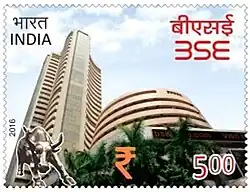
BSE Limited, also known as the Bombay Stock Exchange (BSE), is an Indian stock exchange based in Mumbai. Established in 1875, it is the oldest stock exchange in Asia, and also the tenth oldest in the world. It is the 6th largest stock exchange in the world by total market capitalisation, exceeding $5 trillion in May 2024.[8][9][10][11]
History
Bombay Stock Exchange logo used until June 2023
Bombay Stock Exchange was founded by a Jain businessman Premchand Roychand in 1875.[12] While BSE Limited is now synonymous with Dalal Street, it was not always so. In the 1850s, four Gujarati and one Parsi stockbroker gathered together under a banyan tree in front of Bombay (now Mumbai) Town Hall, where Horniman Circle is now situated.[9][13] A decade later, the brokers moved their location to under the banyan trees at the junction of Meadows Street and what was then called Esplanade Road, now MG Road. With a rapid increase in the number of brokers, they had to shift places repeatedly. At last, in 1874, the brokers found a permanent location, the one that they could call their own. The brokers group became an official organisation known as "The Native Share & Stock Brokers Association" in 1875.[14]
In 1957, the BSE became the first stock exchange to be recognised by the Indian Government under the Securities Contracts Regulation Act.[15]
The BSE is also a Partner Exchange of the United Nations Sustainable Stock Exchange initiative, joining in September 2012.[16]
BSE established the India International Exchange (India INX) on 30th December 2016. India INX, based out of GIFT City, is the first international stock exchange of India.[17]
BSE became the first stock exchange in the country to launch commodity derivatives contract in gold and silver in October 2018.[18]
BSE was demutualised and corporatised on 19 May 2007, pursuant to the BSE (Corporatisation and Demutualisation) Scheme, 2005 notified by SEBI.[19][20]
BSE has witnessed several high-profile market manipulation scandals.[24][25][26][27][28] At times, the Securities and Exchange Board of India (SEBI) has barred several individuals and entities from trading on the exchanges for insider trading and stock manipulation, especially in illiquid small-caps and penny stocks.[29][30][31][32]
The BSE faced criticism during the early 2000s for delayed technology upgrades, which contributed to its competitor NSE gaining market dominance in electronic trading. In 2013, market participants raised concerns over alleged preferential access to BSE's trading systems, prompting calls for improved transparency and oversight, though no regulatory action followed.[33]
↑SEBI Regulation 45(1) of Securities Contracts (Regulation) (Stock Exchanges and Clearing Corporations) Regulations, 2018 prohibits self-listing of a stock exchange in India.[23]
Citations
↑India, BSE. "Corporate profile"(PDF). Archived(PDF) from the original on 25 September 2021. Retrieved 8 August 2020.
Kochhar, S. (2015). BSE: Journey of an Aspiring Nation. Skoch Media. ISBN978-8-1929-1725-2.
Ramkumar, R.R. and Selvam, M. (2014). Efficiency of BSE Sectoral Indices in India: A Study with Special Reference to Bombay Stock Exchange Ltd in India. Lap Lambert Academic Publishing GmbH KG. ISBN978-3-6592-1130-0.{{cite book}}: CS1 maint: multiple names: authors list (link)
Kaur, H. (2002). Stock Market Volatility in India. Deep & Deep Publications. ISBN978-8-1762-9361-7.
Basu, D. and Dalal, S. (1993). The Scam: Who Won, who Lost, who Got Away. UBS Publishers' Distributors. ISBN978-8-1859-4410-4. LCCN93902443.{{cite book}}: CS1 maint: multiple names: authors list (link)
Hiremath, G.S. (2013). Indian Stock Market: An Empirical Analysis of Informational Efficiency. Springer India. ISBN978-8-1322-1590-5. LCCN2013946889.
Cummings, L. (2014). Rethinking the BSE Crisis: A Study of Scientific Reasoning under Uncertainty. Springer Netherlands. ISBN978-9-4017-8491-7.
Razdan, A. Scaling in the bombay stock exchange index. Pramana - J Phys 58, 537–544 (2002). doi:10.1007/s12043-002-0063-y
Goel, A., Tripathi, V. and Agarwal, M. (2021), "Market microstructure: a comparative study of Bombay stock exchange and national stock exchange", Journal of Advances in Management Research, Vol. 18 No. 3, pp.414–442. doi:10.1108/JAMR-06-2020-0109
Krishnamurti, Chandrasekhar and Eleswarapu, Venkat R., Liquidity, Stock Returns and Ownership Structure - An Empirical Study of the Bombay Stock Exchange (March 31, 1994). IIM Bangalore Research Paper No. 65, Available at SSRN2181543 or doi:10.2139/ssrn.2181543
Sumon Kumar Bhaumik. “Stock Index Futures in India: Does the Market Justify Its Use?” Economic and Political Weekly, vol. 32, no. 41, 1997, pp.2608–11. JSTOR4405950. Retrieved 13 Feb. 2024.
Ganeshaiah, K. N. “Has the Behaviour of the Stock Market Been Affected by the Scam? — A Statistical Analysis.” Current Science, vol. 63, no. 7, 1992, pp.345–47. JSTOR24095453. Retrieved 13 Feb. 2024.
Nair, S. (2021). Bulls, Bears and Other Beasts (5th Anniversary Edition): A Story of the Indian Stock Market. Pan Macmillan. ISBN978-9-3907-4257-8.


 ₹3,236 crore (US$340 million) (2025)