齐多夫定
 维基百科中的醫學内容仅供参考,並不能視作專業意見。如需獲取醫療幫助或意見,请咨询专业人士。詳見醫學聲明。
 | |
 | |
| 臨床資料 | |
|---|---|
| 读音 | /zaɪˈdoʊvjuːˌdiːn/ zy-DOH-vyoo-deen |
| 商品名 | Retrovir及其他 |
| AHFS/Drugs.com | Monograph |
| MedlinePlus | a687007 |
| 核准狀況 |
|
| 懷孕分級 |
|
| 给药途径 | 口服給藥, 靜脈注射, 直腸栓劑 |
| ATC碼 |
|
| 法律規範狀態 | |
| 法律規範 |
|
| 藥物動力學數據 | |
| 生物利用度 | 藥物經吸收後,雖受首渡效應影響,其系統生物利用率(全身利用率)仍達75%(介於52%至75%)。 |
| 血漿蛋白結合率 | 30 - 38% |
| 药物代谢 | 肝臟 |
| 生物半衰期 | 0.5 - 3小時 |
| 排泄途徑 | 腎臟及膽管(最終經由糞便) |
| 识别信息 | |
| CAS号 | 30516-87-1  |
| PubChem CID | |
| IUPHAR/BPS | |
| DrugBank | |
| ChemSpider | |
| UNII | |
| KEGG | |
| ChEBI | |
| ChEMBL | |
| NIAID ChemDB | |
| PDB配體ID | |
| CompTox Dashboard (EPA) | |
| ECHA InfoCard | 100.152.492 |
| 化学信息 | |
| 化学式 | C10H13N5O4 |
| 摩尔质量 | 267.25 g·mol−1 |
| 3D模型(JSmol) | |
| |
| |
齊多夫定 (INN:zidovudine, 簡稱ZDV) ,而在美國藥典(USP)中稱為azidothymidine(根據化學式,azidothymidine也可譯為疊氮胸苷, 簡稱AZT),是第一種用於預防及治療愛滋病的抗反轉錄病毒藥物。通常建議將此藥物與其他抗反轉錄病毒藥物聯合使用。[5]齊多夫定可用於預防已感染病毒的孕婦於分娩過程中的母子垂直傳染,或在針刺傷害及其他潛在暴露後進行預防性投藥。[5]此藥物以單方劑型銷售,也與其他成分組成複方藥,如拉米夫定/齊多夫定以及阿巴卡韋/拉米夫定/齊多夫定 。[5]
使用後常出現的副作用有頭痛、發燒與噁心。[5]嚴重的副作用則有肝臟問題、肌肉損傷及乳酸性酸中毒(高乳酸血症) 。[5]齊多夫定常用於妊娠的個體,且目前證據顯示該藥物對胎兒而言似乎屬於安全。[5]齊多夫定屬於核苷類似物反轉錄酶抑制劑 (NRTI)。[5]其作用原理在於抑制愛滋病毒用於製造DNA的反轉錄酶,而減少病毒的複製。[5]
對齊多夫定的描述於1964首次出現。[6]伯勒斯·維康公司 (Burroughs Wellcome,最終併入葛蘭素史克製藥) 經由公開領域取得的配方進行重新合成。[7]此藥物於1987年在美國獲得批准,成為史上首個治療愛滋病的方案。[5][8]此藥物已收錄於世界衛生組織基本藥物標準清單中。[9]目前市面上已有其通用名藥物(學名藥)流通 。[5]
醫療用途
此藥物主要用於愛滋病治療。通常會與其他抗反轉錄病毒療法聯合使用,每日給藥兩次。這種聯合療法被稱為高效能抗反轉錄病毒療法 (Highly Active Antiretroviral Therapy,HAART),目的在將病毒產生抗藥作用的可能性降低。[10][11]截至2019年已演變為每日一次的三藥聯合口服療法,其中有齊多夫定的成分。[12]
齊多夫定在預防愛滋病感染方面亦有重要應用。此藥物曾與另一種名為拉米夫定的藥物聯合用於暴露後預防 (PEP)。這兩種藥物的組合能顯著降低初次單次接觸病毒後的感染風險。[13]近期的醫療做法則多以替諾福韋等其他藥物取代齊多夫定來進行PEP治療。[14]齊多夫定在替諾福韋問世前,是預防與治療個體在妊娠期間、陣痛及分娩過程中母子垂直感染臨床路徑的核心成分,並已證實對於確保這些成功避開病毒感染的新生兒,在圍產期與發育階段的健康,具有非常重要的作用。[15][16]相關研究數據顯示,若個體於受孕後、分娩時及產後六週採取三階段齊多夫定給藥方案,能將感染風險降至8%。持續且積極的預防措施(如嚴格使用藥物、採剖腹產、佩戴口罩、使用重型橡膠手套及臨床隔離紙尿褲,並避免口腔接觸)可將兒童與照護者之間的愛滋病毒傳播的風險進一步降低至1-2%。[17][18][19]
此藥物在1994年至1999年間是預防母子垂直感染的主要方式。齊多夫定預防療法在美國已成功阻止超過1,000名父母與嬰兒因愛滋病死亡。[20]當時美國的標準護理方案稱為076方案,要求具愛滋病毒陽性母親從第二孕期開始每日服用五次齊多夫定,並在分娩期間進行靜脈注射。[21]由於這種療法過程漫長且費用昂貴,而被認為在母子傳染問題嚴重的全球南方(Global South) 地區並不可行。多項研究於1990年代後期啟動,以測試適用於"資源匱乏國家"的簡短療程方案。[22]所發展出的齊多夫定短程療法雖屬於較低品質的護理標準,若在美國進行此類試驗很可能會被視為醫療失當,但它確實提升貧困受試者的照護品質與生存率。[22]
抗菌特性
齊多夫定也具備抗菌特性。[23]但臨床上並未常態性將其作為抗生素使用。科學界對齊多夫定的抗菌作用機制尚未完全了解。在體外與體內的研究顯示齊多夫定對多重抗藥性革蘭氏陰性菌(包括攜帶mcr-1基因及產生金屬β-內醯胺酶的菌株)具有療效,特別是與磷黴素、黏菌素或替加環素等其他活性藥物聯合使用時效果更佳。[24][25]
使用齊多夫定最常見的副作用有噁心、嘔吐、胃食道逆流(胃灼熱)、頭痛、腹部脂肪減少、睡眠障礙以及食慾不振。較不常見的副作用有指甲或趾甲輕微變色、情緒亢奮、手腳偶發性刺痛或暫時性麻木,以及輕微的皮膚色素沉著。臨床上的過敏反應則屬罕見。[26]
早期使用高劑量齊多夫定的長期療法最初與一些副作用相關,包括貧血、嗜中性白血球低下、肝毒性、心肌病及肌肉病變,而有時會因此限制治療的進行。前述所有症狀通常在減少劑量後即可逆轉。這些病症的誘因可能歸結於粒線體DNA的暫時性耗損、部分細胞粒線體中γ-DNA聚合酶的敏感性、[27]胸苷三磷酸的耗損、氧化壓力、細胞內肉鹼減少或肌肉細胞的凋亡。[28]由齊多夫定引起的貧血已成功透過使用紅血球生成素刺激紅血球產生來治療。[29][30]抑制肝臟葡萄糖醛酸化作用的藥物(如吲哚美辛、去甲西泮、乙醯柳酸(阿斯匹靈)與甲氧苄啶)會降低排泄速度並增強該藥物的治療強度。[31]齊多夫定的副作用在現今使用低劑量的情況下已顯著減少。[32]國際癌症研究機構(IARC)認為有足夠證據顯示齊多夫定對實驗動物具有致癌性,對人類則屬於可能致癌物(國際癌症研究機構二B類致癌物)。[33]美國加利福尼亞州政府於2009年將齊多夫定列入已知會導致癌症或其他生殖傷害的化學物質清單。[34]
病毒抗藥性
齊多夫定即使在患者可耐受的最高劑量下,其效力仍不足以完全阻止病毒複製,僅是減緩病毒增殖與病情展。長期接受齊多夫定治療可能導致愛滋病毒出現反轉錄酶的突變而產生抗藥性 。[35][36]通常醫師為延緩抗藥性的發展,會建議將齊多夫定與另一種反轉錄酶抑制劑,以及另一類抗反轉錄病毒藥物(如蛋白酶抑制劑、非核苷類反轉錄酶抑制劑或整合酶抑制劑)聯合給藥。這種治療方案即為著名的高效能抗反轉錄病毒療法 (HAART)。
藥理機制
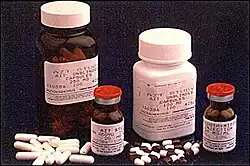
齊多夫定是一種胸苷類似物。其作用原理在於選擇性地抑制愛滋病毒的反轉錄酶,即該病毒用來將其RNA轉錄為DNA副本的酶。反轉錄過程是產生愛滋病毒雙股DNA的必要步驟,這些DNA隨後會整合進受感染細胞的遺傳物質中(在此階段被稱為原病毒)。[37][38][39]
細胞內的酶會將齊多夫定轉化為具備活性的5'-三磷酸形式。部分研究指出,終止愛滋病毒DNA鏈的合成正是其具體的抑制機制。[40]
齊多夫定的三磷酸形式在極高劑量下,也可能抑制人類細胞用於細胞分裂的DNA聚合酶,但無論劑量多寡,齊多夫定對愛滋病毒反轉錄酶的親和力皆高出約100倍。[41]這種選擇性被認為源於人類細胞具備快速修復受阻DNA鏈的能力,而愛滋病毒則缺乏此種機制 .[42]齊多夫定因此能在不影響未感染細胞功能的情況下,有效抑制病毒複製。[37]高劑量的藥物使用則會開始抑制粒線體複製時所需的細胞DNA聚合酶,這是此藥物對心肌與骨骼肌可能產生的毒性及其可逆影響,進而引發肌肉發炎的原因。[43][44][45][46][47]
化學
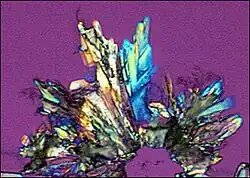
對映體純藥物的齊多夫定晶體屬於單斜晶系中的P21空間群。在分子間的結合上,該結構主要透過兩個N-H...O交互作用形成氫鍵二聚環狀圖案。[48][49]
歷史
醫學界1960年代推測多數癌症由環境中的逆轉錄病毒所引起。美國科學家及諾貝爾獎得主霍華德·馬丁·特明與戴維·巴爾的摩證實鳥類癌症的病毒成因,但人類對應病毒仍未現蹤。[50]同時美國藥理學家喬治·H·希欽斯與格特魯德·B·埃利恩研發出能阻斷核酸合成的藥物,如抗腫瘤藥巰嘌呤。[51]
齊多夫定於1961年由美國生物化學家理查德·E·貝爾茨(Richard E. Beltz)首次合成但未發表。[52][53]美國有機化學家傑羅姆·霍維茨於1964年在美國國家衛生院資助下再次合成齊多夫定,[54][55][56]卻因小鼠實驗無生物活性而遭擱置。[54][57]德國生物學家沃爾夫勒姆·奧斯特塔格(Wolfram Ostertag)於1974年發現齊多夫定能針對 佛蘭德病毒發揮作用,[42]但因當時尚未發現人類逆轉錄病毒疾病,這項發現並未獲得重視 。.[58]
治療愛滋病的研究
位於巴黎的巴斯德研究院研究人員於1983年證實人類免疫缺陷病毒(HIV)是引起愛滋病(AIDS)的元兇。[59][60]隨後,於美國國家癌症研究所(NCI)服務的塞繆爾·布羅德、滿屋裕明與羅伯特·雅芳啟動研發計畫,利用自創的輔助性T細胞株建立篩選平台,藉此測試藥物保護細胞免受病毒侵害的能力,並積極尋求與藥理企業合作。[37][61]
伯勒斯·維康公司藥廠在喬治·H·希欽斯與格特魯德·B·埃利恩等專家的領導下於1984年6月針對反轉錄酶開發藥物。由於當時廠內缺乏HIV檢測環境,研究員瑪蒂·聖克萊爾( Marty St. Clair )先以佛蘭德病毒與哈維肉瘤病毒(Harvey sarcoma virus)作為替代模型,發現齊多夫定能顯著抑制這些病毒。隨後,化學家珍妮特·賴德奧特(Janet Rideout )將齊多夫定選為11種送往NCI測試的候選化合物之一。[58]
NCI於1985年2證實齊多夫定在體外實驗具有強大效力。[37][54]數月後,NCI與杜克大學展開第一期臨床試驗。[38][43][62]研究顯示齊多夫定耐受性良好,能提升患者輔助性T細胞數量,並透過皮膚延遲性過敏反應試驗證實可恢復T細胞功能。此外,臨床發現患者體重增加,且藥物能經由全身給藥達到有效濃度,並進入中樞神經系統。[62][63]
申請專利及取得FDA核准
隨後伯勒斯-威康廠進行齊多夫定的雙盲安慰劑對照隨機對照試驗,證實其能延長愛滋病患者。[63]由於療效極為顯著,該研究基於倫理考量而提前終止,以避免安慰劑組錯失治療機會。[64]
美國食品藥物管理局(FDA)於1987年3月20日核准齊多夫定用於治療愛滋病及愛滋相關綜合症(ARC),從實驗室證實療效到獲批僅歷時25個月.[65]該藥於1990年獲一致通過用於嬰幼兒。初期給藥劑量遠高於現今,通常為每4小時400毫克,而現代標準則為每日兩次,每次300毫克。[66]該臨床試驗在2020年代初期再次於網路社群掀起波瀾,成為一系列網路迷因(一種通過網際網路傳播的文化集合(如一種思想、行為或風格))的攻擊對象,其目的很可能是為抹黑免疫學家安東尼·佛奇。[64]
社會與文化
針對1991年之前的科研資源配置研究顯示,國家衛生院愛滋病臨床試驗組4.2億美元預算中的八成均投入於齊多夫定的研究。從1987年至1993年間,除了兩款相似的藥物ddI與ddC與齊多夫定外,並無其他抗愛滋藥物獲批,而引發外界對過度專注於單一藥物研發而延誤更高效藥物開發的批評。[7]
公民組織Public Citizen於1991年提出訴訟,主張此藥物的專利無效。多家製藥實驗室隨後亦對專利提出挑戰,部分理由是他們認為國家癌症研究院的科學家應被列為共同發明人,並申請銷售學名藥。美國聯邦巡迴區上訴法院於1992年判決伯勒斯·維康公司勝訴,理由是該公司在將藥物送測前即已具備相關作用的構想。這項訴訟案最終上訴至最高法院,但法院於1996年拒絕受理。[67]該案件已成為美國法律中關於發明人資格認定的指標性案例。[68]
愛滋病保健基金會於2002年再次提起訴訟,挑戰專利,並對葛蘭素史克提出反壟斷訴訟。[69]此專利訴訟案於2003年被駁回,隨後該基金會又提出新的挑戰。[69]
葛蘭素史克持有的專利於2005年到期。FDA於同年9月批准三款學名藥製劑。[70]
引用
- ^ Retrovir 100mg Capsules – Summary of Product Characteristics (SmPC). (emc). 2018-12-14 [2021-01-23]. (原始内容存档于2025-12-06).
- ^ Retrovir – zidovudine capsule Retrovir – zidovudine solution Retrovir – zidovudine injection, solution. DailyMed. [2021-01-23]. (原始内容存档于2026-03-07).
- ^ Active substance: Zidovudine (PDF). European Medicines Agency. 2017-11-30 [2026-05-15]. (原始内容存档 (PDF)于2023-07-18).
- ^ Zidovudine from PubChem
- ^ 5.00 5.01 5.02 5.03 5.04 5.05 5.06 5.07 5.08 5.09 5.10 Zidovudine. The American Society of Health-System Pharmacists. [2016-11-28]. (原始内容存档于2016-12-21).
- ^ Fischer J, Ganellin CR. Analogue-based Drug Discovery. John Wiley & Sons. 2006: 505. ISBN 978-3-527-60749-5. (原始内容存档于2017-09-08).
- ^ 7.0 7.1 Marsa L. TOXIC HOPE : WIDELY EMBRACED, THE AIDS DRUG IS NOW UNDER HEAVY FIRE.: THE AZT STORY. Los Angeles Times. 1993-06-20 [2026-05-15]. (原始内容存档于2025-11-29) (美国英语).
- ^ Reeves JD, Derdeyn CA. Entry Inhibitors in HIV Therapy. Springer Science & Business Media. 2007: 179. ISBN 978-3-7643-7783-0.
- ^ The selection and use of essential medicines 2023: web annex A: World Health Organization model list of essential medicines: 23rd list (2023). Geneva: World Health Organization. 2023. hdl:10665/371090
 . WHO/MHP/HPS/EML/2023.02.
- ^ De Clercq E. HIV resistance to reverse transcriptase inhibitors. Biochemical Pharmacology. January 1994, 47 (2): 155–169. PMID 7508227. doi:10.1016/0006-2952(94)90001-9.
- ^ Yarchoan R, Mitsuya H, Broder S. AIDS therapies. Scientific American. October 1988, 259 (4): 110–119. Bibcode:1988SciAm.259d.110Y. PMID 3072667. doi:10.1038/scientificamerican1088-110.
- ^ Phanuphak N, Gulick RM. HIV treatment and prevention 2019: current standards of care. Current Opinion in HIV and AIDS. January 2020, 15 (1): 4–12. PMID 31658110. S2CID 204952772. doi:10.1097/COH.0000000000000588.
- ^ Panlilio AL, Cardo DM, Grohskopf LA, Heneine W, Ross CS. Updated U.S. Public Health Service guidelines for the management of occupational exposures to HIV and recommendations for postexposure prophylaxis (PDF). MMWR Recomm Rep. September 2005, 54 (RR-9): 1–17 [2026-05-15]. PMID 16195697. (原始内容存档 (PDF)于2020-07-31).
- ^ UK guideline for the use of post-exposure prophylaxis for HIV following sexual exposure (2011). [2014-04-07]. (原始内容存档于2014-04-08).
- ^ Recommendations for Use of Antiretroviral Drugs in Pregnant HIV-1-Infected Women for Maternal Health (PDF). AIDSinfo. U.S. Department of Health and Human Services. 2005-11-17 [2006-03-29]. (原始内容 (PDF)存档于2006 -04-22).
- ^ Briand N, Lallemant M, Jourdain G, Techapalokul S, Tunthanathip P, Suphanich S, Chanpoo T, Traisathit P, McIntosh K, Le Coeur S. Haematological safety of perinatal zidovudine in pregnant HIV-1-infected women in Thailand: secondary analysis of a randomized trial. PLOS Clinical Trials. April 2007, 2 (4): e11. PMC 1863515 . PMID 17476315. doi:10.1371/journal.pctr.0020011 .
- ^ CIDRZ. Prevention of AIDS Transmission (PMTCT). Prevention of mother-to-child HIV transmission (PMTCT) | CIDRZ. [2012-03-31]. (原始内容存档于2012-02-14).
- ^ Transmission of HIV from infants Transmission of HIV from infants to women who breastfeed them.. Aids Perspective. 2012-07-01 [2012-08-03]. (原始内容存档于2013-12-03).
- ^ Connor E, Sperling R, Gelber R, Kiselev P, Scott G, O'Sullivan M, VanDyke R, Bey M, Shearer W, Jacobson R. Reduction of maternal-infant transmission of human immunodeficiency virus type 1 with zidovudine treatment. Pediatric AIDS Clinical Trials Group Protocol 076 Study Group. N Engl J Med. 1994, 331 (18): 1173–80. PMID 7935654. S2CID 13457499. doi:10.1056/NEJM199411033311801 .
- ^ Walensky RP, Paltiel AD, Losina E, Mercincavage LM, Schackman BR, Sax PE, Weinstein MC, Freedberg KA. The survival benefits of AIDS treatment in the United States. The Journal of Infectious Diseases. July 2006, 194 (1): 11–19. PMID 16741877. doi:10.1086/505147 .
- ^ Morris K. Short course of AZT halves HIV-1 perinatal transmission. Lancet. February 1998, 351 (9103): 651. PMID 9500334. S2CID 8293828. doi:10.1016/S0140-6736(05)78436-1.
- ^ 22.0 22.1 Crane J. Adverse events and placebo effects: African scientists, HIV, and ethics in the 'global health sciences'. Social Studies of Science. December 2010, 40 (6): 843–870. PMID 21553555. S2CID 26027925. doi:10.1177/0306312710371145.
- ^ DeSarno AE, Parcell BJ, Coote PJ. Repurposing the anti-viral drug zidovudine (AZT) in combination with meropenem as an effective treatment for infections with multi-drug resistant, carbapenemase-producing strains of Klebsiella pneumoniae. Pathogens and Disease. December 2020, 78 (9). PMID 33053176. doi:10.1093/femspd/ftaa063 . hdl:10023/24137 . 已忽略未知参数
|article-number=(帮助) - ^ Zhou YF, Liu P, Dai SH, Sun J, Liu YH, Liao XP. Activity of Tigecycline or Colistin in Combination with Zidovudine against Escherichia coli Harboring tet(X) and mcr-1. Antimicrobial Agents and Chemotherapy. December 2020, 65 (1). PMC 7927862 . PMID 33020156. doi:10.1128/AAC.01172-20. 已忽略未知参数
|article-number=(帮助) - ^ Antonello RM, Di Bella S, Betts J, La Ragione R, Bressan R, Principe L, Morabito S, Gigliucci F, Tozzoli R, Busetti M, Knezevich A, Furlanis L, Fontana F, Luzzaro F, Luzzati R, Lagatolla C. Zidovudine in synergistic combination with fosfomycin: an in vitro and in vivo evaluation against multidrug-resistant Enterobacterales. International Journal of Antimicrobial Agents. July 2021, 58 (1). PMID 34010710. S2CID 234791392. doi:10.1016/j.ijantimicag.2021.106362. 已忽略未知参数
|article-number=(帮助) - ^ zidovudine, Retrovir. Medicinenet.com. August 12, 2010 [December 14, 2010]. (原始内容存档于2010-12-20).
- ^ Sun R, Eriksson S, Wang L. Identification and characterization of mitochondrial factors modulating thymidine kinase 2 activity. Nucleosides, Nucleotides & Nucleic Acids. June 2010, 29 (4–6): 382–385. PMID 20544523. S2CID 13539181. doi:10.1080/15257771003741018.
- ^ Scruggs ER, Dirks Naylor AJ. Mechanisms of zidovudine-induced mitochondrial toxicity and myopathy. Pharmacology. 2008, 82 (2): 83–88. PMID 18504416. S2CID 2044833. doi:10.1159/000134943 .
- ^ Fisher JW. Erythropoietin: physiologic and pharmacologic aspects. Proceedings of the Society for Experimental Biology and Medicine. December 1997, 216 (3): 358–369. PMID 9402140. S2CID 26177904. doi:10.3181/00379727-216-44183.
- ^ Fisher JW. Erythropoietin: physiology and pharmacology update. Experimental Biology and Medicine. January 2003, 228 (1): 1–14. PMID 12524467. S2CID 2829677. doi:10.1177/153537020322800101.
- ^ ZIDOVUDINE (AZT) – ORAL (Retrovir) side effects, medical uses, and drug interactions. MedicineNet. [2006-01-09]. (原始内容存档于2005-06-30).
- ^ Side Effects. NAM Aidsmap. Zidovudine (AZT, Retrovir). [2012-03-28]. (原始内容存档于2011-12-26).
- ^ Summary of Data Reported and Evaluation. 2000 [2012-08-11]. (原始内容存档于2012-01-04).
- ^ State of California Environmental Protection Agency Office of Environmental Hazard Assessment Safe Drinking Water and Toxic Enforcement Act of 1986 Chemicals Known to the State to Cause Cancer or Reproductive Toxicity July 29, 1011 (PDF). 2011-07-29 [2022-11-14]. (原始内容存档 (PDF)于2024-05-25).
- ^ Richman DD. Susceptibility to nucleoside analogues of zidovudine-resistant isolates of human immunodeficiency virus. The American Journal of Medicine. May 1990, 88 (5B): 8S–10S. PMID 2186629. doi:10.1016/0002-9343(90)90414-9.
- ^ Wainberg MA, Brenner BG, Turner D. Changing patterns in the selection of viral mutations among patients receiving nucleoside and nucleotide drug combinations directed against human immunodeficiency virus type 1 reverse transcriptase. Antimicrobial Agents and Chemotherapy. May 2005, 49 (5): 1671–1678. PMC 1087622 . PMID 15855480. doi:10.1128/AAC.49.5.1671-1678.2005.
- ^ 37.0 37.1 37.2 37.3 Mitsuya H, Weinhold KJ, Furman PA, St Clair MH, Lehrman SN, Gallo RC, Bolognesi D, Barry DW, Broder S. 3'-Azido-3'-deoxythymidine (BW A509U): an antiviral agent that inhibits the infectivity and cytopathic effect of human T-lymphotropic virus type III/lymphadenopathy-associated virus in vitro. Proceedings of the National Academy of Sciences of the United States of America. October 1985, 82 (20): 7096–7100. Bibcode:1985PNAS...82.7096M. PMC 391317 . PMID 2413459. doi:10.1073/pnas.82.20.7096 .
- ^ 38.0 38.1 Yarchoan R, Klecker R, Weinhold K, Markham P, Lyerly H, Durack D, Gelmann E, Lehrman S, Blum R, Barry D. Administration of 3'-azido-3'-deoxythymidine, an inhibitor of HTLV-III/LAV replication, to patients with AIDS or AIDS-related complex. Lancet. 1986, 1 (8481): 575–80. PMID 2869302. S2CID 37985276. doi:10.1016/S0140-6736(86)92808-4.
- ^ Mitsuya H, Yarchoan R, Broder S. Molecular targets for AIDS therapy. Science (Submitted manuscript). 1990, 249 (4976): 1533–44 [2026-05-15]. Bibcode:1990Sci...249.1533M. PMID 1699273. doi:10.1126/science.1699273. (原始内容存档于2020-09-23).
- ^ Quan Y, Rong L, Liang C, Wainberg MA. Reverse transcriptase inhibitors can selectively block the synthesis of differently sized viral DNA transcripts in cells acutely infected with human immunodeficiency virus type 1. Journal of Virology. August 1999, 73 (8): 6700–6707. PMC 112754 . PMID 10400767. doi:10.1128/JVI.73.8.6700-6707.1999.
- ^ Furman PA, Fyfe JA, St Clair MH, Weinhold K, Rideout JL, Freeman GA, Lehrman SN, Bolognesi DP, Broder S, Mitsuya H. Phosphorylation of 3'-azido-3'-deoxythymidine and selective interaction of the 5'-triphosphate with human immunodeficiency virus reverse transcriptase. Proceedings of the National Academy of Sciences of the United States of America. November 1986, 83 (21): 8333–8337. Bibcode:1986PNAS...83.8333F. PMC 386922 . PMID 2430286. doi:10.1073/pnas.83.21.8333 .
- ^ 42.0 42.1 Ostertag W, Roesler G, Krieg CJ, Kind J, Cole T, Crozier T, Gaedicke G, Steinheider G, Kluge N, Dube S. Induction of endogenous virus and of thymidine kinase by bromodeoxyuridine in cell cultures transformed by Friend virus. Proceedings of the National Academy of Sciences of the United States of America. December 1974, 71 (12): 4980–4985. Bibcode:1974PNAS...71.4980O. PMC 434023 . PMID 4531031. doi:10.1073/pnas.71.12.4980 .
- ^ 43.0 43.1 Yarchoan R, Mitsuya H, Myers C, Broder S. Clinical pharmacology of 3'-azido-2',3'-dideoxythymidine (zidovudine) and related dideoxynucleosides. N Engl J Med. 1989, 321 (11): 726–38. PMID 2671731. doi:10.1056/NEJM198909143211106.
- ^ Collins ML, Sondel N, Cesar D, Hellerstein MK. Effect of nucleoside reverse transcriptase inhibitors on mitochondrial DNA synthesis in rats and humans. Journal of Acquired Immune Deficiency Syndromes. September 2004, 37 (1): 1132–1139. PMID 15319672. S2CID 20020419. doi:10.1097/01.qai.0000131585.77530.64 .
- ^ Parker WB, White EL, Shaddix SC, Ross LJ, Buckheit RW, Germany JM, Secrist JA, Vince R, Shannon WM. Mechanism of inhibition of human immunodeficiency virus type 1 reverse transcriptase and human DNA polymerases alpha, beta, and gamma by the 5'-triphosphates of carbovir, 3'-azido-3'-deoxythymidine, 2',3'-dideoxyguanosine and 3'-deoxythymidine. A novel RNA template for the evaluation of antiretroviral drugs. The Journal of Biological Chemistry. January 1991, 266 (3): 1754–1762. PMID 1703154. doi:10.1016/S0021-9258(18)52360-7 .
- ^ Rang HP, Dale MM, Ritter JM. Pharmacology 3rd. Pearson Professional Ltd. 1995. ISBN 978-0-443-05974-2.
- ^ Balzarini J, Naesens L, Aquaro S, Knispel T, Perno C, De Clercq E, Meier C. Intracellular metabolism of CycloSaligenyl 3'-azido-2', 3'-dideoxythymidine monophosphate, a prodrug of 3'-azido-2', 3'-dideoxythymidine (zidovudine)
 . Molecular Pharmacology. December 1999, 56 (6): 1354–1361. PMID 10570065. S2CID 25678740. doi:10.1124/mol.56.6.1354. (原始内容存档于2007-09-21).
- ^ Dyer I, Low JN, Tollin P, Wilson HR, Howie RA. Structure of 3'-azido-3'-deoxythymidine, AZT. Acta Crystallogr C. April 1988, 44 (4): 767–9. Bibcode:1988AcCrC..44..767D. PMID 3271074. doi:10.1107/S0108270188000368.
- ^ Camerman A, Mastropaolo D, Camerman N. Azidothymidine: crystal structure and possible functional role of the azido group. Proc Natl Acad Sci USA. 1987, 84 (23): 8239–8242. Bibcode:1987PNAS...84.8239C. PMC 299517 . PMID 2446321. doi:10.1073/pnas.84.23.8239 .
- ^ The Nobel Prize in Physiology or Medicine 1975. NobelPrize.org. (原始内容存档于2017-01-03).
- ^ The Purine Path To Chemotherapy (PDF). (原始内容 (PDF)存档于August 8, 2017).
- ^ Marsa L. Toxic Hope: Widely Embraced, the AIDS Drug is now under Heavy Fire. Los Angeles Times. 1993-06-20 [2026-05-15]. (原始内容存档于2025-11-29).
- ^ Brinck A. Inventing AZT (PDF). [2026-05-15]. (原始内容存档 (PDF)于2025-12-02).
- ^ 54.0 54.1 54.2 Broder S. The development of antiretroviral therapy and its impact on the HIV-1/AIDS pandemic. Antiviral Research. January 2010, 85 (1): 1–18. PMC 2815149 . PMID 20018391. doi:10.1016/j.antiviral.2009.10.002.
- ^ Horwitz JP, Chua J, Noel MJ. The monomesylates of 1-(2-deoxy-bd-lyxofuranosyl) thymines. Org. Chem. Ser. Monogr. 1964, 29 (7): 2076–9. doi:10.1021/jo01030a546.
- ^ Detours V; Henry D (writers/directors). I am alive today (history of an AIDS drug) (Film). ADR Productions/Good & Bad News. 2002.
- ^ A Failure Led to Drug Against AIDS. The New York Times. 1986-09-20 [June 30, 2010]. (原始内容存档于2009-08-16).
- ^ 58.0 58.1 Sneader W. Drug Discovery – A History
 . Wiley. 2006: 260–261. ISBN 978-0-471-89980-8.
- ^ Weiss RA. How does HIV cause AIDS?. Science. May 1993, 260 (5112): 1273–1279. Bibcode:1993Sci...260.1273W. PMID 8493571. doi:10.1126/science.8493571.
- ^ Douek DC, Roederer M, Koup RA. Emerging concepts in the immunopathogenesis of AIDS. Annual Review of Medicine. 2009, 60: 471–484. PMC 2716400 . PMID 18947296. doi:10.1146/annurev.med.60.041807.123549.
- ^ NIH Clinical Center's 50th Anniversary. Clinical Center 50th Anniversary Celebration (PDF). [2012-04-18]. (原始内容 (PDF)存档于2013-06-19).
- ^ 62.0 62.1 Yarchoan R, Klecker RW, Weinhold KJ, Markham PD, Lyerly HK, Durack DT, Gelmann E, Lehrman SN, Blum RM, Barry DW. Administration of 3'-azido-3'-deoxythymidine, an inhibitor of HTLV-III/LAV replication, to patients with AIDS or AIDS-related complex. Lancet. 1986, 1 (8481): 575–80. PMID 2869302. S2CID 37985276. doi:10.1016/s0140-6736(86)92808-4.
- ^ 63.0 63.1 Fischl MA, Richman DD, Grieco MH, Gottlieb MS, Volberding PA, Laskin OL, Leedom JM, Groopman JE, Mildvan D, Schooley RT. The efficacy of azidothymidine (AZT) in the treatment of patients with AIDS and AIDS-related complex. A double-blind, placebo-controlled trial. The New England Journal of Medicine. July 1987, 317 (4): 185–191. PMID 3299089. doi:10.1056/NEJM198707233170401.
- ^ 64.0 64.1 Did Controversial AZT Treatment Kill More Patients than AIDS in '80s, '90s?. 2021-09-21 [2026-05-15]. (原始内容存档于2025-12-06).
- ^ Cimons M. U.S. Approves Sale of AZT to AIDS Patients. Los Angeles Times. 1987-03-21: 1.
- ^ Zidovudine (AZT) | Johns Hopkins ABX Guide. [2026-05-15]. (原始内容存档于2025-11-04).
- ^ Greenhouse L. Supreme Court Roundup;Justices Reject Challenge Of Patent for AIDS Drug. The New York Times. J1996-01-17. (原始内容存档于2016-11-17).
- ^ Armstrong M, Murphy Jr GM. Inventorship and ownership considerations and pitfalls with collaborative research: patent highlight.. ACS Medicinal Chemistry Letters. 2012-04-26, 3 (5): 349–51. PMC 4025834 . PMID 24900477. doi:10.1021/ml300084e.
- ^ 69.0 69.1 Meland M. Judge Denies Request To Dismiss Patent Challenge Vs. Glaxo's AZT – Law360. Law360. 2004-5-03. (原始内容存档于2016-11-17).
- ^ HIV/AIDS History of Approvals – HIV/AIDS Historical Time Line 2000 – 2010. U.S. Food and Drug Administration (FDA). 2014-08-08. (原始内容存档于2016-10-23).
外部連結
- Zidovudine. Drug Information Portal. U.S. National Library of Medicine. (原始内容存档于2016-08-18).
| 附屬公司 |
| ||||||||||
|---|---|---|---|---|---|---|---|---|---|---|---|
| 前身及完全整合收購 |
| ||||||||||
| 產品(列表) |
| ||||||||||
| 相關人物 |
| ||||||||||
| 其它相關 |
| ||||||||||

