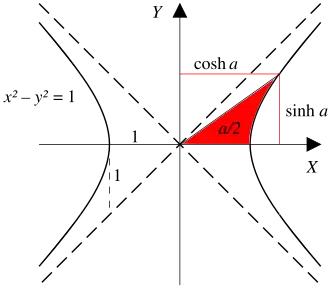
射線出原點交單位雙曲線
x
2
−
y
2
=
1
{\displaystyle x^{2}-y^{2}=1}
(
cosh
a
,
sinh
a
)
{\displaystyle (\cosh a,\sinh a)}
a
{\displaystyle a}
在数学 中,双曲函数 是一类与常见的三角函数 (也叫圆函数)类似的函数。最基本的双曲函数是雙曲正弦 函数
sinh
{\displaystyle \sinh }
雙曲餘弦 函数
cosh
{\displaystyle \cosh }
双曲正切 函数
tanh
{\displaystyle \tanh }
双曲函数的定义域是实数,其自变量的值叫做双曲角。双曲函数出现于某些重要的线性微分方程 的解中,譬如說定义悬链线 和拉普拉斯方程 。
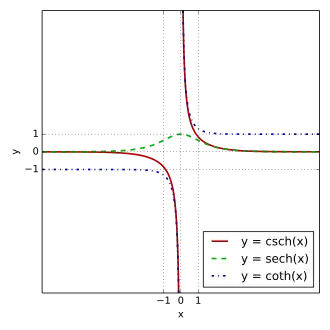
sinh 、cosh 和tanh csch 、sech 和coth 最簡單的幾種雙曲函數為[ 1]
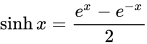
雙曲正弦:
sinh
x
=
e
x
−
e
−
x
2
{\displaystyle \sinh x={\frac {e^{x}-e^{-x}}{2}}}
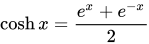
雙曲餘弦:
cosh
x
=
e
x
+
e
−
x
2
{\displaystyle \cosh x={\frac {e^{x}+e^{-x}}{2}}}
雙曲正切 :
tanh
x
=
sinh
x
cosh
x
=
e
x
−
e
−
x
e
x
+
e
−
x
=
e
2
x
−
1
e
2
x
+
1
.
{\displaystyle \tanh x={\frac {\sinh x}{\cosh x}}={\frac {e^{x}-e^{-x}}{e^{x}+e^{-x}}}={\frac {e^{2x}-1}{e^{2x}+1}}.}
雙曲餘切 :當
x
≠
0
{\displaystyle x\neq 0}
coth
x
=
cosh
x
sinh
x
=
e
x
+
e
−
x
e
x
−
e
−
x
=
e
2
x
+
1
e
2
x
−
1
.
{\displaystyle \coth x={\frac {\cosh x}{\sinh x}}={\frac {e^{x}+e^{-x}}{e^{x}-e^{-x}}}={\frac {e^{2x}+1}{e^{2x}-1}}.}
雙曲正割 :
sech
x
=
1
cosh
x
=
2
e
x
+
e
−
x
=
2
e
x
e
2
x
+
1
.
{\displaystyle \operatorname {sech} x={\frac {1}{\cosh x}}={\frac {2}{e^{x}+e^{-x}}}={\frac {2e^{x}}{e^{2x}+1}}.}
雙曲餘割 :當
x
≠
0
{\displaystyle x\neq 0}
csch
x
=
1
sinh
x
=
2
e
x
−
e
−
x
=
2
e
x
e
2
x
−
1
.
{\displaystyle \operatorname {csch} x={\frac {1}{\sinh x}}={\frac {2}{e^{x}-e^{-x}}}={\frac {2e^{x}}{e^{2x}-1}}.}
函数
cosh
x
{\displaystyle \cosh x}
偶函数 。函数
sinh
x
{\displaystyle \sinh x}
奇函数 。
如同当
t
{\displaystyle t}
实数集
R
{\displaystyle \mathbb {R} }
cos
t
{\displaystyle \cos t}
sin
t
{\displaystyle \sin t}
圆
x
2
+
y
2
=
1
{\displaystyle x^{2}+y^{2}=1}
t
{\displaystyle t}
R
{\displaystyle \mathbb {R} }
cosh
t
{\displaystyle \cosh t}
sinh
t
{\displaystyle \sinh t}
x
2
−
y
2
=
1
{\displaystyle x^{2}-y^{2}=1}
cosh
2
t
−
sinh
2
t
=
1
{\displaystyle \cosh ^{2}t-\sinh ^{2}t=1}
参数t 不是圆角 而是双曲角,它表示在x 轴和连接原点和双曲线上的点(
cosh
t
{\displaystyle \cosh t}
sinh
t
{\displaystyle \sinh t}
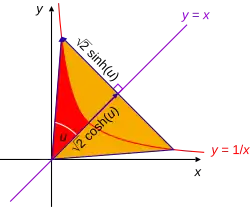
在直角雙曲線(方程
y
=
1
x
{\displaystyle y={1 \over x}}
u 的雙曲線扇形(紅色)。這個三角形的邊分別是雙曲函數 中
cosh
{\displaystyle \cosh }
sinh
{\displaystyle \sinh }
2
{\displaystyle {\sqrt {2}}}
在18世紀,約翰·海因里希·蘭伯特引入雙曲函數[ 2] 雙曲幾何 中雙曲三角形的面積[ 3] 自然對數 函數是在直角雙曲線
x
y
=
1
{\displaystyle xy=1}
y
=
x
{\displaystyle y=x}
自然對數 即雙曲角作為參數的函數,是自然對數的逆函數指數函數 ,即要形成指定雙曲角
u
{\displaystyle u}
x
{\displaystyle x}
y
{\displaystyle y}
(
e
u
+
e
−
u
)
2
2
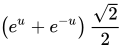
{\displaystyle \left(e^{u}+e^{-u}\right){\frac {\sqrt {2}}{2}}}
(
e
u
−
e
−
u
)
2
2
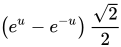
{\displaystyle \left(e^{u}-e^{-u}\right){\frac {\sqrt {2}}{2}}}
通過旋轉和縮小線性變換 ,得到單位雙曲線下的情況,有:
cosh
u
=
e
u
+
e
−
u
2
{\displaystyle \cosh u={\frac {e^{u}+e^{-u}}{2}}}
sinh
u
=
e
u
−
e
−
u
2
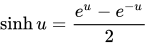
{\displaystyle \sinh u={\frac {e^{u}-e^{-u}}{2}}}
單位雙曲線中雙曲線扇形的面積是對應直角雙曲線
x
y
=
1
{\displaystyle xy=1}
1
2
{\displaystyle {1 \over 2}}
雙曲角經常定義得如同虛數 圓角 。實際上,如果
x
{\displaystyle x}
i
2
=
−
1
{\displaystyle i^{2}=-1}
cos
(
i
x
)
=
cosh
(
x
)
,
{\displaystyle \cos(ix)=\cosh(x),\quad }
−
i
sin
(
i
x
)
=
sinh
(
x
)
.
{\displaystyle -i\sin(ix)=\sinh(x).}
所以雙曲函數
cosh
{\displaystyle \cosh }
sinh
{\displaystyle \sinh }
圓函數 來定義。這些恆等式不是從圓或旋轉得來的,它們應當以無窮級數 的方式來理解。特別是,可以將指數函數 表達為由偶次項和奇次項組成,前者形成
cosh
{\displaystyle \cosh }
sinh
{\displaystyle \sinh }
cos
{\displaystyle \cos }
cosh
{\displaystyle \cosh }
sin
{\displaystyle \sin }
sinh
{\displaystyle \sinh }
i
{\displaystyle i}
(
−
1
)
n
{\displaystyle (-1)^{n}}
e
x
=
cosh
x
+
sinh
x
{\displaystyle e^{x}=\cosh x+\sinh x\!}
cosh
x
=
∑
n
=
0
∞
x
2
n
(
2
n
)
!
sinh
x
=
∑
n
=
0
∞
x
2
n
+
1
(
2
n
+
1
)
!
cos
x
=
∑
n
=
0
∞
(
−
1
)
n
x
2
n
(
2
n
)
!
sin
x
=
∑
n
=
0
∞
(
−
1
)
n
x
2
n
+
1
(
2
n
+
1
)
!
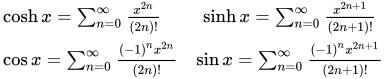
{\displaystyle {\begin{array}{lcl}\cosh x=\sum _{n=0}^{\infty }{\frac {x^{2n}}{(2n)!}}&\sinh x=\sum _{n=0}^{\infty }{\frac {x^{2n+1}}{(2n+1)!}}\\\cos x=\sum _{n=0}^{\infty }{\frac {(-1)^{n}x^{2n}}{(2n)!}}&\sin x=\sum _{n=0}^{\infty }{\frac {(-1)^{n}x^{2n+1}}{(2n+1)!}}\\\end{array}}}
雙曲函數可以通過虛數圓角定義為:
雙曲正弦:[ 1]
sinh
x
=
−
i
sin
(
i
x
)
{\displaystyle \sinh x=-i\sin(ix)\!}
雙曲餘弦:[ 1]
cosh
x
=
cos
(
i
x
)
{\displaystyle \cosh x=\cos(ix)\!}
雙曲正切:
tanh
x
=
−
i
tan
(
i
x
)
{\displaystyle \tanh x=-i\tan(ix)\!}
雙曲餘切:
coth
x
=
i
cot
(
i
x
)
{\displaystyle \coth x=i\cot(ix)\!}
雙曲正割:
sech
x
=
sec
(
i
x
)
{\displaystyle \operatorname {sech} x=\sec(ix)\!}
雙曲餘割:
csch
x
=
i
csc
(
i
x
)
{\displaystyle \operatorname {csch} x=i\csc(ix)\!}
這些複數 形式的定義得出自歐拉公式 。
奧古斯都·德·摩根在其1849年出版的教科書《Trigonometry and Double Algebra》中將圓三角學 擴展到了雙曲線 [ 4]
給定相同的角α,在雙曲線上計算雙曲角的量值(雙曲扇形面積 除以半徑 )得到雙曲函數,角
α
{\displaystyle \alpha }
三角函數 。在單位圓 和單位雙曲線上,双曲函数与三角函数 有如下的关係:
正弦 同樣是從x軸 到曲線 的半弦 。餘弦 同樣是從y軸 到曲線 的半弦 (圖中的餘弦 是長方形 的另一條邊 )。正切 同樣是過x軸 上單位點(1,0)在曲線上的切線 到終邊的長度。餘切同樣是從y軸 與過終邊和曲線交點的切線 與y軸 的交點和曲線連線之長度 。
正割同樣是在一個有正切 和單位長的直角三角形 上,但邊不一樣。
餘割同樣是y軸 與過終邊和曲線交點的切線 與y軸 的交點和原點之距離 。
角的量值可以從0到無限大,但
α
{\displaystyle \alpha }
0
{\displaystyle 0}
2
π
{\displaystyle 2\pi }
度 )之間,其餘是
α
{\displaystyle \alpha }
0
{\displaystyle 0}
α
{\displaystyle \alpha }
π
4
{\displaystyle {\frac {\pi }{4}}}
度 ),故無法如三角函數一樣有周期性。
与双曲函数有关的恆等式 如下:
cosh
2
x
−
sinh
2
x
=
1
1
−
tanh
2
x
=
sech
2
x
coth
2
x
−
1
=
csch
2
x
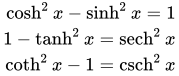
{\displaystyle {\begin{aligned}\cosh ^{2}x-\sinh ^{2}x=1\\1-\tanh ^{2}x=\operatorname {sech} ^{2}x\\\operatorname {coth} ^{2}x-1=\operatorname {csch} ^{2}x\\\end{aligned}}}
sinh
(
x
+
y
)
=
sinh
x
cosh
y
+
cosh
x
sinh
y
{\displaystyle \sinh(x+y)=\sinh x\cosh y+\cosh x\sinh y}
cosh
(
x
+
y
)
=
cosh
x
cosh
y
+
sinh
x
sinh
y
{\displaystyle \cosh(x+y)=\cosh x\cosh y+\sinh x\sinh y}
tanh
(
x
+
y
)
=
tanh
x
+
tanh
y
1
+
tanh
x
tanh
y
{\displaystyle \tanh(x+y)={\frac {\tanh x+\tanh y}{1+\tanh x\tanh y}}}
sinh
2
x
=
2
sinh
x
cosh
x
{\displaystyle \sinh 2x\ =2\sinh x\cosh x}
cosh
2
x
=
cosh
2
x
+
sinh
2
x
=
2
cosh
2
x
−
1
=
2
sinh
2
x
+
1
{\displaystyle \cosh 2x\ =\cosh ^{2}x+\sinh ^{2}x=2\cosh ^{2}x-1=2\sinh ^{2}x+1}
tanh
2
x
=
2
tanh
x
1
+
tanh
2
x
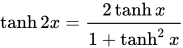
{\displaystyle \tanh 2x={\frac {2\tanh x}{1+\tanh ^{2}x}}}
sinh
x
+
sinh
y
=
2
sinh
(
x
+
y
2
)
cosh
(
x
−
y
2
)
cosh
x
+
cosh
y
=
2
cosh
(
x
+
y
2
)
cosh
(
x
−
y
2
)
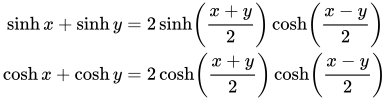
{\displaystyle {\begin{aligned}\sinh x+\sinh y&=2\sinh \left({\frac {x+y}{2}}\right)\cosh \left({\frac {x-y}{2}}\right)\\\cosh x+\cosh y&=2\cosh \left({\frac {x+y}{2}}\right)\cosh \left({\frac {x-y}{2}}\right)\\\end{aligned}}}
sinh
x
2
=
sinh
x
2
(
cosh
x
+
1
)
=
sgn
x
cosh
x
−
1
2
{\displaystyle \sinh {\frac {x}{2}}={\frac {\sinh x}{\sqrt {2(\cosh x+1)}}}=\operatorname {sgn} x\,{\sqrt {\frac {\cosh x-1}{2}}}}
cosh
x
2
=
cosh
x
+
1
2
{\displaystyle \cosh {\frac {x}{2}}={\sqrt {\frac {\cosh x+1}{2}}}}
tanh
x
2
=
sinh
x
cosh
x
+
1
=
sgn
x
cosh
x
−
1
cosh
x
+
1
=
e
x
−
1
e
x
+
1
{\displaystyle \tanh {\frac {x}{2}}={\frac {\sinh x}{\cosh x+1}}=\operatorname {sgn} x\,{\sqrt {\frac {\cosh x-1}{\cosh x+1}}}={\frac {e^{x}-1}{e^{x}+1}}}
其中 sgn
若 x ≠ 0
tanh
x
2
=
cosh
x
−
1
sinh
x
=
coth
x
−
csch
x
{\displaystyle \tanh {\frac {x}{2}}={\frac {\cosh x-1}{\sinh x}}=\coth x-\operatorname {csch} x}
由于雙曲函數和三角函数之间的对应关系,雙曲函數的恆等式和三角函數的恒等式之间也是一一对应的。对于一个已知的三角函数公式,只需要將其中的三角函數轉成相應的雙曲函數,并将含有有兩個
sinh
{\displaystyle \sinh }
coth
2
x
,
tanh
2
x
,
csch
2
x
,
sinh
x
sinh
y
{\displaystyle \coth ^{2}x,\tanh ^{2}x,\operatorname {csch} ^{2}x,\sinh x\sinh y}
[ 5]
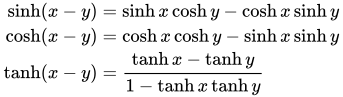
三角函数的三倍角公式为:
sin
3
x
=
3
sin
x
−
4
sin
3
x
{\displaystyle \sin 3x\ =3\sin x-4\sin ^{3}x}
cos
3
x
=
−
3
cos
x
+
4
cos
3
x
{\displaystyle \cos 3x\ =-3\cos x+4\cos ^{3}x}
而对应的双曲函数三倍角公式则是:
sinh
3
x
=
3
sinh
x
+
4
sinh
3
x
{\displaystyle \sinh 3x\ =3\sinh x+4\sinh ^{3}x}
cosh
3
x
=
−
3
cosh
x
+
4
cosh
3
x
{\displaystyle \cosh 3x\ =-3\cosh x+4\cosh ^{3}x}
sinh
(
x
−
y
)
=
sinh
x
cosh
y
−
cosh
x
sinh
y
cosh
(
x
−
y
)
=
cosh
x
cosh
y
−
sinh
x
sinh
y
tanh
(
x
−
y
)
=
tanh
x
−
tanh
y
1
−
tanh
x
tanh
y
{\displaystyle {\begin{aligned}\sinh(x-y)&=\sinh x\cosh y-\cosh x\sinh y\\\cosh(x-y)&=\cosh x\cosh y-\sinh x\sinh y\\\tanh(x-y)&={\frac {\tanh x-\tanh y}{1-\tanh x\tanh y}}\\\end{aligned}}}
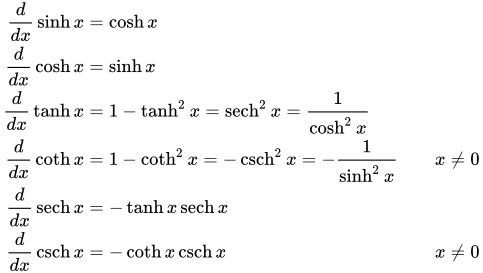
d
d
x
sinh
x
=
cosh
x
d
d
x
cosh
x
=
sinh
x
d
d
x
tanh
x
=
1
−
tanh
2
x
=
sech
2
x
=
1
cosh
2
x
d
d
x
coth
x
=
1
−
coth
2
x
=
−
csch
2
x
=
−
1
sinh
2
x
x
≠
0
d
d
x
sech
x
=
−
tanh
x
sech
x
d
d
x
csch
x
=
−
coth
x
csch
x
x
≠
0
{\displaystyle {\begin{aligned}{\frac {d}{dx}}\sinh x&=\cosh x\\{\frac {d}{dx}}\cosh x&=\sinh x\\{\frac {d}{dx}}\tanh x&=1-\tanh ^{2}x=\operatorname {sech} ^{2}x={\frac {1}{\cosh ^{2}x}}\\{\frac {d}{dx}}\coth x&=1-\coth ^{2}x=-\operatorname {csch} ^{2}x=-{\frac {1}{\sinh ^{2}x}}&&x\neq 0\\{\frac {d}{dx}}\operatorname {sech} x&=-\tanh x\operatorname {sech} x\\{\frac {d}{dx}}\operatorname {csch} x&=-\coth x\operatorname {csch} x&&x\neq 0\end{aligned}}}
雙曲函數也可以以泰勒級數 展開:
sinh
x
=
x
+
x
3
3
!
+
x
5
5
!
+
x
7
7
!
+
⋯
=
∑
n
=
0
∞
x
2
n
+
1
(
2
n
+
1
)
!
{\displaystyle \sinh x=x+{\frac {x^{3}}{3!}}+{\frac {x^{5}}{5!}}+{\frac {x^{7}}{7!}}+\cdots =\sum _{n=0}^{\infty }{\frac {x^{2n+1}}{(2n+1)!}}}
cosh
x
=
1
+
x
2
2
!
+
x
4
4
!
+
x
6
6
!
+
⋯
=
∑
n
=
0
∞
x
2
n
(
2
n
)
!
{\displaystyle \cosh x=1+{\frac {x^{2}}{2!}}+{\frac {x^{4}}{4!}}+{\frac {x^{6}}{6!}}+\cdots =\sum _{n=0}^{\infty }{\frac {x^{2n}}{(2n)!}}}
tanh
x
=
x
−
x
3
3
+
2
x
5
15
−
17
x
7
315
+
⋯
=
∑
n
=
1
∞
2
2
n
(
2
2
n
−
1
)
B
2
n
x
2
n
−
1
(
2
n
)
!
,
|
x
|
<
π
2
{\displaystyle \tanh x=x-{\frac {x^{3}}{3}}+{\frac {2x^{5}}{15}}-{\frac {17x^{7}}{315}}+\cdots =\sum _{n=1}^{\infty }{\frac {2^{2n}(2^{2n}-1)B_{2n}x^{2n-1}}{(2n)!}},\left|x\right|<{\frac {\pi }{2}}}
coth
x
=
1
x
+
x
3
−
x
3
45
+
2
x
5
945
+
⋯
=
1
x
+
∑
n
=
1
∞
2
2
n
B
2
n
x
2
n
−
1
(
2
n
)
!
,
0
<
|
x
|
<
π
{\displaystyle \coth x={\frac {1}{x}}+{\frac {x}{3}}-{\frac {x^{3}}{45}}+{\frac {2x^{5}}{945}}+\cdots ={\frac {1}{x}}+\sum _{n=1}^{\infty }{\frac {2^{2n}B_{2n}x^{2n-1}}{(2n)!}},0<\left|x\right|<\pi }
sech
x
=
1
−
x
2
2
+
5
x
4
24
−
61
x
6
720
+
⋯
=
∑
n
=
0
∞
E
2
n
x
2
n
(
2
n
)
!
,
|
x
|
<
π
2
{\displaystyle \operatorname {sech} \,x=1-{\frac {x^{2}}{2}}+{\frac {5x^{4}}{24}}-{\frac {61x^{6}}{720}}+\cdots =\sum _{n=0}^{\infty }{\frac {E_{2n}x^{2n}}{(2n)!}},\left|x\right|<{\frac {\pi }{2}}}
csch
x
=
1
x
−
x
6
+
7
x
3
360
−
31
x
5
15120
+
⋯
=
1
x
+
∑
n
=
1
∞
2
(
1
−
2
2
n
−
1
)
B
2
n
x
2
n
−
1
(
2
n
)
!
,
0
<
|
x
|
<
π
{\displaystyle \operatorname {csch} \,x={\frac {1}{x}}-{\frac {x}{6}}+{\frac {7x^{3}}{360}}-{\frac {31x^{5}}{15120}}+\cdots ={\frac {1}{x}}+\sum _{n=1}^{\infty }{\frac {2(1-2^{2n-1})B_{2n}x^{2n-1}}{(2n)!}},0<\left|x\right|<\pi }
其中
B
n
{\displaystyle B_{n}}
n
{\displaystyle n}
E
n
{\displaystyle E_{n}}
n
{\displaystyle n}
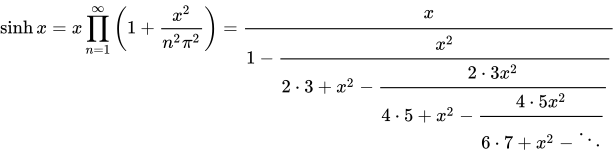
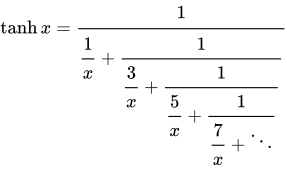
下列的擴展在整個複數平面上成立:
sinh
x
=
x
∏
n
=
1
∞
(
1
+
x
2
n
2
π
2
)
=
x
1
−
x
2
2
⋅
3
+
x
2
−
2
⋅
3
x
2
4
⋅
5
+
x
2
−
4
⋅
5
x
2
6
⋅
7
+
x
2
−
⋱
{\displaystyle \sinh x=x\prod _{n=1}^{\infty }\left(1+{\frac {x^{2}}{n^{2}\pi ^{2}}}\right)={\cfrac {x}{1-{\cfrac {x^{2}}{2\cdot 3+x^{2}-{\cfrac {2\cdot 3x^{2}}{4\cdot 5+x^{2}-{\cfrac {4\cdot 5x^{2}}{6\cdot 7+x^{2}-\ddots }}}}}}}}}
cosh
x
=
∏
n
=
1
∞
(
1
+
x
2
(
n
−
1
/
2
)
2
π
2
)
=
1
1
−
x
2
1
⋅
2
+
x
2
−
1
⋅
2
x
2
3
⋅
4
+
x
2
−
3
⋅
4
x
2
5
⋅
6
+
x
2
−
⋱
{\displaystyle \cosh x=\prod _{n=1}^{\infty }\left(1+{\frac {x^{2}}{(n-1/2)^{2}\pi ^{2}}}\right)={\cfrac {1}{1-{\cfrac {x^{2}}{1\cdot 2+x^{2}-{\cfrac {1\cdot 2x^{2}}{3\cdot 4+x^{2}-{\cfrac {3\cdot 4x^{2}}{5\cdot 6+x^{2}-\ddots }}}}}}}}}
tanh
x
=
1
1
x
+
1
3
x
+
1
5
x
+
1
7
x
+
⋱
{\displaystyle \tanh x={\cfrac {1}{{\cfrac {1}{x}}+{\cfrac {1}{{\cfrac {3}{x}}+{\cfrac {1}{{\cfrac {5}{x}}+{\cfrac {1}{{\cfrac {7}{x}}+\ddots }}}}}}}}}
∫
sinh
c
x
d
x
=
1
c
cosh
c
x
+
C
{\displaystyle \int \sinh cx\,\mathrm {d} x={\frac {1}{c}}\cosh cx+C}
∫
cosh
c
x
d
x
=
1
c
sinh
c
x
+
C
{\displaystyle \int \cosh cx\,\mathrm {d} x={\frac {1}{c}}\sinh cx+C}
∫
tanh
c
x
d
x
=
1
c
ln
(
cosh
c
x
)
+
C
{\displaystyle \int \tanh cx\,\mathrm {d} x={\frac {1}{c}}\ln(\cosh cx)+C}
∫
coth
c
x
d
x
=
1
c
ln
|
sinh
c
x
|
+
C
{\displaystyle \int \coth cx\,\mathrm {d} x={\frac {1}{c}}\ln \left|\sinh cx\right|+C}
∫
sech
c
x
d
x
=
1
c
arctan
(
sinh
c
x
)
+
C
{\displaystyle \int \operatorname {sech} cx\,\mathrm {d} x={\frac {1}{c}}\arctan(\sinh cx)+C}
∫
csch
c
x
d
x
=
1
c
ln
|
tanh
c
x
2
|
+
C
{\displaystyle \int \operatorname {csch} cx\,\mathrm {d} x={\frac {1}{c}}\ln \left|\tanh {\frac {cx}{2}}\right|+C}
從雙曲正弦和餘弦的定義,可以得出如下恆等式:
e
x
=
cosh
x
+
sinh
x
{\displaystyle e^{x}=\cosh x+\sinh x}
和
e
−
x
=
cosh
x
−
sinh
x
{\displaystyle e^{-x}=\cosh x-\sinh x}
因為指數函數 可以定義為任何複數 參數,也可以擴展雙曲函數的定義為複數參數。函數
sinh
z
{\displaystyle \sinh z}
cosh
z
{\displaystyle \cosh z}
全純函數 。
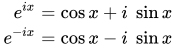
指數函數與三角函數的關係由歐拉公式 給出:
e
i
x
=
cos
x
+
i
sin
x
e
−
i
x
=
cos
x
−
i
sin
x
{\displaystyle {\begin{aligned}e^{ix}&=\cos x+i\;\sin x\\e^{-ix}&=\cos x-i\;\sin x\end{aligned}}}
所以:
cosh
i
x
=
1
2
(
e
i
x
+
e
−
i
x
)
=
cos
x
sinh
i
x
=
1
2
(
e
i
x
−
e
−
i
x
)
=
i
sin
x
tanh
i
x
=
i
tan
x
{\displaystyle {\begin{aligned}\cosh ix&={\frac {1}{2}}\left(e^{ix}+e^{-ix}\right)=\cos x\\\sinh ix&={\frac {1}{2}}\left(e^{ix}-e^{-ix}\right)=i\sin x\\\tanh ix&=i\tan x\\\end{aligned}}}
cosh
(
x
+
i
y
)
=
cosh
(
x
)
cos
(
y
)
+
i
sinh
(
x
)
sin
(
y
)
sinh
(
x
+
i
y
)
=
sinh
(
x
)
cos
(
y
)
+
i
cosh
(
x
)
sin
(
y
)
{\displaystyle {\begin{aligned}\cosh(x+iy)&=\cosh(x)\cos(y)+i\sinh(x)\sin(y)\\\sinh(x+iy)&=\sinh(x)\cos(y)+i\cosh(x)\sin(y)\\\end{aligned}}}
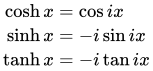
cosh
x
=
cos
i
x
sinh
x
=
−
i
sin
i
x
tanh
x
=
−
i
tan
i
x
{\displaystyle {\begin{aligned}\cosh x&=\cos ix\\\sinh x&=-i\sin ix\\\tanh x&=-i\tan ix\end{aligned}}}
因此,雙曲函數是關於虛部有週期 的,週期為
2
π
i
{\displaystyle 2\pi i}
π
i
{\displaystyle \pi i}
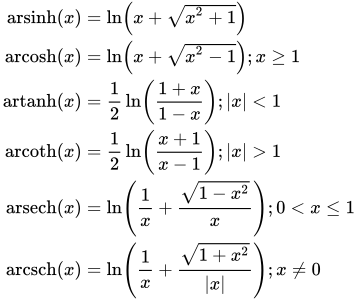
反双曲函数 是双曲函数的反函数 。它们的定义为:
arsinh
(
x
)
=
ln
(
x
+
x
2
+
1
)
arcosh
(
x
)
=
ln
(
x
+
x
2
−
1
)
;
x
≥
1
artanh
(
x
)
=
1
2
ln
(
1
+
x
1
−
x
)
;
|
x
|
<
1
arcoth
(
x
)
=
1
2
ln
(
x
+
1
x
−
1
)
;
|
x
|
>
1
arsech
(
x
)
=
ln
(
1
x
+
1
−
x
2
x
)
;
0
<
x
≤
1
arcsch
(
x
)
=
ln
(
1
x
+
1
+
x
2
|
x
|
)
;
x
≠
0
{\displaystyle {\begin{aligned}\operatorname {arsinh} (x)&=\ln \left(x+{\sqrt {x^{2}+1}}\right)\\\operatorname {arcosh} (x)&=\ln \left(x+{\sqrt {x^{2}-1}}\right);x\geq 1\\\operatorname {artanh} (x)&={\frac {1}{2}}\ln \left({\frac {1+x}{1-x}}\right);\left|x\right|<1\\\operatorname {arcoth} (x)&={\frac {1}{2}}\ln \left({\frac {x+1}{x-1}}\right);\left|x\right|>1\\\operatorname {arsech} (x)&=\ln \left({\frac {1}{x}}+{\frac {\sqrt {1-x^{2}}}{x}}\right);0<x\leq 1\\\operatorname {arcsch} (x)&=\ln \left({\frac {1}{x}}+{\frac {\sqrt {1+x^{2}}}{\left|x\right|}}\right);x\neq 0\end{aligned}}}
^ 1.0 1.1 1.2 Weisstein, Eric W. (编). Hyperbolic Functions . at MathWorld Wolfram Research, Inc. [2020-08-29 ] . (原始内容 存档于2022-05-21) (英语) . ^ Eves, Howard, Foundations and Fundamental Concepts of Mathematics , Courier Dover Publications: 59, 2012, ISBN 9780486132204, We also owe to Lambert the first systematic development of the theory of hyperbolic functions and, indeed, our present notation for these functions. ^ Ratcliffe, John, Foundations of Hyperbolic Manifolds , Graduate Texts in Mathematics 149 , Springer: 99, 2006 [2014-03-27 ] , ISBN 9780387331973, (原始内容存档 于2014-01-12), That the area of a hyperbolic triangle is proportional to its angle defect first appeared in Lambert's monograph Theorie der Parallellinien , which was published posthumously in 1786. ^ Augustus De Morgan (1849) Trigonometry and Double Algebra (页面存档备份 ,存于互联网档案馆 ), Chapter VI: "On the connection of common and hyperbolic trigonometry"
^ G. Osborn, Mnemonic for hyperbolic formulae , The Mathematical Gazette, p. 189, volume 2, issue 34, July 1902
基本函數 反函數 少見函數
正矢
餘矢
正弧
餘弧
半正矢
半餘矢
外正割
外餘割 函數分類
正函數 餘函數
餘角
餘弦 餘切
餘割
餘矢
餘弧
半餘矢
外餘割
其他函數
極正弦
弦函數
arc函數
cis函數
餘cis函數
cas函數
arg函數
atan2 古德曼函數 符號
sin cos tan cot
sec
csc
exs
exc
ver
cvs
vcs
cvc
hav
hcv
hvc
hcc
arc
crd
sag
apo cis
cas
arg 双曲函数 相關概念 定理 恒等式 其他