東莨菪鹼
 维基百科中的醫學内容仅供参考,並不能視作專業意見。如需獲取醫療幫助或意見,请咨询专业人士。詳見醫學聲明。
 | |
 | |
| 臨床資料 | |
|---|---|
| 商品名 | Transderm Scop及其他 |
| 其他名稱 | Hyoscine,[1] Devil's Breath |
| AHFS/Drugs.com | Monograph |
| MedlinePlus | a682509 |
| 核准狀況 |
|
| 懷孕分級 | |
| 给药途径 | 口服給藥, 微針貼片, 眼科藥物, 皮下注射, 靜脈注射, 口腔黏膜吸收(含頰部給藥), 直腸給藥, 肌肉注射 |
| 藥物類別 |
|
| ATC碼 | |
| 法律規範狀態 | |
| 法律規範 |
|
| 藥物動力學數據 | |
| 生物利用度 | 20-40%[7] |
| 药物代谢 | 肝臟 (CYP3A4)[8] |
| 生物半衰期 | 5小時[7] |
| 排泄途徑 | 腎臟 |
| 识别信息 | |
| |
| CAS号 | 51-34-3  |
| PubChem CID | |
| IUPHAR/BPS | |
| DrugBank | |
| ChemSpider | |
| UNII |
|
| KEGG | |
| ChEBI | |
| ChEMBL | |
| PDB配體ID | |
| CompTox Dashboard (EPA) | |
| ECHA InfoCard | 100.000.083 |
| 化学信息 | |
| 化学式 | C17H21NO4 |
| 摩尔质量 | 303.36 g·mol−1 |
| 3D模型(JSmol) | |
| |
| |

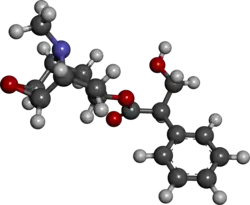
東莨菪鹼(USAN(美國採用名稱):scopolamine),INN:hyoscine)[9]或稱惡魔之息(Devil's Breath)),[10]是一種用於治療暈動病[11]以及術後噁心嘔吐的藥物。[12][1]它有時也於個體在手術之前使用,以減少其唾液分泌。[1]
經由注射給藥時,藥效約在20分鐘後開始顯現,可持續長達8小時。[1]由於其經皮生物利用度早為人知,因此也可透過口服或微針貼片來施用 。[1][13]
東莨菪鹼屬於抗蕈毒鹼類藥物,其作用原理是阻斷神經系統中乙醯膽鹼的部分作用。[1]
東莨菪鹼最早見於1881年的文獻記載,並於1900年前後開始用於外科手術的麻醉用途 。[14][15]東莨菪鹼是某些茄科植物所產生的主要活性成分。史上這些植物因高劑量使用會產生由抗蕈毒鹼誘發的幻覺作用,而被歸類為致譫妄劑,並作為精神藥物使用。[12]在這些脈絡下,其改變心智的效果曾被用於娛樂性用藥及神秘學用途。[16][17][18]: 277–282 "scopolamine"的名稱源自茄科的一屬-賽茛菪屬),而"hyoscine"的名稱則源自另一種植物-天仙子(又名黑茛菪(black henbane))。[19][20]此藥物已列入世界衛生組織基本藥物標準清單之中。[21]
醫療用途
東莨菪鹼在現代醫學中有多種正式用途,通常以純化分離的形式及低劑量投藥,用於治療:[22][23]
- 手術後噁心與嘔吐
- 暈動病(包括暈船),水肺潛水人員常使用此類藥物(通常以微針貼片貼於耳後)[24][25][26]
- 胃腸道痙攣
- 腎臟或肝臟痙攣
- 輔助胃腸道放射檢查及內視鏡檢查
- 強力散瞳、麻痺睫狀肌[27]
- 大腸激躁症
- 氯氮平誘發的流涎症
- 腸絞痛
- 眼睛發炎[28]
東莨菪鹼有時在手術前給藥,特別是為減少個體於手術中的呼吸道分泌物,最常透過注射方式給藥。[22][23]常見的副作用有嗜睡、視力模糊、瞳孔放大以及口乾。[1]不建議閉角型青光眼或腸阻塞患者使用此藥。[1]目前尚不清楚個體在懷孕期間使用對於胎兒是否安全。此外,醫療專業人員與藥物製造商對於進行母乳哺育的個體使用此藥物仍持謹慎態度,以免對於嬰兒不利。[29]
東莨菪鹼可透過口服、皮下注射、眼部滴劑、靜脈注射以及微針貼片等方式給藥。[30]
哺乳
東莨菪鹼會經由滲入母體的乳汁。目前尚無人類研究足以證明哺乳期間使用東莨菪鹼對於嬰兒的安全性,但藥物製造商建議對哺乳期婦女投與東莨菪鹼,應謹慎從事。[29]
不良反應
不常見(發生率為 0.1–1%)的有:
罕見(發生率<0.1%)的有:
頻率不明的有:
過量
毒扁豆鹼是一種能輕易穿過血腦屏障的膽鹼能藥物,已被用作治療東莨菪鹼過量所引起之中樞神經系統抑制症狀的解毒劑。[34]除此種支持性治療外,對於口服過量者,通常建議進行洗胃及催吐來治療 。[33]
- 心跳過速
- 心律不整
- 視力模糊
- 畏光
- 尿瀦留
- 嗜睡或反常反應(可能表現為幻覺)
- 謝恩—斯托克斯呼吸(間歇性呼吸或臨終呼吸)
- 口乾
- 皮膚發紅
- 胃腸蠕動受阻
藥理學
藥效學
東莨菪鹼是一種非特異性抗蕈毒鹼藥物,透過競爭性拮抗中樞神經系統與周圍神經系統的 M1、M2、M3及M4蕈毒鹼型乙醯膽鹼受體發揮作用。[35][36]
在醫療劑量下,其療效主要源於對週邊受體的影響及乙醯膽鹼信號的"輕微降低"。[37]
當劑量過高時,其對主要分佈於中樞神經、負責認知與知覺的M1受體之拮抗作用,是導致幻覺、認知功能障礙及瞻妄的唯一主因。[38]此外,M2、M3、M4受體分別分佈於心、肺、唾腺及大腦,影響自主神經調節 。[38]由於它並不阻斷菸鹼型乙醯膽鹼受體,因此精確的說法應為"抗蕈毒鹼"而非廣義的"抗膽鹼能"。[38]
藥代動力學
東莨菪鹼會經歷首渡效應,約有2.6%以原形經由尿液排出。其生物利用度為20–40%,使用後大約45分鐘後達到血漿濃度峰值。在健康受試者中,其平均生物半衰期為5小時(觀察範圍為2–10小時)。[7]東莨菪鹼主要由CYP3A4酵素代謝,而葡萄柚汁會降低東莨菪鹼的代謝,進而增加其於血漿中的濃度。[8]
化學
植物中的生物合成
東莨菪鹼源自茄科植物。[39][19]由鳥胺酸經腐胺、托品酮及利托林等多步酶促反應合成,最終由茛菪鹼環氧化生成。[40][41]
歷史
東莨菪鹼廣泛存在於顛茄、木曼陀羅屬及天仙子等茄科植物中,人類自史前時代便開始利用這些植物。[42][18][43]德國化 學家阿爾貝特·拉登堡於1880年正式分離出此生物鹼,開啟鹽酸鹽等純化製劑的使用歷史。[44]
東莨菪鹼於1899年開始與嗎啡聯用於外科學麻醉用途。[14][45]此組合於1902年被引入產科,發展出著名的暮色睡眠(德文:Dämmerschlaf)麻醉法,利用兩藥的協同作用實現無痛分娩。[45][46]此技術在20世紀初發展緩慢且劑量標準不一,但仍在美國盛行多年,直至1960年代因化學恐懼症及自然分娩風潮興起而淡出醫學舞台。[47]
社會與文化
名稱
INN中的東莨菪鹼鹽類形式(氫溴酸東莨菪鹼)名稱為hyoscine hydrobromide,而在USAN中則為scopolamine hydrobromide。其他名稱還有"levo-duboisine"、"devil's breath"(惡魔之息)以及"burundanga"。[17][48]
澳洲荒野草藥
同盟國於第二次世界大戰期間曾使用一種由澳大利亞東部各州原住民開發的荒野草藥,這種藥物萃取自軟木製杜波依斯樹。同盟國士兵們在諾曼第戰役期間橫渡英吉利海峽前往法國時,便是利用此藥物來預防暈船。後來人們發現同一物質可用於生產東莨菪鹼與莨菪鹼,這些成分被廣泛應用於眼科手術。昆士蘭州也以此物質為基礎,建立一個產值達數百萬美元的產業。[49]
娛樂與宗教用途
東莨菪鹼被歸類為"致瞻妄劑",雖具致幻性,但這類體驗在生理與心理上往往令人不悅,罕有重複娛樂使用者。[50]過往案例顯示攝入偽藥或植物製劑常導致大規模集體住院 。[51][52]青少年常利用曼陀羅等植物追求意識改變,但植物內含的阿托品與茛菪鹼會產生更強的協同毒性。[53][54]
史上美洲原住民與西方世界女巫將其用於靈性或魔法儀式。[18][55]東莨菪鹼是此類植物中唯一能經皮吸收的成分,因此成為女巫飛行軟膏的核心成分。[13][56]此外,《聖經》記載的曼德拉草亦含有此成分,被視為催情與助孕的象徵。[57][58]
審訊
人們在20世紀初曾研究將東莨菪鹼作為審訊中的吐真劑使用,[59]但由於其副作用過大,相關研究隨後被終止。[60]而在2009 年,捷克斯洛伐克國家安全秘密警察被證實曾至少三次使用東莨菪鹼,以取得所謂反國家異議人士的供詞。[61]
犯罪用途
東莨菪鹼常在哥倫比亞等地被用於搶劫、性侵或快捷綁架,罪犯常將其加入飲食,使受害者昏迷或喪失反抗力。[62]}}[17][63]雖然媒體將其粉末稱為"惡魔之息",並誇大其能透過皮膚接觸(如紙張、名片)立即達到洗腦或控制受害者的程度,但科學證據顯示僅憑短暫皮膚接觸的吸收劑量極低,難以產生顯著作用,醫療用貼片亦需數小時才能生效。[30] [64][63]
醫療機構發現這類犯罪多發生於社交場所,受害者以男性為主。[62]儘管相關中毒病例在急診室中確有記載,但許多關於其"洗腦控制" 的說詞仍具爭議,多數結論僅基於受害者的事後陳述而非毒物學實證。[63] [65]
研究
東莨菪鹼在科學研究中被視為誘導暫時性認知缺陷的標準工具藥。[66]它透過抑制海馬迴中的乙醯膽鹼與麩胺酸釋放,損害長期記憶編碼、情節記憶及短期學習能力,常用於模擬阿茲海默症或失智症的膽鹼能受損模型。[67][68]
此外,東莨菪鹼因能促進神經塑性,正被研究作為快速發揮作用的抗憂鬱藥物,尤其在女性群體中表現出潛力。[69][70]NASA亦開發比傳統口服藥更迅速可靠的鼻噴劑來對抗暈動症。[71]雖然在醫學領域已有相當多關於東莨菪鹼的研究,但相較於其他幻覺劑,其作為"致瞻妄劑"的特定精神機制仍未被充分理解。[72]
參見
- 西美托溴銨,由東莨菪鹼與環丙基甲基溴(cyclopropylmethyl bromide)反應衍生成的產物。
- 氧托溴銨(Oxitropium),一種支氣管擴張劑,由去甲東莨菪鹼製成
參考文獻
- ^ 1.0 1.1 1.2 1.3 1.4 1.5 1.6 1.7 Scopolamine. Drugs.com. The American Society of Health-System Pharmacists. [2016-12-08]. (原始内容存档于2016-10-07).
- ^ Scopolamine Use During Pregnancy. Drugs.com. 2023-0906 [2024-06-21]. (原始内容存档于2016-12-21).
- ^ Poisons Standard October 2020. Federal Register of Legislation. 2020-09-30 [2020-10-23]. (原始内容存档于2021-01-25).
- ^ Hyoscine 400 micrograms/ml Solution for Injection. (emc). 2017-09-18 [2024-06-21]. (原始内容存档于2023-11-08).
- ^ Kwells 300 microgram tablets Summary of Product Characteristics (SmPC). (emc). 2020-09-02 [2024-06-21]. (原始内容存档于2024-03-02).
- ^ 6.0 6.1 Transderm Scop - scopolamine patch, extended-release. DailyMed. 2024-03-14 [2024-06-21]. (原始内容存档于2023-11-30).
- ^ 7.0 7.1 7.2 Putcha L, Cintrón NM, Tsui J, Vanderploeg JM, Kramer WG. Pharmacokinetics and oral bioavailability of scopolamine in normal subjects. Pharmaceutical Research. June 1989, 06 (6): 481–485. PMID 2762223. S2CID 27507555. doi:10.1023/A:1015916423156.
- ^ 8.0 8.1 Renner UD, Oertel R, Kirch W. Pharmacokinetics and pharmacodynamics in clinical use of scopolamine. Therapeutic Drug Monitoring. October 2005, 27 (5): 655–665. PMID 16175141. S2CID 32720769. doi:10.1097/01.ftd.0000168293.48226.57.
- ^ Juo PS. Concise Dictionary of Biomedicine and Molecular Biology. 2nd. Hoboken: CRC Press. 2001: 570. ISBN 978-1-4200-4130-9. (原始内容存档于2017-09-10).
- ^ Duffy R. Colombian Devil's Breath. Vice. 2007-07-23 [2022-02-03]. (原始内容存档于2022-04-18).
- ^ About hyoscine hydrobromide. nhs.uk. National Health Service. 2022-10-24 [2023-03-14]. (原始内容存档于2023-03-14).
- ^ 12.0 12.1 Osbourn AE, Lanzotti V. Plant-derived Natural Products: Synthesis, Function, and Application. Springer Science & Business Media. 2009: 5. ISBN 978-0-387-85498-4. (原始内容存档于2017-09-10).
- ^ 13.0 13.1 Sollmann T. A Manual of Pharmacology and Its Applications to Therapeutics and Toxicology 8th. Philadelphia and London: W.B. Saunders. 1957.
- ^ 14.0 14.1 Keys TE. The history of surgical anesthesia (PDF) Reprint. Park Ridge, Ill.: Wood Library, Museum of Anesthesiology. 1996: 48ff [2022-07-26]. ISBN 978-0-9614932-7-1. (原始内容存档 (PDF)于2022-04-19).
- ^ Fischer J, Ganellin CR. Analogue-based Drug Discovery. John Wiley & Sons. 2006: 551. ISBN 978-3-527-60749-5.
- ^ Kennedy DO. The Deliriants - The Nightshade (Solanaceae) Family. Plants and the Human Brain. New York: Oxford University Press. 2014: 131–137 [2021-09-17]. ISBN 978-0-19-991401-2. LCCN 2013031617. (原始内容存档于2021-09-17).
- ^ 17.0 17.1 17.2 Uribe-Granja MG, Moreno-López CL, Zamora-Suárez A, Acosta PJ. Perfil epidemiológico de la intoxicación con burundanga en la clínica Uribe Cualla S. A. de Bogotá, D. C. [Epidemiological profile of burundanga poisoning at the Uribe Cualla SA clinic in Bogotá, D. C.] (PDF). Acta Neurológica Colombiana. September 2005, 21 (3): 197–201 [2024-07-01]. (原始内容存档于2024-07-03) (西班牙语).
- ^ 18.0 18.1 18.2 Rätsch, Christian. The Encyclopedia of Psychoactive Plants: Ethnopharmacology and Its Applications. Park Street Press. 2005.
- ^ 19.0 19.1 The Chambers Dictionary. Allied Publishers. 1998: 788, 1480. ISBN 978-81-86062-25-8.
- ^ Cattell HW. Lippincott's new medical dictionary. Lippincott. 1910: 435 [2012-02-25]. (原始内容存档于2017-09-10) –通过Google Books.
- ^ The selection and use of essential medicines 2023: web annex A: World Health Organization model list of essential medicines: 23rd list (2023). Geneva: World Health Organization. 2023. hdl:10665/371090
 . WHO/MHP/HPS/EML/2023.02.
- ^ 22.0 22.1 Joint Formulary Committee. British National Formulary (BNF) 65. London, UK: Pharmaceutical Press. 2013: 49, 266, 822, 823. ISBN 978-0-85711-084-8.
- ^ 23.0 23.1 Rossi S (编). Australian Medicines Handbook 2013. Adelaide: The Australian Medicines Handbook Unit Trust. 2013. ISBN 978-0-9805790-9-3.
- ^ Bitterman N, Eilender E, Melamed Y. Hyperbaric oxygen and scopolamine. Undersea Biomedical Research. May 1991, 18 (3): 167–174 [2008-08-13]. PMID 1853467. 原始内容存档于2008-08-20.
- ^ Williams TH, Wilkinson AR, Davis FM, Frampton CM. Effects of transcutaneous scopolamine and depth on diver performance. Undersea Biomedical Research. March 1988, 15 (2): 89–98. PMID 3363755. 原始内容存档于2008-08-20.
- ^ Motion Sickness. Divers Alert Network. [2022-11-06]. (原始内容存档于2022-11-06).
- ^ 財團法人藥害救濟基金會. 含hyoscine hydrobromide(scopolamine hydrobromide) 成分藥品穿皮貼片劑安全資訊風險溝通表 – 藥害救濟基金會. 財團法人藥害救濟基金會/藥物安全訊息. 財團法人藥害救濟基金會. 2023-08-25 (中文(臺灣)).
- ^ scopolamine solution - ophthalmic, Isopto. MedicineNet.com. [2019-02-12]. (原始内容存档于2019-03-31).
- ^ 29.0 29.1 Briggs GG, Freeman RK, Yaffe SJ. Scopolamine. Drugs in Pregnancy and Lactation. Baltimore, Maryland: Williams and Wilkins. 1994: 777–778. ISBN 978-0-683-01060-2.
- ^ 30.0 30.1 White PF, Tang J, Song D, Coleman JE, Wender RH, Ogunnaike B, Sloninsky A, Kapu R, Shah M, Webb T. Transdermal scopolamine: an alternative to ondansetron and droperidol for the prevention of postoperative and postdischarge emetic symptoms. Anesthesia and Analgesia. January 2007, 104 (1): 92–96. PMID 17179250. S2CID 44784425. doi:10.1213/01.ane.0000250364.91567.72 .
- ^ DBL HYOSCINE INJECTION BP. TGA eBusiness Services. Hospira Australia Pty Ltd. 2012-01-30 [2013-10-22]. (原始内容存档于201-03-30).
- ^ 32.0 32.1 Buscopan Tablets - Summary of Product Characteristics (SPC). electronic Medicines Compendium. Boehringer Ingelheim Limited. 2013-09-11 [2013-10-22]. (原始内容存档于2013-10-23).
- ^ 33.0 33.1 33.2 Kwells 300 microgram tablets - Summary of Product Characteristics. electronic Medicines Compendium. Bayer plc. 2008-01-07 [2013-10-22]. (原始内容存档于2013-10-23).
- ^ Barash PG, Cahalan M, Cullen BF, Stock MC, Stoelting RK (编). Clinical anesthesia 6th. Philadelphia: Wolters Kluwer/Lippincott Williams & Wilkins. 2009: 346. ISBN 978-0-7817-8763-5.
- ^ Google Scholar. scholar.google.com. [2017-12-16]. (原始内容存档于2020-10-30).
- ^ PDSP Ki Database. [2020-07-23]. (原始内容存档于2020-07-23).
- ^ Lessenger JE, Feinberg SD. Abuse of prescription and over-the-counter medications. Journal of the American Board of Family Medicine. 2008, 21 (1): 45–54. PMID 18178702. doi:10.3122/jabfm.2008.01.070071 .
- ^ 38.0 38.1 38.2 Dawson AH, Buckley NA. Pharmacological management of anticholinergic delirium - theory, evidence and practice. British Journal of Clinical Pharmacology. March 2016, 81 (3): 516–524. PMC 4767198 . PMID 26589572. doi:10.1111/bcp.12839.
Delirium is only associated with the antagonism of post‐synaptic M1 receptors and to date, other receptor subtypes have not been implicated
- ^ Muranaka T, Ohkawa H, Yamada Y. Continuous Production of Scopolamine by a Culture of Duboisia leichhardtii Hairy Root Clone in a Bioreactor System. Applied Microbiology and Biotechnology. 1993, 40 (2–3): 219–223. S2CID 45125074. doi:10.1007/BF00170370.
- ^ Ziegler J, Facchini PJ. Alkaloid biosynthesis: metabolism and trafficking. Annual Review of Plant Biology. 2008, 59 (1): 735–769. Bibcode:2008AnRPB..59..735Z. PMID 18251710. doi:10.1146/annurev.arplant.59.032607.092730.
- ^ Li R, Reed DW, Liu E, Nowak J, Pelcher LE, Page JE, Covello PS. Functional genomic analysis of alkaloid biosynthesis in Hyoscyamus niger reveals a cytochrome P450 involved in littorine rearrangement. Chemistry & Biology. May 2006, 13 (5): 513–520. PMID 16720272. doi:10.1016/j.chembiol.2006.03.005 .
- ^ Armando T. Hunziker: The Genera of Solanaceae. A.R.G. Gantner Verlag K.G., Ruggell, Liechtenstein 2001. ISBN 3-904144-77-4
- ^ Pharmacognosy and Phytochemistry : Drugs Containing Alkaloids. pharmacy180.com. [2022-12-16]. (原始内容存档于2022-12-20).
- ^ Ladenburg A. Die natürlich vorkommenden mydriatisch wirkenden Alkaloïde [The naturally occurring mydriatic alkaloids]. Justus Liebigs Annalen der Chemie. January 1881, 206 (3): 274–307. doi:10.1002/jlac.18812060303 (德语).
- ^ 45.0 45.1 Twilight Sleep: the Dammerschlaf of the Germans. Canadian Medical Association Journal. September 1915, 5 (9): 805–808. PMC 1584452 . PMID 20310688.
- ^ TWILIGHT SLEEP; Is Subject of a New Investigation. The New York Times. 31 January 1915 [2024-06-27]. (原始内容存档于2023-04-22).
- ^ Finkbeiner A. Labor Dispute. Book review: What a Blessing She Had Chloroform: The Medical and Social Response to the Pain of Childbirth from 1800 to the Present. The New York Times. 1999-10-31 [2018-06-17]. (原始内容存档于2020-10-30).
- ^ Bell V. Mind controller: What is the 'burundanga' drug?. Wired UK. 2011-03-03 (April 2011). (原始内容存档于2017-08-11).
- ^ Visitors to Art of Healing exhibition told how Australian Indigenous bush medicine was given to every allied soldier landing at Normandy on D-Day. kcl.ac.uk. King's College London. 2019-06-07 [2020-06-02]. (原始内容存档于2020-06-02).
- ^ Freye E. Toxicity of Datura Stramonium. Pharmacology and Abuse of Cocaine, Amphetamines, Ecstasy and Related Designer Drugs. Netherlands: Springer. 2010: 217–218. ISBN 978-90-481-2447-3. doi:10.1007/978-90-481-2448-0_34.
- ^ Bilsykemedisin i falske rohypnol-tabletter. Aftenposten.no. (原始内容存档于2008 -06-27).
- ^ Perth backpacker overdose linked to common anti-nausea drug. ABC News. 2018-01-04 [2018-01-04]. (原始内容存档于2020-11-07).
- ^ Fatur K, Kreft S. Common anticholinergic solanaceaous plants of temperate Europe - A review of intoxications from the literature (1966-2018). Toxicon. April 2020, 177: 52–88. Bibcode:2020Txcn..177...52F. PMID 32217234. S2CID 213559151. doi:10.1016/j.toxicon.2020.02.005.
- ^ Preissel U, Preissel HG. Brugmansia and Datura: Angel's Trumpets and Thorn Apples. Buffalo, NY: Firefly Books. 2002: 106–129. ISBN 1-55209-598-3.
- ^ Harner M. The Way of the Shaman
 . New York: Harper & Row. 1980. ISBN 978-0-06-250373-2.
- ^ Hansen, Harold A. The Witch's Garden. 1978. ISBN 978-0913300473.
- ^ Genesis 30:14–16 (King James Version). Bible Gateway. [2014-01-06]. (原始内容存档于2014-01-07).
- ^ Song of Songs 7:12–13 (King James Version). Bible Gateway. [2014-01-06]. (原始内容存档于2014-01-07).
- ^ House RE. The Use of Scopolamine in Criminology. Texas State Journal of Medicine. September 1922, 18: 256–263.
Reprinted in: House RE. The Use of Scopolamine in Criminology. American Journal of Police Science. July–August 1931, 2 (4): 328–336. JSTOR 1147361. doi:10.2307/1147361. - ^ Bimmerle G. 'Truth' Drugs in Interrogation. CIA.gov. US: Central Intelligence Agency. 1993-09-22 [2012-06-14]. (原始内容存档于2012-09-27).
- ^ Gazdík J, Navara L. Svědek: Grebeníček vězně nejen mlátil, ale dával jim i drogy [A witness: Grebeníček not only beat prisoners, he also administered drugs to them]. iDnes. 2009-08-08 [2009-08-10]. (原始内容存档于2009-08-11) (捷克语).
- ^ 62.0 62.1 Colombia 2012 Crime and Safety Report: Cartagena. Overseas Security Advisory Council, United States Department of State. 2012-03-04 [2015-08-06]. (原始内容存档于15 March 2013).
- ^ 63.0 63.1 63.2 Domínguez, I. Burundanga: the stealth drug that cancels the victim's willpower. Crime. El País, Madrid. 2016-07-25 [2016-08-12]. (原始内容存档于2016-08-20).
- ^ Burundanga Business Card Drug Warning. Hoax-Slayer.com. 2008-10-12. (原始内容存档于2009-03-07).
- ^ Anderson L. Devil's Breath: Urban Legend or the World's Most Scary Drug?. Drugs.com. [2019-07-09]. (原始内容存档于2019-06-23).
- ^ Hasselmo ME, Wyble BP. Free recall and recognition in a network model of the hippocampus: simulating effects of scopolamine on human memory function. Behavioural Brain Research. December 1997, 89 (1–2): 1–34. PMID 9475612. S2CID 584350. doi:10.1016/s0166-4328(97)00048-x.
- ^ More SV, Kumar H, Cho DY, Yun YS, Choi DK. Toxin-Induced Experimental Models of Learning and Memory Impairment. International Journal of Molecular Sciences. September 2016, 17 (9): 1447. PMC 5037726 . PMID 27598124. doi:10.3390/ijms17091447 .
- ^ Lott IT. Neurological phenotypes for Down syndrome across the life span. Down Syndrome: From Understanding the Neurobiology to Therapy. Progress in Brain Research 197. 2012: 101–21. ISBN 978-0-444-54299-1. PMC 3417824 . PMID 22541290. doi:10.1016/b978-0-444-54299-1.00006-6.
- ^ Olson DE. Psychoplastogens: A Promising Class of Plasticity-Promoting Neurotherapeutics. Journal of Experimental Neuroscience. 19 September 2018, 12. PMC 6149016 . PMID 30262987. S2CID 52877093. doi:10.1177/1179069518800508. 已忽略未知参数
|article-number=(帮助) - ^ Drevets WC, Zarate CA, Furey ML. Antidepressant effects of the muscarinic cholinergic receptor antagonist scopolamine: a review. Biological Psychiatry. June 2013, 73 (12): 1156–1163. PMC 4131859 . PMID 23200525. doi:10.1016/j.biopsych.2012.09.031.
- ^ NASA Signs Agreement to Develop Nasal Spray for Motion Sickness. NASA.gov (新闻稿). 2023-07-26 [2024-06-21]. (原始内容存档于2024-06-15).
- ^ Volgin AD, Yakovlev OA, Demin KA, Alekseeva PA, Kyzar EJ, Collins C, Nichols DE, Kalueff AV. Understanding Central Nervous System Effects of Deliriant Hallucinogenic Drugs through Experimental Animal Models. ACS Chemical Neuroscience. January 2019, 10 (1): 143–154. PMID 30252437. S2CID 52824516. doi:10.1021/acschemneuro.8b00433.
外部連結

Template:Motion sickness Template:Muscarinic acetylcholine receptor modulators